

June 24, 2026

The stolen head of St John the Baptist

Melanie McDonagh
More
Related
Min read
share

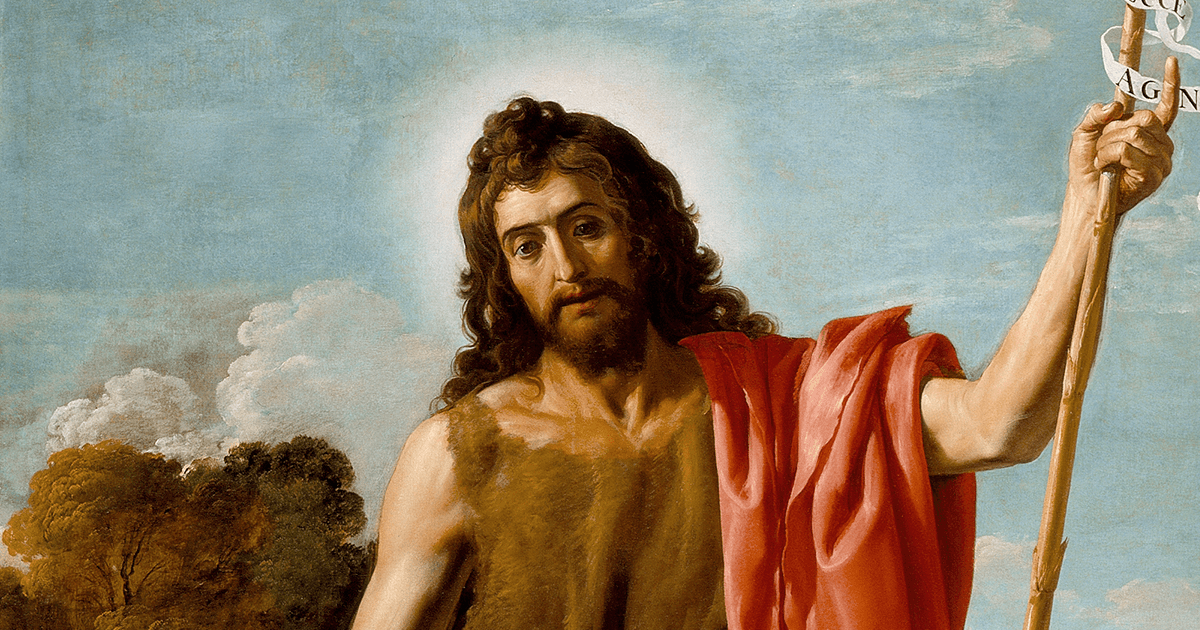
June 24 is the feast of St John the Baptist. Ever since the date of Christmas was established as December 25, the Church has celebrated the birthday of John in Midsummer, since, working from the Gospel of Luke, the Virgin Mary’s cousin Elizabeth was six months pregnant when the Archangel appeared to Mary. These were the only two earthly birthdays kept by Christians; later the Nativity of the Virgin became the third. Every other saint’s day was marked on the anniversary of his or her death – or birth into eternal life.

Like Christmas, the feast day fell on the solstice and, like Christmas, it took on some of the customs – chiefly bonfires on the vigil and rolling burning cartwheels down hills, an obvious metaphor. John in scripture was a lantern and a burning light; the symbolism fitted. All of which is a roundabout way of saying that this feast day is huge.

One place where the feast of John’s Nativity is celebrated is in Amiens, where his head is put on the high altar to be venerated. Or rather, the frontal part of the skull. It was appropriated during the Fourth Crusade in 1204 by an enterprising canon of the cathedral, Walon de Sarton. There is a medieval description of the theft in a manuscript in the British Library.

Walon identified this prestigious relic, then hid overnight inside the church where it was kept, emerged when the coast was clear and passed the relic out of the window to an accomplice. He returned triumphantly with it and, in 1206, presented it, with relics of St George, to Bishop Richard de Gerberoy (bishop from 1204 to 1210). Naturally it became the prized relic of the cathedral and a favourite pilgrimage destination. It had a protective golden mask with the legend in Greek: John the Forerunner.

We may take a dim view of thieving a relic but there was justification at the time. This was sacra furta, sacred theft, since people held that a relic would allow itself to be taken from a place where it was insufficiently venerated to one where it would be honoured. So the very fact that it happened was its own justification.

When I first visited the head it was kept to the side of the cathedral where it was, in my view, far too little visited. Now it is in the treasury of the cathedral with other relics and brought out on the feast of the Baptist. There is, of course, a rationale – security – but the treasury is a museum-like space, not a devotional space. You cannot really get down on your knees before it.

But it is worth seeing. The jewelled platter the skull rests on, and the cover, is 19th century, for the 15th-century version was melted down in the French Revolution like so many other priceless objects – kings and queens donated jewels to it (St Louis gave an emerald). In the Revolution the quick-witted mayor of Amiens, Louis Alexandre Lescouvé, saved the relic itself. He also saved the marvellous rock-crystal mask in which the skull was encased, a 13th-century work from a Parisian workshop. Fortunately, it could not be melted, so it survived. The 19th-century platter is based on an illustration of the original by the Parisian Placide Poussièlgue-Rusand in 1876.

The relic is not the entire head. It is, however, the most important part: from the upper jaw to the forehead. The eye and nasal cavities are filled with pieces of leather, and the skull is covered in wax. Above the left brow there is a hole, which gave rise to its own legend. The story was that when the head was presented to Herodias on a platter by her daughter Salome, she was so inflamed with indignation against the man who had condemned her for adultery (Matthew 14) that she picked up a knife from the dinner table and stabbed the head with it, leaving the hole we see to this day. This unedifying episode is depicted in the marvellous Tudor wooden screens in the cathedral itself.

The relic of St John’s skull was brought whole to Constantinople in the 9th century before being divided among several churches in the city at the end of the 11th. This gave rise to the confusing circumstance that there are several heads of the Baptist – possibly together they comprise a whole skull. Certainly the head in the Topkapi in Constantinople/Istanbul is not the same as that in Amiens. There is a well-attested relic in Bulgaria from the island monastery of St John and another in Damascus which is visited by Muslims and Christians. According to my guide in Amiens, tests show its relic is that of a male of the 1st century AD.

Why just the head? We are told the Emperor Julian the Apostate was so inflamed against the bones of the Baptist – for the miracles they worked – that he had them burned. Only the finger that had pointed to Christ, as the Baptist said, Ecce Agnus Dei, survived the flames. Meanwhile the head went on its travels and is – perhaps – there to be venerated in Amiens.

Continue reading with a free account

Create a free account to read up to five articles each month
Create free account

You have # free articles remaining this month.

Subscribe to get unlimited access.
Sign up

subscribe to the catholic herald today

Our best content is exclusively available to our subscribers. Subscribe today and gain instant access to expert analysis, in-depth articles, and thought-provoking insights—anytime, anywhere. Don’t miss out on the conversations that matter most.
Subscribe