



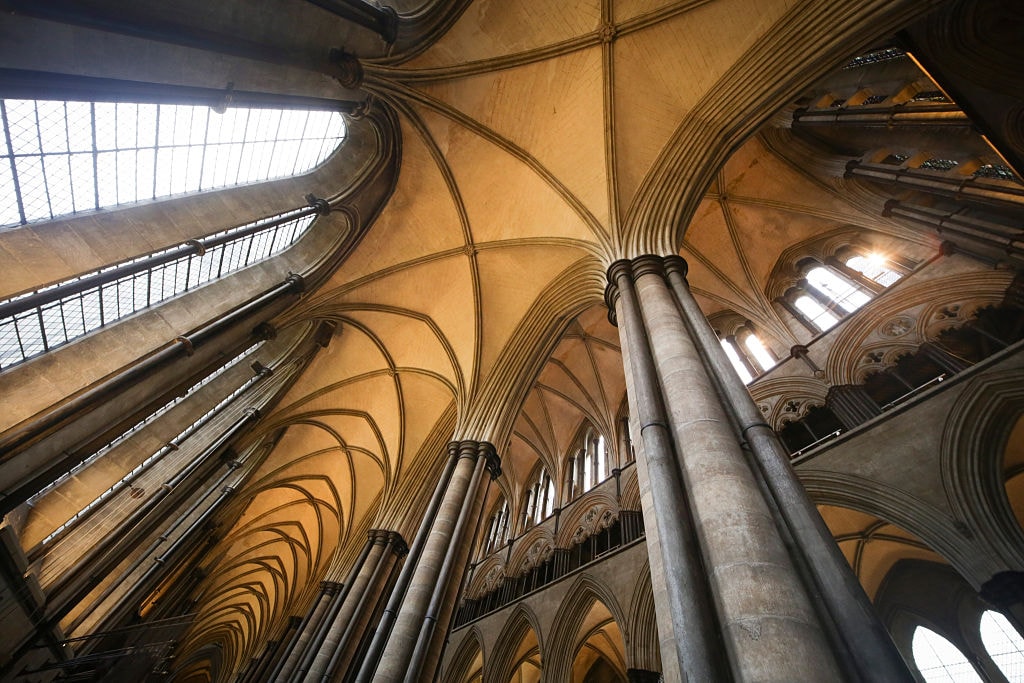
What makes an agnostic composer, with no strong connections to any faith, devote eight years of his life to composing a symphony requiring – at its most recent live performance in 2011 – nearly 1,000 players on (and off) stage, the bulk of it an hour-long setting in Latin of the Te Deum laudamus? The answers are complex, the roots of the work – The Gothic, which takes around 105 minutes to perform – being as diverse as its scoring for a huge orchestra, vocal soloists, two choirs, children’s chorus and four small brass bands placed antiphonally around the hall. Havergal Brian was born plain William Brian in 1876 (the pen name Havergal adopted from a family of hymn-composing Staffordshire rectors). Of working-class origins (highly unusual for a creative figure in Britain until recent times), Brian left school aged 12 to be apprenticed to a carpenter. He did not last long, having been “let go” for writing marches on plasterboard instead of working it. Although he learned to read music, play the organ, violin and cello, he had no formal composition training, yet even his earliest works – including a fine setting of Psalm 23 – displayed a confidence in handling larger forms. When he finally essayed a true symphony in his forties (discounting the parodistic A Fantastic Symphony from 1907-8, based on the children’s rhyme “Three Blind Mice”), he did so as a fully experienced composer of orchestral works, songs and cantatas. There were many spurs to the composition of The Gothic. One was the suggestion from Sir Henry Wood, founder of the Proms, for a work reviving old instruments that had fallen out of fashion, such as the oboe d’amore, bass oboe and basset horn. This bore fruit in The Gothic’s scoring for families of wind instruments (in which all the above – and more – feature). Most immediately for the work’s expressive purpose was the First World War. Brian, 38 in August 1914, was too old to fight but gained an intimate understanding of the scale of the losses in his war work, by cataloguing the effects of soldiers killed in the slaughter. The Gothic is one of two works rooted in the conflict, the other being the surreal anti-war opera The Tigers (1916-8, orchestrated in 1927-9 after The Gothic’s completion), which satirised the attitudes and mores of the British military classes. This was a public statement of his horror at the carnage, yet the opera has never been staged and was performed once only in a 1983 BBC studio recording. The Gothic is both the antithesis of The Tigers and its deeper, more spiritual twin, a work of private contemplation (despite needing hundreds of performers). Whether Brian intended to write such a symphony when he started in 1919 is debatable but as work proceeded, as he noted in a rare autobiographical reminiscence, the Te Deum pushed itself forward as “the only possible text”. Another inspiration was the Gothic cathedral, the one nearest to him in childhood – Lichfield’s – being one of the glories of medieval English architecture. For Brian, Gothic cathedrals represented, in the words of the critic Malcolm MacDonald, “an embodiment of the Gothic Age in all its richness – an enormous continuum of artistic, intellectual and spiritual growth, a homage to the past in the language of the present.” Its proportions may even be reflected in the symphony’s structure through the durations of its six movements, as Paul Rapoport has suggested. The first and third (of equal length) represent the transepts, the fourth the apse, the second and fifth the crossing and tower, and the sixth and longest the nave. In a sense, The Gothic is two works in one, since the first three movements, for orchestra alone, are performable as an independent work (indeed, they were entered in the Columbia Graphophone Company’s famous Schubert Centenary Competition in 1928, reaching the final). They have a Faustian connection, the whole work prefaced by a quotation from Goethe rendered in English as:
12:00 AM
The 'Te Deum' that needs 1,000 musicians
what makes an agnostic composer, with no strong connections to any faith, devote eight years of his life to composing a symphony requiring –...
The Catholic Herald

7 min read



Already a subscriber? Sign in
5freearticles every month
Continue reading with a free account. No card needed.
- Five free articles every thirty days, on any device you sign in on
- The Catholic Herald newsletter, every morning
- Subscribe whenever you like for everything: every article and the magazine



subscribe to the catholic herald today
Our best content is exclusively available to our subscribers. Subscribe today and gain instant access to expert analysis, in-depth articles, and thought-provoking insights—anytime, anywhere. Don’t miss out on the conversations that matter most.
Subscribe



