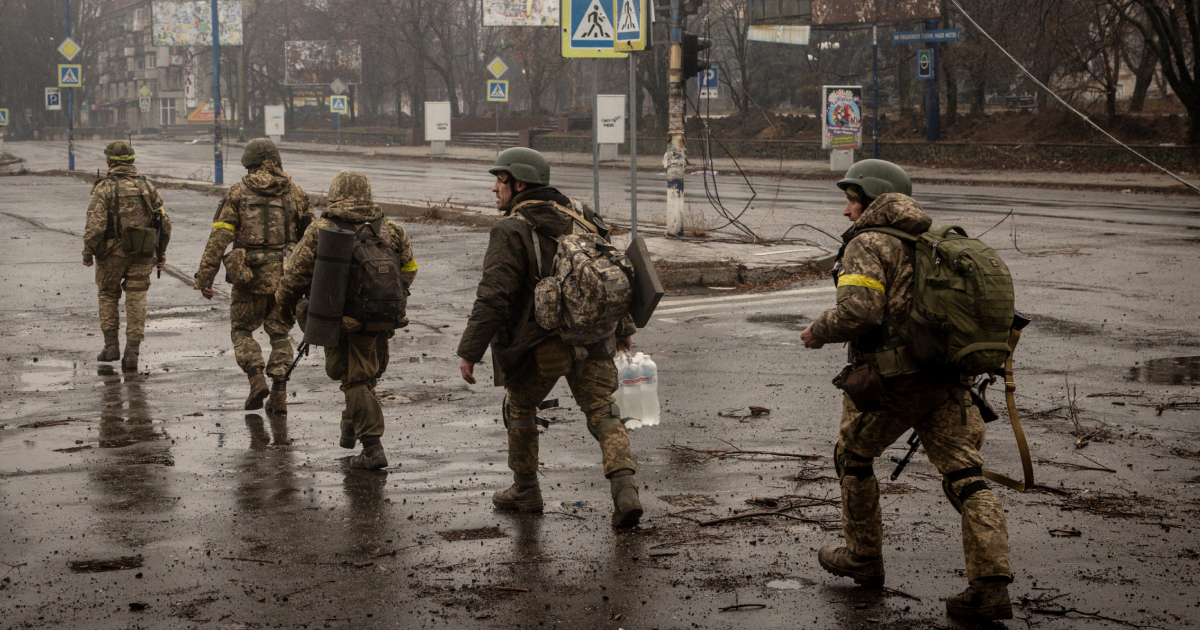


The Russian invasion of Ukraine has now lasted longer than the First World War. Hundreds of thousands are dead and there are millions of casualties. What started in 2022 as a rapid Russian strike into Ukraine has come to resemble much more the trenches in Flanders.
It has brought major conflict back to Europe for the first time since the Second World War and has seen brutal developments in military capability. The ever-present threat of drone warfare takes a psychological toll on soldiers previously unseen, further distancing the relationship between killer and killed.
Throughout the conflict, the Church has responded as it has traditionally: as a messenger of peace between the warring parties. It continues today, as the Holy See has once again sent envoys to Kyiv to reaffirm its closeness to the war-torn country.
This week, Archbishop Paul Richard Gallagher, Secretary for Relations with States for the Vatican, met with Ukrainian President Volodymyr Zelenskyy to conclude his second diplomatic mission to Ukraine, with his first occurring following the invasion.
Speaking with Vatican Media, Archbishop Gallagher recounted the suffering endured by the Ukrainian people.
He said: “There is no doubt about it: the exhaustion caused by this violence is clearly visible. At the same time, however, one encounters a determined and resilient people, fully aware of the many sacrifices made by their fellow citizens for the sake of their country.”
During the visit, Archbishop Gallagher visited bombed sites and laid roses at the Maidan Memorial, which commemorates the 2013 and 2014 Euromaidan demonstrations that ousted the pro-Russian President Viktor Yanukovych. The Russian annexation of Crimea followed, as well as the attempted secession by Donbas separatists and a long, harsh conflict before the 2022 invasion would begin
The Archbishop reflected on the memorial: “Faith has sustained these people. They are convinced – and they say so openly – that they are fighting not only for Ukraine but for all of Europe. I believe they feel they have no alternative. For them, this is a struggle for the very survival of their nation.”
In talks with the acting Foreign Minister, Andrij Sybiha, Archbishop Gallagher called for a lasting, just peace. As did Cardinal Matteo Maria Zuppi, visiting Kyiv as president of the Italian Bishops’ Conference the day after another Russian missile attack on the capital.
While there, Cardinal Zuppi prayed: “May prisoners return home, may children embrace their families once again, may the missing be found and may everyone be able to mourn over the body of their loved one who has fallen. Inspire in each one of us the courage and wisdom to become builders of peace.”
Prisoners of war from both sides have been of particular concern for the Church. While in Ukraine, Cardinal Zuppi met with Russian prisoners near Lviv to distribute gifts, including prayer cards, from Pope Leo XIV; he told them that the Pope was praying for them and “that the war may end and that you may return home”.
Part of the Vatican’s ability to act as an envoy of peace comes from its international structure, which allows it to speak to both parties at a time when diplomatic channels are cut off. Almost immediately following the outbreak of the full-scale invasion – which finds its origins in the war in Donbas eight years earlier – Pope Francis opened communication with both Ukraine and Russia.
The day after the invasion of Ukraine, Pope Francis visited the Russian embassy to the Vatican to express his concerns.
Recounting the visit, he said he “asked them to explain. I said, ‘please stop’”.
“On the first day of the war I called Ukrainian President Zelenskyy on the phone. Instead, I did not call Putin. I had heard from him in December for my birthday but this time no, I did not call.”
For the sake of peace, however, the Pope announced he was willing to do what was perhaps the most unpopular thing he could: meet the Russian president in Moscow, a message he put in the hands of Cardinal Secretary of State Pietro Parolin. It did not materialise. In the same interview, he warned Patriarch Kiril of Moscow against becoming Putin’s “altar boy”.
Less than a month later, he met with Patriarch Kirill over a video call in an effort to pave the way to peace.
Pope Francis said: “As pastors we have the duty to remain close and to help all those suffering due to the war. There was a time, even in our own Churches, when people spoke of holy war or just war. We can no longer speak like that today. The Christian awareness of the importance of peace has developed.”
At Castel Gandolfo on July 19 2026, Pope Leo continued the message: “Let us not forget those who are suffering and dying because of these conflicts and let us add our constant prayers to the generous efforts for peace.” A year earlier in May, 2025, Pope Leo said during a meeting with the Eastern Churches that the Holy See was “available so that enemies can meet and look each other in the eye”.
US President Donald Trump welcomed the idea of hosting peace talks at the Vatican, stating that he thought it could “help dispel some of that anger”. Despite the Holy See’s willingness to meet in the Vatican, Russian officials would still have to travel via Italy – a prospect which undoubtedly would raise concerns as a Nato member.
Despite repeated Vatican offers to mediate between Russia and Ukraine, there have only so far been false glimmers of a possibility for peace. And while Rome has a long history of brokering peace between warring nations that spans continents, it also has one just as long of efforts that bear little fruit.
Throughout the First World War, Pope Benedict XV declared the neutrality of the Holy See and repeatedly pleaded for peace – a war he labelled the “suicide of civilised Europe”. His attempted mediations in 1916 and 1917 fell on deaf ears and the war continued until its grinding conclusion. And, like the Great War it is so often compared to, many struggle to see an end to the War in Ukraine that arises from diplomacy rather than the exhaustion of one side or another.