




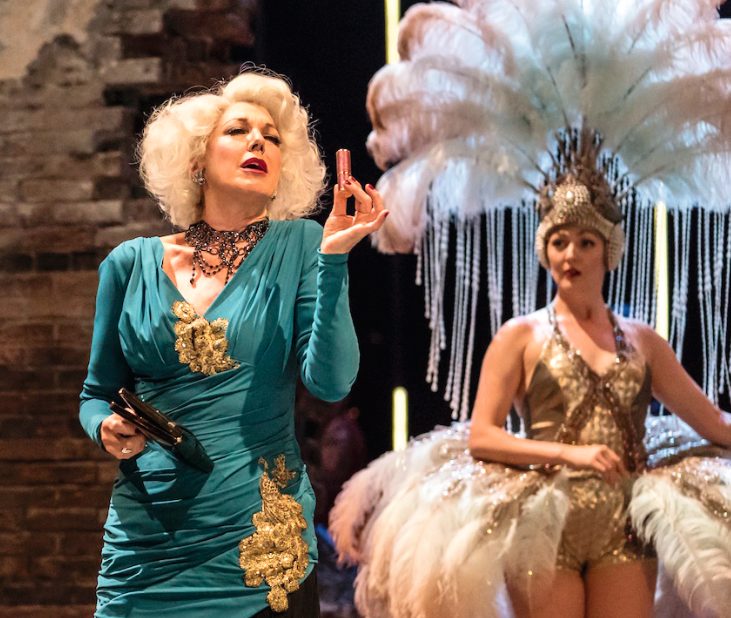
Stephen Sondheim and James Goldman’s Follies, one of the great American musicals, looks back to the golden age of vaudeville and the glamour of the famously beautiful Ziegfeld Follies, with their long legs, furs, feathers and fantastic headgears. The musical is so expensive to stage that revivals have usually been concert performances. Dominic Cooke’s thrilling production for the National Theatre is the first full-scale version since 1987. It’s a major theatrical event and not to be missed. The action is set during a reunion of old chorus girls in a crumbling theatre, where they once performed and which is about to be pulled down to make way for a car park. The party is also attended by chorus girl ghosts, heavily sequined and gloriously feathered, who silently stalk their older selves. Ziegfeld’s shows in the 1920s and 1930s were famous for their spectacular lavishness, an opulence which the National Theatre cannot match, not having the financial resources. There is no grand staircase for starters. The leads instead make their entrance down a fire escape, a brilliantly witty and appropriate alternative. High spots include Beautiful Girls, the ultimate showgirls-descending-staircase number, and Mirrors, when the old and the young have a joint dance routine. Tracie Bennett singing I’m Still Here and Di Botcher singing Broadway Baby, two definitive songs of survival against the odds, predictably stop the show. Josephine Barstow has her show‑stopping moment with One More Kiss, which is made all the more poignant for being sung with her younger self (Alison Langer). Wisecracking Janie Dee singing Could I Leave You and Imelda Staunton singing In Buddy’s Eyes and Losing My Mind give the show its bitterness and pathos. John Patrick Shanley’s gripping 90-minute Doubt won many awards on Broadway in 2005 and then went on to be a film with Meryl Streep and Philip Seymour Hoffman. Sister Aloysius, the principal of a Catholic school in the Bronx in the 1960s, accuses Fr Flynn of paedophilia. Aloysius, a sour, abrasive disciplinarian, is a traditionalist who dislikes Flynn’s liberality. She has no compassion and is prepared to go to any lengths, however illegal, to destroy him. Stella Gonet gets the Sister’s icy tone exactly. But is Flynn guilty? Was his relationship with the 12-year-old altar boy ever anything more than teacher-pupil? The playwright, the director Ché Walker and the actor Jonathan Chambers are deliberately ambiguous in this excellently acted production at Southwark Playhouse. However, I don’t think there will be any doubt in the audience’s mind. But where’s the proof? That’s the point. Shanley describes his play as a parable on the dangers of rigid moral certainty. Also at Southwark Playhouse is Tony Cox’s very entertaining Mrs Orwell, which deserves a longer run. George Orwell married Sonia Brownell on his deathbed. Sixteen years his junior, she freely admits she doesn’t love him. So why does she marry “gloomy George”? It was generally thought, unfairly, that she had married him for his fame and the massive royalties from the hugely successful Animal Farm. Peter Hamilton Dyer and Cressida Bonas are excellent.
1:00 PM
Theatre: A cut-price chorus line that’s not to be missed
Robert Tanitch

3 min read



Already a subscriber? Sign in
5freearticles every month
Continue reading with a free account. No card needed.
- Five free articles every thirty days, on any device you sign in on
- The Catholic Herald newsletter, every morning
- Subscribe whenever you like for everything: every article and the magazine
Related articles
 Newsroom
Church leaders urge Drumcree dialogue: ‘Too much is at stake’
The Catholic and Church of Ireland Archbishops of Armagh have urged a renewed commitment to peace and reconciliation amid the Drumcree stand-off
Corrie Douglas-Young Newsroom
Thousands of Irish children to join global Rosary campaign
Corrie Douglas-Young Newsroom
TikTok priest urges young people to stand with persecuted Christians
Nathalie Raffray Newsroom
Baby born at 25 weeks reunites with neonatologist two years after leaving hospital
The Catholic Herald Newsroom
Joe Biden honoured by Planned Parenthood after defending abortion rights
Christine Rousselle
subscribe to the catholic herald today
Our best content is exclusively available to our subscribers. Subscribe today and gain instant access to expert analysis, in-depth articles, and thought-provoking insights—anytime, anywhere. Don’t miss out on the conversations that matter most.
Subscribe



