




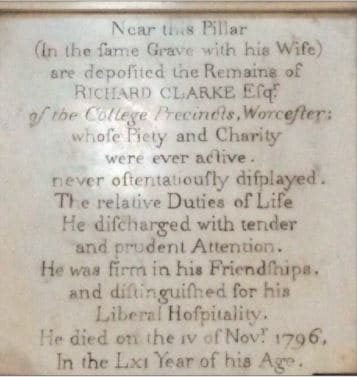
I never used to think much about the tombstones and plaques that fill the aisles of churches across England. Some of them drew me with their carving, but the words on them seemed obviously trite and insincere. Were all those mothers really so tender, those officers so gallant? A few years ago, however, while researching a book on the history of courage, prudence, justice and other virtues, I started looking at these monuments with a professional eye, as an invaluable and almost entirely neglected source of evidence for the changing use of these terms. I started taking photographs, first casually, then methodically, then obsessively. Trips to churches and cathedrals became little more than excuses to add to my collection. Eventually, I thought it sensible to create a website to display and organise the images I had assembled, and so with the help of a technically savvy friend, “Virtues of the Dead” was born; see epigraphs.net. The power of the computer opens up new lines of enquiry not only for scientists but also for historians and literary scholars. Suppose you are curious to know whether “prudence” was primarily a virtue of men or of women. A word search on my website reveals all the epitaphs containing that word, grouped decade by decade. What you’ll discover is a marked change around 1720. Before that date, “prudence” is mentioned only in connection with women; after it – with just one exception – only in connection with men. Why this sea change? I’m not sure exactly, but I suspect it has some connection with the declining importance of the household as the basic unit of production. In the 17th century, wives of the upper class would be expected to follow the example of the virtuous woman of the book of Proverbs, who “looketh well to the ways of her household, and eateth not the bread of idleness”. But over the course of the 18th century, as managers took over the running of grand estates, the wife’s role was confined to that of companion and support to her husband and children. “Prudence” was no longer one of her essential attributes. In fact, it could be a term of reproach, suggesting a kind of self-seeking shrewdness. There was also a shift in attitudes to death and the hereafter. Memorials in the 17th and early 18th-century are typically memento mori – reminders of death’s inevitability, festooned with skulls and crossbones. Artless verses press home the grim message. “Behold thyself by me”, runs the epitaph of Nicholas Adams, who died in 1738: "For once I was as thou And thou in time shall be In dust as I am now." Other early tombstones strike a more upbeat note, reminding us that death is but a prelude to life eternal. “Her soul resteth with God till the general resurrection when she shall rise again.” Another: “Herein lyeth deposited his mortal part untill it shall be raised up unto immortal life and glory.” There is nothing vague or mystical about the Resurrection so conceived. It is as real and matter-of-fact as getting up after a long sleep. A charming expression of this ancient faith can be found on the tombstone of the serving girl Hannah Twinnoy, who was eaten by a tiger in 1703:
7:06 AM
Tombstones tell a story
Towards the end of the 18th century, the afterlife comes to be seen through a mist of human emotions, as an object of hope or source of consolation.
Edward Skidelsky

4 min read



Already a subscriber? Sign in
5freearticles every month
Continue reading with a free account. No card needed.
- Five free articles every thirty days, on any device you sign in on
- The Catholic Herald newsletter, every morning
- Subscribe whenever you like for everything: every article and the magazine
Related articles
 Newsroom
Church leaders urge Drumcree dialogue: ‘Too much is at stake’
The Catholic and Church of Ireland Archbishops of Armagh have urged a renewed commitment to peace and reconciliation amid the Drumcree stand-off
Corrie Douglas-Young Newsroom
Thousands of Irish children to join global Rosary campaign
Corrie Douglas-Young Newsroom
TikTok priest urges young people to stand with persecuted Christians
Nathalie Raffray Newsroom
Baby born at 25 weeks reunites with neonatologist two years after leaving hospital
The Catholic Herald Newsroom
Joe Biden honoured by Planned Parenthood after defending abortion rights
Christine Rousselle
subscribe to the catholic herald today
Our best content is exclusively available to our subscribers. Subscribe today and gain instant access to expert analysis, in-depth articles, and thought-provoking insights—anytime, anywhere. Don’t miss out on the conversations that matter most.
Subscribe



