
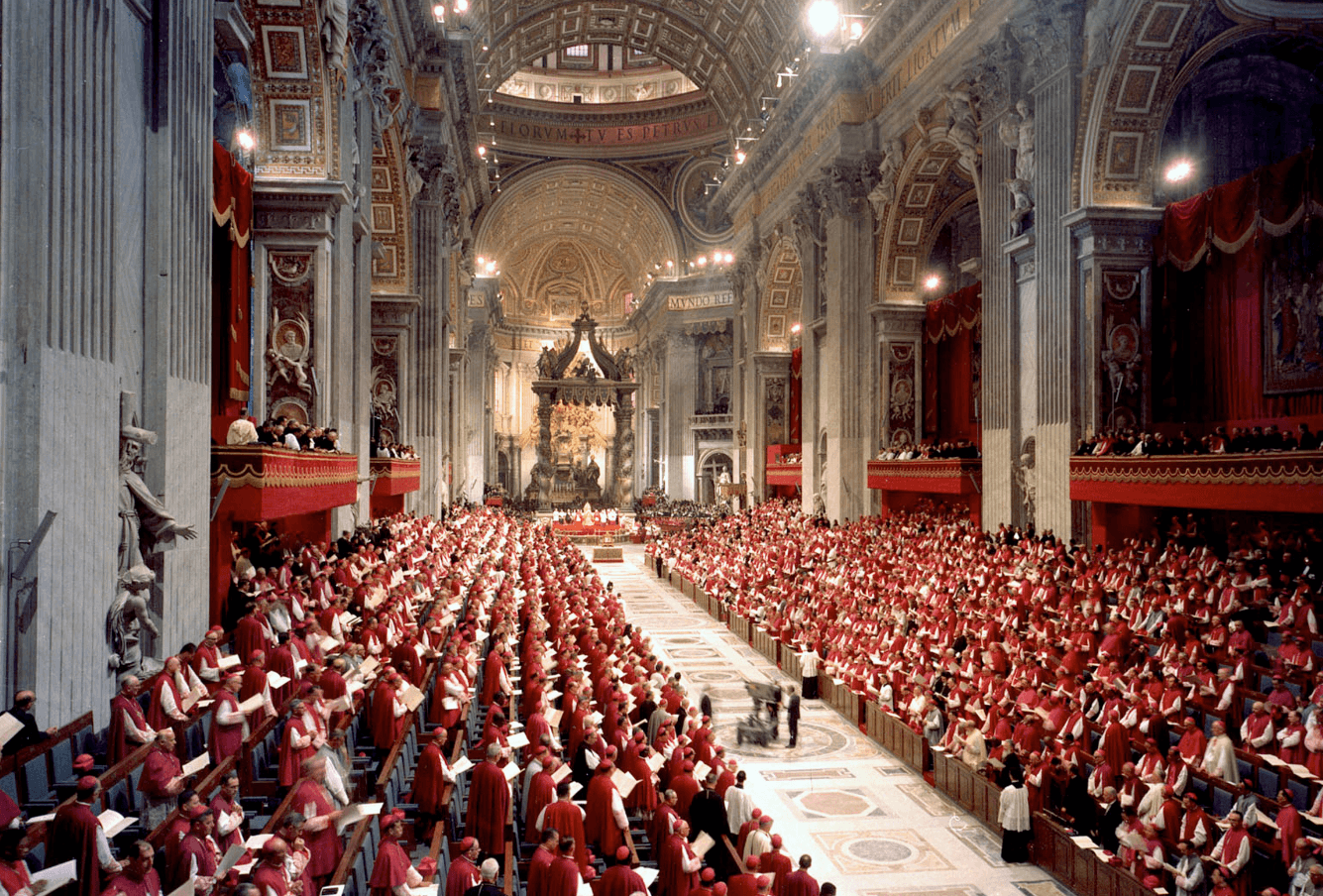
On October 11 1962, St John XXIII formally opened the Second Vatican Council. Its avowed purpose was, he told the thousands assembled in St Peter’s Basilica, to “really succeed in bringing men, families and nations to the appreciation of supernatural values”. While this would require some “timely changes” to “keep up to date with the changing conditions of this modern world, and of modern living”, John declared that the Church must “never for an instant lose sight of that sacred patrimony of truth inherited from the Fathers”. Though not oblivious to the crises threatening humanity “at the threshold of a new age”, the future saint’s optimism was both palpable and – as it soon proved – contagious: “For with the opening of this Council a new day is dawning on the Church, bathing her in radiant splendour.” Vatican II ran until December 1965, outliving its convoker by two and a half years. The Council has a serious claim to being (in John O’Malley’s phrase) “the biggest meeting in the history of the world”. It is not surprising that its teachings, spread across 16 documents and broaching a huge range of topics, defy easy summary. That said, among the more prominent themes is undoubtedly that of the role of the laity: “all the faithful except those in holy orders and those in the state of religious life specially approved by the Church” (Lumen Gentium 30). That is to say, the laity are the overwhelming majority of baptised Catholics, without whom “the Church would look foolish”, as Newman famously quipped. (Incidentally, this bon mot was not, as often claimed, uttered in response to Bishop Ullathorne asking him: “Who are the laity?” Newman’s elegant formulation, as recorded in his diary, is rather what he wished he had said.) The prominence Vatican II accorded to the laity is striking, especially in light of prior councils’ reticence on the subject. It declares, for instance, that “the laity, dedicated to Christ and anointed by the Holy Spirit, are marvellously called and wonderfully prepared so that ever more abundant fruits of the Spirit may be produced in them” (Lumen Gentium 34). As befits those called to ‘‘consecrate the world itself to God’’ (ibid), and possessing their own “apostolate of evangelisation and sanctification” (Apostolicam Actuositatem 6), the laity are thus “not only bound to penetrate the world with a Christian spirit, but are also called to be witnesses to Christ in all things in the midst of human society” (Gaudium et Spes 43). This stirring vision of the laity has been enthusiastically received among commentators. I have lost count of the number of times I have read that it was only at Vatican II that the laity finally and fully “came of age”. It is now more than 50 years since the end of Vatican II. According to recently published data, nearly half of all those born and raised in the UK as Catholics no longer consider themselves to be Catholic; the vast majority of these – almost two out of every five British cradle Catholics – claim to have “no religion”. Those leaving Catholicism outnumber converts by a ratio of 10 to 1. Furthermore, among those who still identify as Catholic to pollsters, somewhat fewer than one in three attend church on a weekly basis – roughly the same proportion as attend “never or practically never”. Meanwhile in the United States, a third of cradle Catholics no longer identify as such, with half of these now being religious “nones”. In the US, there is roughly one convert for every seven who leave. Towards the end of his detailed and nuanced study of “the collapse of Boston’s Catholic culture”, Philip Lawler observes:
2:00 PM
Vatican II was meant to be the laity's 'coming of age'. So what went wrong?
on october 11 1962, st john xxiii formally opened the second vatican council. its avowed purpose was, he told the thousands assembled in st ...
Stephen Bullivant

9 min read



Already a subscriber? Sign in
5freearticles every month
Continue reading with a free account. No card needed.
- Five free articles every thirty days, on any device you sign in on
- The Catholic Herald newsletter, every morning
- Subscribe whenever you like for everything: every article and the magazine

subscribe to the catholic herald today
Our best content is exclusively available to our subscribers. Subscribe today and gain instant access to expert analysis, in-depth articles, and thought-provoking insights—anytime, anywhere. Don’t miss out on the conversations that matter most.
Subscribe



