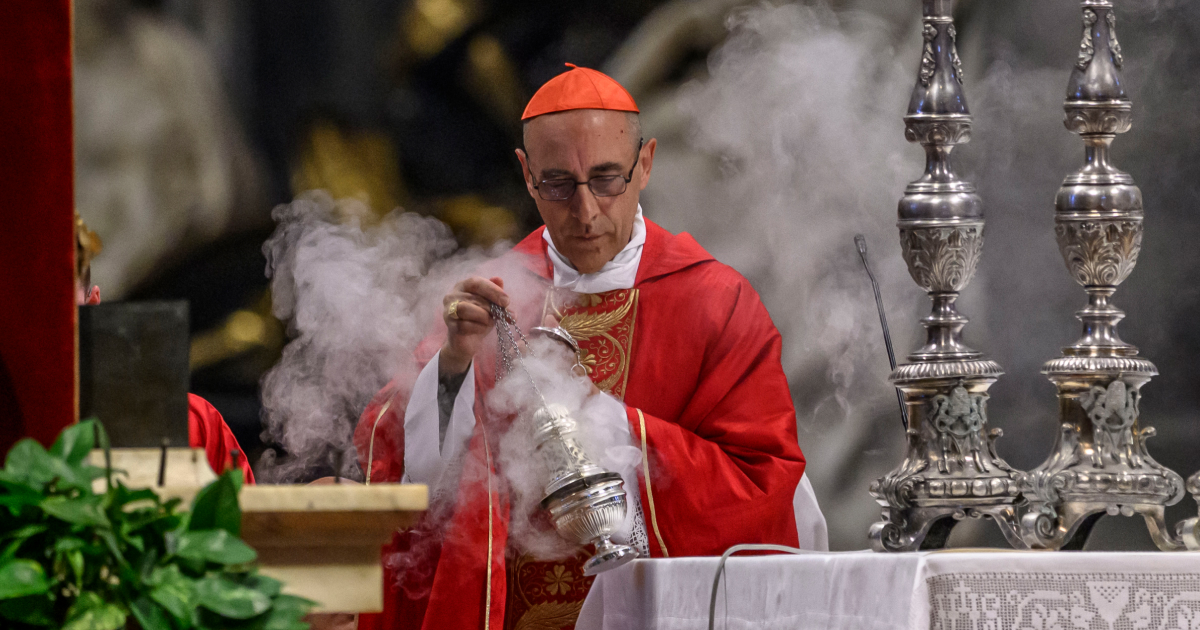


The Priestly Fraternity of Saint Pius X (FSSPX) has confirmed that Cardinal Víctor Manuel Fernández will meet the group's Superior General in Rome next week, days after the traditionalist society announced plans to consecrate new bishops without a papal mandate.
The meeting, scheduled for February 12 at the Dicastery for the Doctrine of the Faith, follows a formal approach made by Cardinal Fernández to Fr Davide Pagliarani after the Society revealed its intention to proceed with episcopal consecrations on July 1. The FSSPX announced on February 5 that its Superior General had accepted the Vatican’s proposal for talks and called on its faithful to pray “for the good outcome of this meeting”.
The existence of the meeting was also confirmed a day earlier by the Catholic news outlet The Pillar, which reported that Cardinal Fernández had personally disclosed his plans to receive Fr Pagliarani at the dicastery he heads. The cardinal told the outlet that recent correspondence between Rome and the Society had culminated in an agreement to meet in person “to try and find a fruitful path of dialogue”.
The development comes amid renewed tension between the Holy See and the Society founded by Archbishop Marcel Lefebvre, following the FSSPX’s public declaration that it intends to consecrate bishops this summer without pontifical approval. Such an act would echo the events of 1988, when Archbishop Lefebvre consecrated four bishops against the explicit wishes of Pope St John Paul II.
In explaining the Society’s decision, Fr Pagliarani said earlier this week that he had sought an audience with Pope Leo XIV in August 2025 and later received a letter from the Vatican which, in his view, failed to address the Society’s concerns. He suggested that the absence of a clear response had left the FSSPX with no alternative but to act to secure its sacramental future.
Cardinal Fernández has since clarified that the letter cited by the Superior General originated from the Dicastery for the Doctrine of the Faith. According to the cardinal, it “merely responded negatively to the possibility of proceeding now with new episcopal ordinations”. He added: “We have been exchanging letters in recent times. Next week I will meet with Fr Pagliarani in the Dicastery for the Doctrine of the Faith to try and find a fruitful path of dialogue.”
The Pillar also reported that discussions in recent months have not been limited to Cardinal Fernández and Fr Pagliarani. They are said to have involved Bishop Bernard Fellay and Bishop Alfonso de Galarreta of the FSSPX, as well as Cardinal Kurt Koch, prefect of the Dicastery for Promoting Christian Unity, and Archbishop Guido Pozzo, the former secretary of the Pontifical Commission Ecclesia Dei, which was dissolved in 2019.
The inclusion of figures such as Cardinal Koch and Archbishop Pozzo is likely to be seen as significant. The Pontifical Commission Ecclesia Dei was originally established by Pope St John Paul II to facilitate dialogue with those attached to the traditional Latin liturgy after the SSPX consecrations, and Archbishop Pozzo has long been involved in attempts to regularise the Society’s status.
Despite decades of talks, the canonical position of the FSSPX remains irregular. While Pope Francis granted faculties for FSSPX priests to hear confessions validly and licitly during the Jubilee of Mercy in 2015, and later extended these permissions indefinitely, the Society has no formal juridical recognition within the Church. Its bishops and priests exercise ministry without canonical mission.
The announcement of a high-level meeting in Rome suggests that the Holy See is keen to prevent a further rupture. Unauthorised episcopal consecrations would raise the prospect of renewed canonical penalties and deepen divisions already sharpened by disputes over liturgy, authority and the interpretation of the Second Vatican Council.
The forthcoming meeting between Cardinal Víctor Manuel Fernández, prefect of the Dicastery for the Doctrine of the Faith, and Fr Davide Pagliarani, Superior General of the Society of St Pius X, comes after the Society announced its intention to consecrate bishops without papal mandate on July 1. That announcement was itself a calculated act. It forced the Holy See’s hand, drawing into the open what has long been managed through private correspondence, unofficial envoys and carefully deniable conversations. Rome responded publicly, and that choice alone is significant.
At one level, the Vatican’s move is unsurprising. As tensions with the SSPX escalate, the doctrinal dicastery is always the final port of call. The Society’s dispute with Rome has never been fundamentally about discipline, personalities or structures. It concerns teachings on religious liberty, collegiality, ecumenism and the authority of the Second Vatican Council. That is why the meeting is not being handled by the Dicastery for Institutes of Consecrated Life, headed by Sr Simona Brambilla. Pope Leo XIV clearly understands that this is not a question of governance or canonical housekeeping, but of theology. Sr Brambilla, whatever her administrative competence, is not the figure to adjudicate disputes rooted in conciliar interpretation.
Instead, the task has fallen once again to Cardinal Fernández, who has a reputation for enforcing the current pontificate’s theological red lines, a fact that even conservative Catholics may not welcome. His role here is not accidental. He is the Vatican’s designated enforcer with regard to its more progressive positions, where Rome believes the problem is not misunderstanding but resistance.
Yet there is something puzzling. If the issue is as grave as Rome implies, why is the meeting not with the Pope himself? There is, of course, the principle that doctrinal matters are handled by the Dicastery for the Doctrine of the Faith. But if episcopal consecrations without mandate threaten communion, why is the Successor of Peter absent from the room? From the Society’s perspective, the question practically asks itself. Were one inclined to dramatics, as many have suggested the SSPX are doing, one might imagine Fr Pagliarani walking into the dicastery, looking around, and asking simply: “Where is Leo?”
For a Society already distrustful of Roman assurances, the absence of the Pope risks confirming its deepest suspicion: that Rome wants delay without decision, dialogue without resolution. Seen in that light, the SSPX’s earlier public declaration begins to look less reckless and more strategic.
The pattern is familiar to 1988. Every serious moment of SSPX–Vatican engagement has followed a crisis created by unilateral action, with Rome responding, talks intensifying and then stalling once the immediate pressure subsides.