



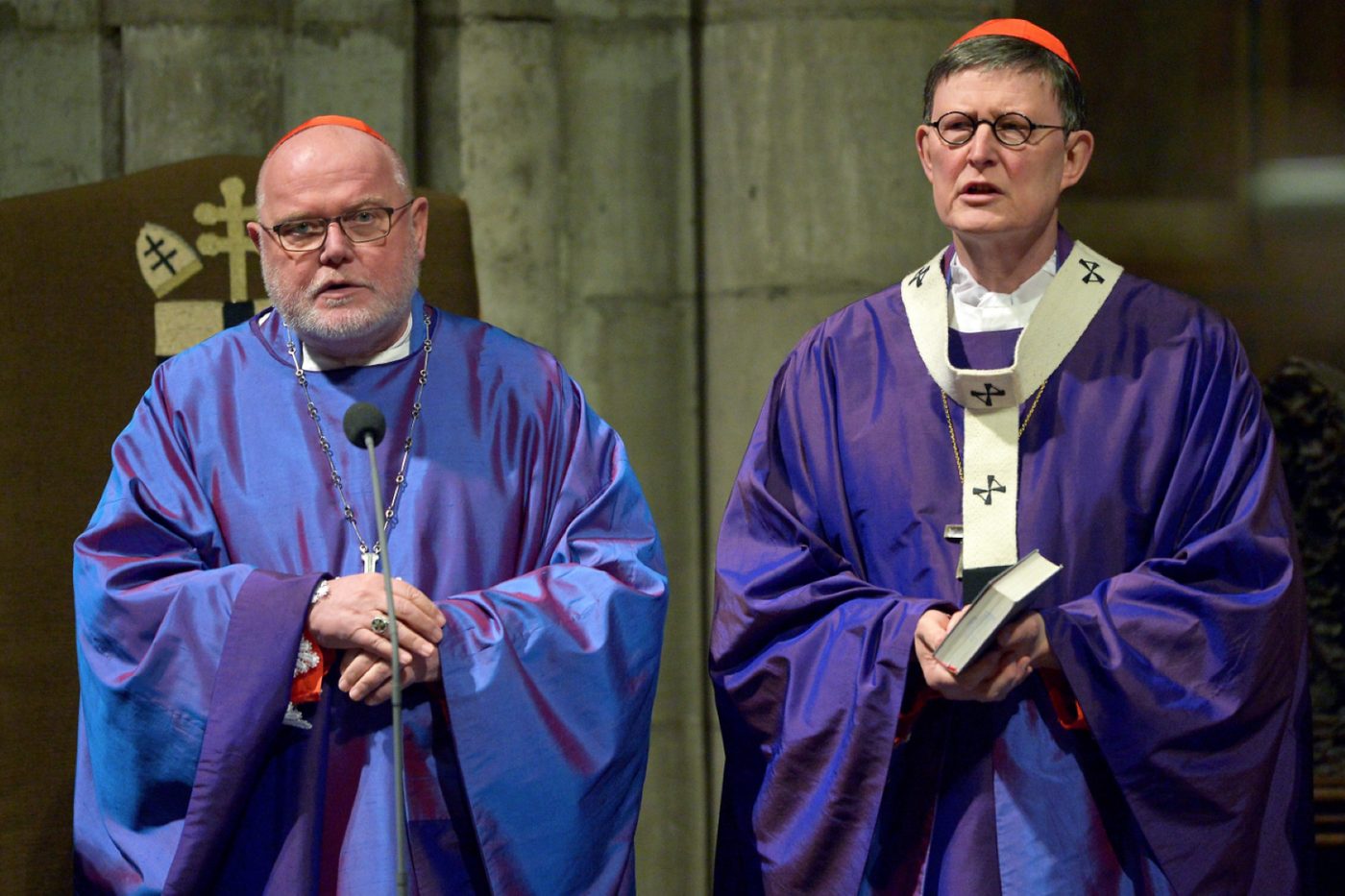
The German bishops are having trouble getting along, and Pope Francis wants to see if he can’t help smooth things over. That is the short version of why the Archbishop of Munich and Freising, Cardinal Reinhard Marx and the Archbishop of Cologne, Rainer Maria Woelki, have been called to Rome along with the Bishop of Münster, Dr Felix Genn. If that version is short, it is also sweet – too short, and too sweet. The matter in dispute is a pastoral pamphlet (Handreichung in German) offering guidelines to pastors and the faithful regarding when and under what circumstances non-Catholics who attend Catholic rites with their Catholic spouses may be admitted to Eucharistic Communion. A press packet prepared by Cardinal Marx’s office to accompany the announcement of bishops’ vote to approve the pamphlet in February explained that the bishops saw this as a serious pastoral issue. “In interdenominational marriages,” the packet explained, “the spiritual hunger for receiving Communion together can be so strong that it might jeopardise the marriage”, as well as the faith of the Catholic party to the union. The bishops propose “mature examination in a spiritual conversation with their priest or another person charged with pastoral care,” after which people who have “come to a decision of conscience to affirm the [Eucharistic] Faith of the Catholic Church”, and “discovering a grave spiritual need” that includes receiving the Eucharist “may approach the Lord’s table and receive Communion” from the Catholic Church. The invocation of “grave spiritual need” is significant, because Church law (Canon 844§4) forbids non-Catholics from receiving Holy Communion except when there is danger of death “or some other grave necessity”. The law also places responsibility for determining the presence of “grave necessity” on the local Ordinary (the bishop of a diocese) or the bishops’ conference. Cardinal Marx insisted in February that neither the vote nor the handout ought to be construed as giving general permission for giving Holy Communion across confessional lines. “We are talking about decisions in individual cases that require a careful spiritual discernment,” he said. The issue has been framed differently in the past. In December, 2016, Bishop Franz-Josef Bode of Osnabrück reportedly told the press agency of the Lutheran Church in Germany: “We must give a foundation to what often already is in place in practice”, ie that non-Catholics with Catholic spouses often do receive Holy Communion in Catholic churches. That is, arguably, a very different matter. The proposal was controversial within the German bishops’ conference (DBK) and was approved after what Cardinal Marx – president of the DBK – called “intensive debate” during plenary assembly in Ingolstadt, Bavaria on February 19-22. In April, a group of seven bishops led by Cardinal Woelki wrote to Rome asking for clarification. The Kölner Stadt-Anzeiger reported that the authors of the letter contend that the “Eucharistic hunger” experienced by non-Catholics is in essence a response to the ecumenical situation throughout the worldwide body of Christian believers. Though the German situation has particular characteristics owing to historical contingency, it nevertheless constitutes a stable and predictable – if unfortunate – circumstance, rather than the sort of emergency envisioned by the law. More generally, the signatories’ concern is that a matter so directly touching the common good of the whole Church be addressed at the highest level of governance. There are other concerns regarding a range of issues, from the practicalities of applying the guidelines to the responsibility of pastors at every level to safeguard the unity of the faith and of the Catholic Church, the pre-eminent sign of which is Eucharistic Communion. The letter from Cardinal Woelki et al apparently went to the apostolic nuncio to Germany, Archbishop Nikola Eterović, to the prefect of the Congregation for the Doctrine of the Faith, Archbishop Luis Ladaria SJ, the president of the Pontifical Council for the Promotion of Christian Unity, Cardinal Kurt Koch, and to the secretary of the Pontifical Council for the Interpretation of Legislative Texts, Bishop Juan Ignacio Arrieta. The Kölner Stadt-Anzeiger described the letter as a “declaration of war”. Last week, Catholic media reported that CDF, with the placet of Pope Francis, had rejected the pastoral plan the German bishops’ conference had adopted at their plenary. The DBK then issued a statement calling those reports “false” and saying that there was an ongoing process. Proposed amendments to the draft needed to be discussed, the bishops said, but no final decision had been taken. On Monday, the DBK released another statement, explaining that the Permanent Council of the DBK had rehashed the debate and incorporated the proposed amendments, and that the desired presence of Cardinals Marx and Woelki, along with Bishop Genn in Rome, to discuss the matter is to “clarify” things. “The Permanent Council welcomes the opportunity for a deepening and clarifying conversation in Rome,” the DBK statement reads. “From the point of view of the Permanent Council,” it continues, “the purpose of the conversation is to discuss and weigh the pastoral aspects and the legal context from the perspective of the universal Church.” No date for the meeting has been announced.
11:25 AM
Vatican: When cardinals collide
Christopher R. Altieri

5 min read



Already a subscriber? Sign in
5freearticles every month
Continue reading with a free account. No card needed.
- Five free articles every thirty days, on any device you sign in on
- The Catholic Herald newsletter, every morning
- Subscribe whenever you like for everything: every article and the magazine
Related articles
 Newsroom
Church leaders urge Drumcree dialogue: ‘Too much is at stake’
The Catholic and Church of Ireland Archbishops of Armagh have urged a renewed commitment to peace and reconciliation amid the Drumcree stand-off
Corrie Douglas-Young Newsroom
Thousands of Irish children to join global Rosary campaign
Corrie Douglas-Young Newsroom
TikTok priest urges young people to stand with persecuted Christians
Nathalie Raffray Newsroom
Baby born at 25 weeks reunites with neonatologist two years after leaving hospital
The Catholic Herald Newsroom
Joe Biden honoured by Planned Parenthood after defending abortion rights
Christine Rousselle
subscribe to the catholic herald today
Our best content is exclusively available to our subscribers. Subscribe today and gain instant access to expert analysis, in-depth articles, and thought-provoking insights—anytime, anywhere. Don’t miss out on the conversations that matter most.
Subscribe



