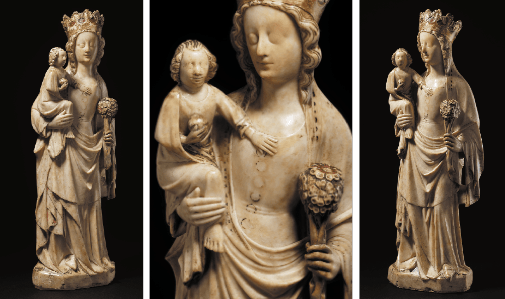
A medieval Virgin and Child that survived the ravages of the Reformation has returned to England for the first time in 600 years.
The alabaster statue, thought to have been made around 1350 in the Midlands, is hailed as a masterpiece and is now on display at the British Museum.
Historian Tom Holland described it as “a haunting glimpse of what we lost”.
Lloyd de Beer, co-curator of the medieval collection at the museum, told the Guardian: “When you look at an object like this and think what it has endured, it is so moving. If the British Museum exists for nothing else, it exists for this.”
The history of the statue is uncertain. For many years it was kept at a Benedictine monastery in St-Truiden, Belgium. It is unclear if it had been purchased before the Reformation or smuggled out during it. Experts at the British Museum suggest the former is more likely.
The abbey was suppressed and plundered by French Revolutionary forces in 1794 but the statue somehow survived. It was exhibited in Brussels 70 years later and has been in the hands of private collectors ever since.
Mr De Beer said the museum had placed the statue next to the head and foot of another, vandalised statue, “so that visitors can see what happened to most of these works.
“It also stands near a French Virgin and Child in ivory, so we can show it is just as sophisticated a piece. English alabaster sculpture has had a bad rap until now, because there was an element of mass production to some of the later work. Here, though, we can see the skill of a real work of art.”
Abbey ‘saddened’ by judge’s remarks about Buckfast wine
Buckfast Abbey has expressed dismay after a judge said there was a “very definite association” between Buckfast tonic wine and violence.The abbey said it was “saddened” by the judge’s opinion that a “small number of people in Scotland are not enjoying Buckfast in a responsible way”.
Sheriff Alastair Brown made the remarks at a court in Dundee after hearing of an 18-year-old who downed two and a half bottles of the caffeinated wine before attacking a 15-year-old.
“I’m aware that the monks of Buckfast Abbey advertise this as something to be taken in moderation,” he said.“The fact is that some people drink far too much of it and get violent.”
Buckfast Abbey told the BBC that it worked hard to ensure “that the tonic wine is marketed and distributed responsibly”.
“The majority of people who drink the tonic wine do so responsibly,” they said.
Figures from the Charity Commission showed the abbey made £8.8 million between 2014 and 2015. Sales of the caffeine-fuelled wine, which is made at Buckfast Abbey, make up the majority of the income.