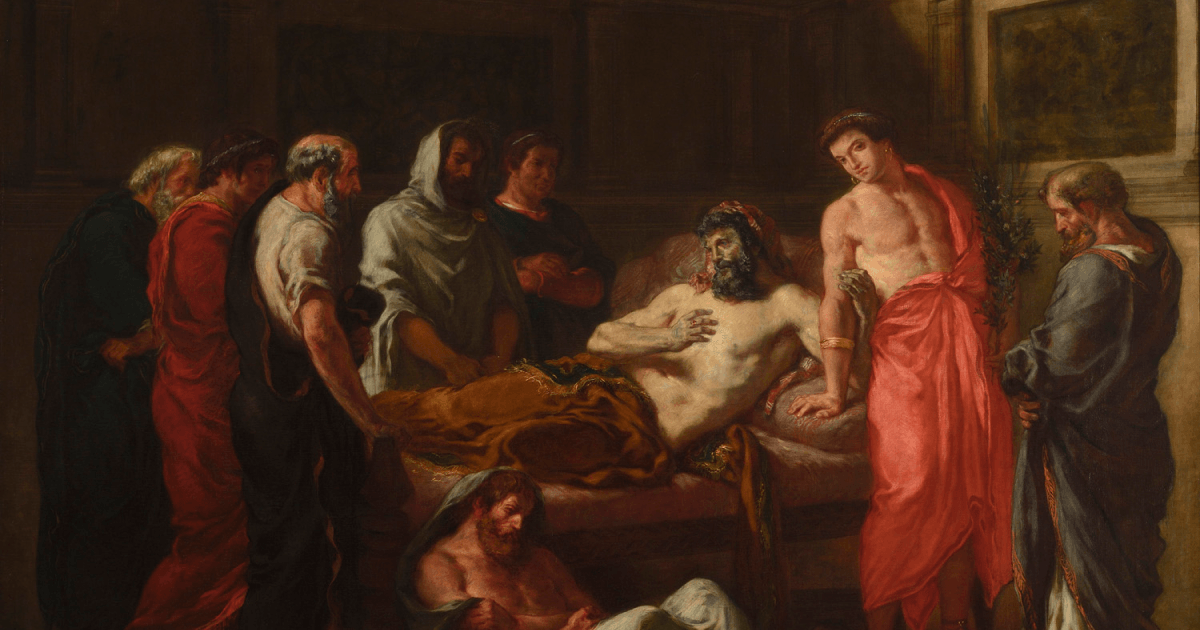

We have collectively forgotten something as a civilisation – we have forgotten how odd Christianity is, and how that oddness saved the West. Like the curse of the Lady of the Green Kirtle in C.S. Lewis’s The Silver Chair, we have been lulled into a forgetful slumber. We have forgotten who we are, our home above and the wonder of our incarnate God.
The virtues are indispensable for a functional society, a useful life and a noble legacy – but who says any of those things are good ends in and of themselves? As Chesterton wrote in The Everlasting Man:
“[In Rome] philosophy began to be a joke; it also began to be a bore. That unnatural simplification of everything into one system or another, which we have noted as the fault of the philosopher, revealed at once its finality and its futility. Everything was virtue or everything was happiness or everything was fate or everything was good or everything was bad; anyhow, everything was everything and there was no more to be said; so they said it.”
Our intuition is not good enough to fend off the sceptics and the hedonists; they rightly recognise the end of the story – “remember man that thou art dust” – and that everything returns to dust. In the face of eternity, all our finite efforts are effectively meaningless, so why not eat, drink and be merry? Hedonism does not build long-lasting civilisations, but why should it have to if the common fate of all – our bodies, our families, our cultures – is the dust?
Only the Christian really sees the value in virtue beyond pleasure and honour – in fact, he is the only one who sees the value in the dust. The Stoic receives pain and pleasure with level-headed resignation. The Christian receives pleasure and pain with thanksgiving because they both – but especially the latter – put him in contact with the man from Nazareth. The pagan cannot love his misery in the way the Christian can embrace his Cross. He sees in the whole temporal order a world groaning for sanctification. He sees the worship of his God in everything he does. Christianity sanctified the sword and plough as well as the altar and temple.
We have forgotten what Christ has done for us. The result has been one not of progression but of regression; we have once again fallen into the great pit and mire of all mankind.
Once again the Stoics philosophise about their endless cultivation of virtue and excellence. Again, man makes myths to fascinate or conjures nightmares once the myths stop satisfying. What begins in innocent pleasure ends in despair – because our desires were never made to be fulfilled in this life.
We are not forging a new path; we are not progressing forwards – in the same way a racehorse does not progress by going round the same track repeatedly. We were made for a definite end, one that demands immense bravery: less the endless circuit of the racehorse than the thunderous charge of the warhorse.
Now we are left with a culture much like a body without a head. The guillotine of French rationalism has fallen on the whole of the West.
The scholars tell us that we must return to our roots, that the wisdom of Athens, the faith of Jerusalem and the law of Rome will lead us aright. As if what we lack today is too little philosophy, monotheism and lawful order. I beg to differ; we have far too much of it all.
The Jordan Petersons and Jocko Willinks have preached the gospel of personal responsibility; the Muslims have spread their one God far and wide; and globalism has made the Pax Romana seem parochial.
Mankind is indeed a brotherhood, and we are one collective pack of orphan brothers. What we need is what our ancestors needed – we need release from the circles of this world – the endless self-improvement that really is as vain as self-enjoyment. We need more than our brotherhood; we need God’s fatherhood.
Men today still seem to think it clever to say that all religions are equally striving after the same thing, and so make a great stew of them all – a syncretic jambalaya. Religion becomes little more than a method of social engineering: a collection of useful moral habits for producing disciplined, prosperous and peaceful societies.
As Chesterton observed of Marcus Aurelius:
“Marcus Aurelius has been blamed for tolerating the pagan amphitheatre or the Christian martyrdoms. But it was characteristic; for this sort of man really thought of popular religion just as he thought of popular circuses.”
One cannot wholly blame them for trivialising religion as a great mass of storytelling; this is indeed true of all but one such story, which we had the great fortune of becoming our history. Their arrogance lies in the inability to recognise that they have simply rebuilt the Roman pantheon or the Hindu temple. Even the noblest men today misattribute the unique work of the God-man to syncretism and the gradual evolution of culture.
This is because they judge religions by their consequences rather than their truth. If Christianity makes men charitable, Buddhism peaceful, Stoicism disciplined and Islam orderly, then one may simply borrow the best elements from each. Virtue itself becomes the highest good, while truth is quietly relegated to a matter of taste. Yet Christianity has never claimed merely to produce admirable men. It claims that God entered history, died, rose again and made possible a life that no philosophy or discipline could ever attain. The virtues are not Christianity’s destination; they are its fruit. Everything is welcomed except the scandalous claim that one man is God, and that every virtue finds its end only in Him.
We do not need to go back down to our roots; those are firm as stone in the earth. We need to go up once more. We need re-capitation – the restoration of our Head, Christ.
More than Aristotelian virtues, we need the mysticism of Aquinas. More than law, we need the life of grace that makes law liveable. More than the lonely God of the East, we need the eternal Love of the Blessed Trinity. Only when we have the latter do the former obtain their end.
“He is before all things, and in Him all things hold together. And He is the head of the body, the Church; He is the beginning and firstborn from among the dead, so that in all things He may have pre-eminence…” (Colossians 1:15–23).


.png)