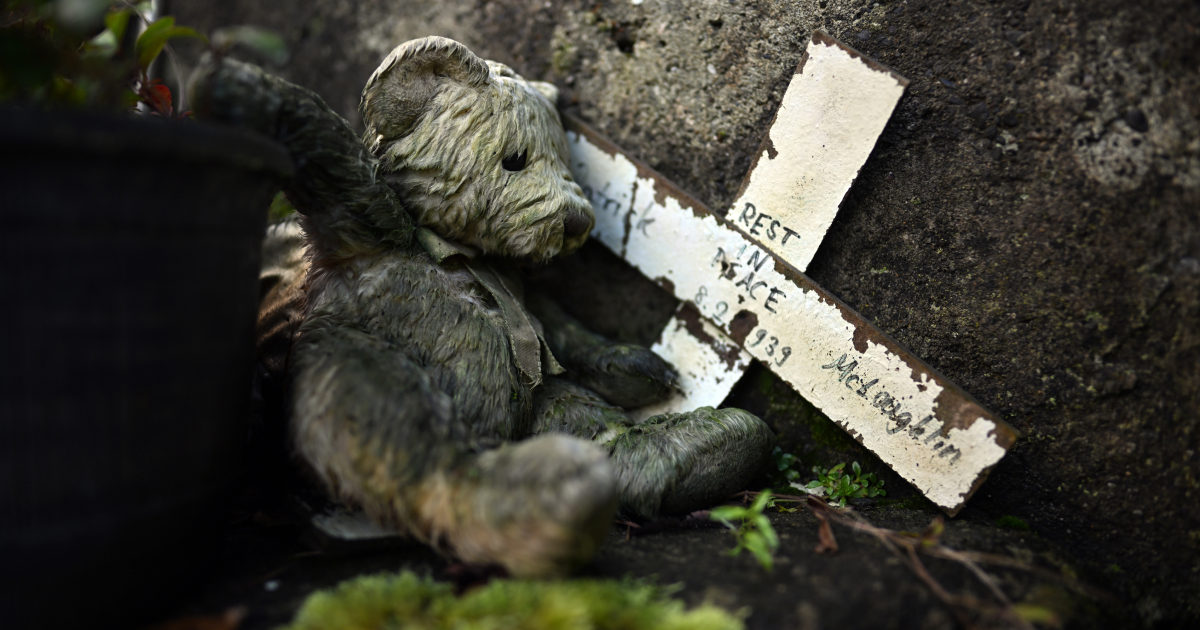


Twelve years ago, an enormous controversy broke out worldwide over a former children’s home in Tuam, County Galway, which had been run by the Bons Secours Sisters from the time it opened in 1925 until it closed in 1961.
The story emerged when a local woman, Catherine Corless, found the death certificates for more than 800 children who died in the place, but no burial certificates. People wondered where they were buried. Beneath the grounds of the old home is a structure that might once have contained waste water or sewage. Some bodies are in it. Everyone concluded that all the bodies were in the structure and that the nuns had put them there.
‘800 skeletons of babies found inside tank at former Irish home for unwed mothers,’ the New York Times declared. ‘Galway historian finds 800 babies in septic tank grave,’ said the Boston Globe.
The tale had all the elements of a gothic horror film, with its evil, villainous nuns in a remote, impoverished part of Ireland, happy to see babies die, or perhaps even to have starved them to death, before dumping the bodies in sewage for the ‘sin’ of being born outside marriage.
The nuns were instantly declared guilty. Irish politicians joined with the media in demanding justice. An inquiry was ordered and eventually a dig of the site itself to find the bodies and then give them a decent burial.
The British writer Brendan O’Neill warned in Spiked when the controversy first broke out, and later in The Irish Times in 2017, that the story had got way ahead of the facts.
The inquiry ordered by the Irish Government was published five years ago, and the dig is currently under way, and so far neither supports the gothic horror film storyline that first broke in 2014.
Let us set out a few facts. As mentioned, Tuam Children’s Home first opened in 1925. Note the name. It was not simply a home for unmarried mothers and their children, as we have been led to believe. It was also intended for married mothers and their children who had nowhere else to go because of poverty. Many of the unaccompanied children who lived in the place had married mothers who could not stay with them.
The Bons Secours Sisters ran it on behalf of Galway County Council. It operated on a shoestring. As the official inquiry made very clear, the sisters repeatedly asked the council for more money and were usually refused.
This meant that for most of its history the home was cold, it had no running hot water, the food was sometimes of low quality, and there was no isolation room where newcomers to the home could be quarantined to ensure they were disease-free. They could therefore mix with the other residents from day one, regardless of the risk of spreading infection.
The children often died in clusters, frequently due to respiratory infections, which would spread very fast once they got into the home. The grim fact is that about a quarter of the children ever resident in the home died there, usually as babies. As soon as antibiotics and vaccinations became widely available, the mortality rate dropped dramatically.
Inspections of the home were carried out fairly regularly. One of the chief inspectors was a woman named Alice Litster. Significantly, she was a member of the Church of Ireland and a socialist, so she had no axe to grind on behalf of the nuns. The Bons Secours Sisters actually emerge well from her reports. She said they were doing their best under very difficult circumstances. She reserved most of her ire for Galway County Council.
The nun who ran the home for most of its history, namely Sister Hortense, also emerges well from Litster’s inspection reports.
You can find all this out for yourself by reading the chapter about Tuam Children’s Home in the official inquiry. Few journalists, and even fewer politicians, have given the slightest hint that they have gone to the bother of reading a single line of it.
They would also learn from the report of the inquiry that Galway County Council, and not the nuns, was legally responsible for carrying out the burials, another key fact omitted from the gothic horror narrative.
As mentioned, the dig at the site is now well under way. The organisation behind it – the Office of the Director of Authorised Intervention, Tuam – has produced several reports on how it is progressing. To date, 69 infant remains have been found, all in coffins. On its own, this dispels the myth that the nuns, or more likely Galway County Council, were dumping all the bodies in a septic tank.
As also mentioned, we do not yet know how many bodies are in the underground structure, nor do we know who put them there, or when, or why. The dig has found a large pit, three metres wide, in the middle of the burial ground that appears to date from the 1970s, when a housing estate on the former grounds of the children’s home was being built. The pit is filled with debris. There is evidence that bodies were disturbed. What happened to those bodies?
Are we meant to believe that the nuns, or the council, as the case may be, were at one time burying the bodies of infants in coffins, and then one day decided to start dumping them in a septic tank instead? Is this plausible? Is it possible that the nuns were not gothic horror film villains after all, but women doing their best under appalling circumstances?
What Tuam shows, above all, is how quickly a compelling narrative can harden into accepted truth before the evidence is properly examined. The facts, as they continue to emerge, deserve the same attention as the accusations once did.