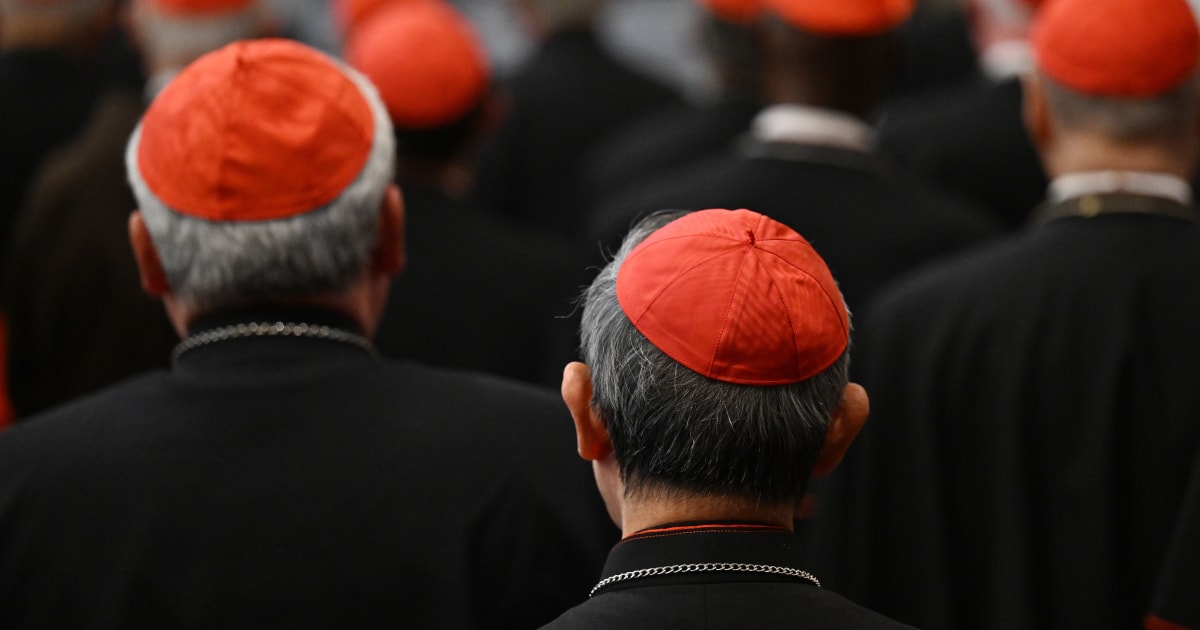
The major event in the ecclesial calendar this week is the Extraordinary Consistory, a formal meeting of cardinals which Pope Leo has summoned for 7 and 8 January. This will be his first, and such meetings take place very much as the Pope wishes. Although Pope Francis held a consistory in almost every year of his pontificate, after 2015 he reduced the discussion element, while continuing to use them primarily to create new cardinals. For ten years the world’s cardinals have been rather muzzled. They now have an opportunity to advise the Holy Father, as it is their particular task to do.
Pope Leo has given the consistory a clear agenda, asking the cardinals to reread two documents of Pope Francis: Evangelii Gaudium (2013), on evangelisation, and Praedicate Evangelium (2022), on the reform of the Curia. He has also indicated that he wishes to discuss synodality and, interestingly, the liturgy.
Pope Leo has not felt inhibited about reversing decisions of his predecessor, most notably the widely unpopular reorganisation of the Diocese of Rome, as well as one of Francis’ final acts, a reform of financial arrangements. So far these changes have not been eye catching, but they are important, and both push back against the centralising tendency of the Francis pontificate.
The use of Pope Francis’ own documents as the focus of the consistory, on the other hand, signals that Pope Leo is not convening any sort of Cadaver Synod, the infamous trial in the year 897 in which the corpse of Pope Formosus was put on trial by his successor, Stephen VI, who concluded proceedings by annulling Formosus’ entire pontificate. A re run of such events might be psychologically satisfying to some, but Pope Leo will be mindful of their historical outcome. Pope Stephen was overthrown and murdered. From all appearances, the Holy Father wishes to stabilise the papacy, not create an atmosphere of chaos. After all, there is much of value in Evangelii Gaudium, including its condemnation of ‘activism’ in section 199, and of the model of a parish as ‘a self absorbed cluster made up of a chosen few’ in section 28.
Indeed, the principle articulated by Pope Francis, ‘the Holy Spirit works as he wills, when he wills and where he wills; we entrust ourselves without pretending to see striking results’ (279), could inspire a form of engagement with the world very different from the one that seemed to prevail during the later years of his pontificate. Much, if not all, of the conflict in the Church could be framed in terms of differing interpretations of this idea.
For fifty years or more, some in the Church have urged us to ‘trust the Spirit’ and to disregard collapsing congregations and declining vocations, on the grounds that things will turn out well in the end, or that, if they do not, it is God’s will that the Church become small. What is striking about this appeal to Providence is that it often involves ferocious opposition to what past generations regarded as providential tools for evangelisation: the Church’s patrimony of music, architecture, and sacred art; her traditional spirituality and devotions; and her ancient liturgy. Those making this argument are convinced that these things were holding the Church back, and for them Pope Francis’ principle becomes a justification for ignoring the calamitous practical results of their pastoral policies.
An alternative reading of the same principle is that the Church should resist the temptation to make concessions to fashions and ideologies which promise popularity, and instead hold fast to the core message of the Gospel. Historically, the Church has done this by taking up the traditions which have conveyed, through a living chain across the centuries, the wisdom of saints, scholars, and pastors. These traditions can develop, certainly, but development does not involve destroying irreplaceable devotional art, banishing traditional sacred music from the liturgy, or hiding fine vestments in cellars.
That the same words can carry diametrically opposed meanings is disconcerting, and the words quoted by Pope Leo on the liturgy have a similar quality. He has asked the cardinals to reflect ‘in order that sound tradition be retained, and yet the way remain open to legitimate progress’, citing Vatican II’s Sacrosanctum Concilium (23). The narrower one makes the concept of sound tradition, the wider legitimate progress can become, since tradition places limits, and therefore shape, on what the Church can rightly progress towards.
This debate is perennial by its nature. What we have witnessed in recent decades is a process of recovery of tradition, which has provided coherent limits and practical guidance for evangelising a world in crisis. That process went into reverse in some respects under Pope Francis, but Pope Leo appears to be taking it forward again. It is not insignificant that the Holy Father has restored the papal mozzetta and the papal throne, rather than the white armchair favoured by his predecessor. These are steps in a clear direction and set an example for the wider Church, while doing so without causing fuss, scandal, or undermining respect for the papal office.
Other decisions will not pass so quietly. At this consistory, or in the near future, the question of the Traditional Mass will have to be addressed. The rationale for the persecution of priests and faithful attached to the Church’s own liturgical tradition is difficult to justify both inside and outside the Church, and it is hard to imagine it persisting long into the new pontificate. Those who promote the ancient Mass will continue to do so in the spirit of trust in the Holy Spirit urged by Pope Francis, and also expressed by the Anglican poet T. S. Eliot: ‘take no thought of the harvest, but only of proper sowing’ (Choruses from The Rock).