



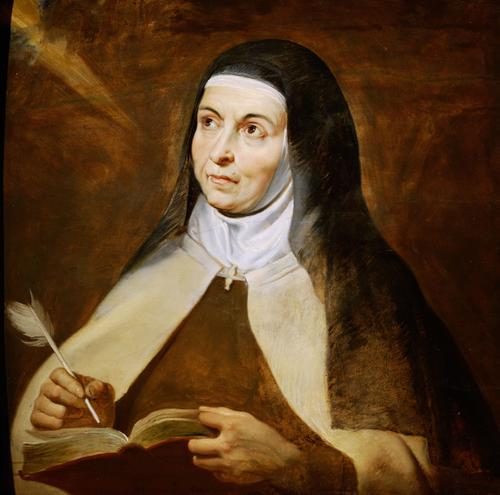
Catholics, on the whole, have always found the subject of self-esteem a difficult one. Jesus tells us that the two most important principles in life are to love God with all our hearts, and to love our neighbour as our own self. How, then, can we have self-esteem, when our actions are not supposed to be about us? There is little popular literature on the subject, barring the wonderful book Building Self-esteem: the Christian Dimension by the German Benedictine monk Anselm Grün, and famously the saints held themselves in low worth: St Teresa of Avila, for one, used to refer to herself as a lowly ‘‘worm’’. Her work The Interior Castle is stuffed with repeated instances of self-deprecation. “I am very ignorant and have poor wits,” she writes. “I am very stupid.” Equally, the Christian requirement to be humble can easily be interpreted as the need to question feeling overly pleased with ourselves. The idea that Jesus enjoyed high self-esteem seems distasteful and quite simply wrong. As St Paul reminds us in his Letter to the Philippians, ‘‘he was humbler yet, even to accepting death on a cross’’ (2:8). Unlike many other world religions or movements, which depict their guru, leader or inspiration at the height of his powers, Christianity uses the image of Jesus humbled on the Cross as its symbol. Given such history, it is intriguing that the world of positive psychology and self-help is itself edging away from the notion that high levels of self-esteem are the key to mental health. Increasingly, there is a new mantra among therapists and researchers: ‘‘self-compassion’’ is a better model to achieve calm and well-being. The argument is being expounded by academics such as Kristen Neff, an associate professor in human development at the University of Texas. Hitherto, achieving high self-esteem was the Holy Grail of good mental health. If we felt high levels of self-worth, then in turn we experienced less depression and anxiety, the argument went. Yet as Neff convincingly argues, the problem is that self-esteem tends to be based on needing to feel above average, and better than others. I will not enjoy self-esteem by writing an OK article: for me to feel good, it needs to be deemed excellent. The problem of invidious comparisons with others has worsened in a world of very public numerical comparisons, be they of Facebook “likes” or Twitter followers, website hits or sales. Nor does self-esteem help when failure hits, as it does to all. Relying on self-esteem provides no psychological shelter in a storm. We are not good enough, and the only option is to remain on an anxious striving treadmill, to taste once again the joy of supposed success. Better for our mental health, Neff argues, is to develop self-compassion, which encompasses three main components: to develop a kindly inner voice of encouragement, understanding and forgiveness rather than harsh judgment; to acknowledge our common humanity and to acknowledge how alike we are in our common imperfection; and to use mindfulness to accept our suffering in the present moment with compassion. As a Catholic, I find that much of the new self-compassion movement resonates with me. The notion of developing a gentler, less judging inner voice is at one with that of a forgiving God who has sent us His son to make our forgiveness possible. Nowhere is this better expressed for me than in George Herbert’s poem Love III, in which the narrator is resisting God’s call to join him at table at one level, or in communion at another. He is the ‘‘unkind, the unworthy’’ who cannot look on Love, or God’s perfection personified.
11:50 AM
Self-esteem can be bad for your health
The world of self-help is edging away from the notion that high levels of self-esteem are the key to mental health
Rachel Kelly

6 min read



Already a subscriber? Sign in
5freearticles every month
Continue reading with a free account. No card needed.
- Five free articles every thirty days, on any device you sign in on
- The Catholic Herald newsletter, every morning
- Subscribe whenever you like for everything: every article and the magazine
Related articles
 Newsroom
Church leaders urge Drumcree dialogue: ‘Too much is at stake’
The Catholic and Church of Ireland Archbishops of Armagh have urged a renewed commitment to peace and reconciliation amid the Drumcree stand-off
Corrie Douglas-Young Newsroom
Thousands of Irish children to join global Rosary campaign
Corrie Douglas-Young Newsroom
TikTok priest urges young people to stand with persecuted Christians
Nathalie Raffray Newsroom
Baby born at 25 weeks reunites with neonatologist two years after leaving hospital
The Catholic Herald Newsroom
Joe Biden honoured by Planned Parenthood after defending abortion rights
Christine Rousselle
subscribe to the catholic herald today
Our best content is exclusively available to our subscribers. Subscribe today and gain instant access to expert analysis, in-depth articles, and thought-provoking insights—anytime, anywhere. Don’t miss out on the conversations that matter most.
Subscribe



