

June 5, 2026

Why you should watch 'The Exorcist'

Luke Collins
More
Related
Min read
share

Catholics are not always very good at understanding artistic temperament. There is no great mystery as to why. We value reverence, restraint, obedience, tradition, proportion and clarity. At our best, we understand beauty better than anyone – but often artists express themselves in ways which can seem excessive, vain, provocative, morally compromised, too drawn to the grotesque, or simply unwilling to say things in what we would consider an appropriate tone.

This is not a small problem, because Catholics are right to know that art is not morally neutral. Bad art does not merely fail aesthetically; it can deform the imagination. There is such a thing as corrupting art, and much of what is defended under the banner of artistic courage is little more than adolescent provocation. The Catholic instinct to be cautious is therefore not without merit. But it can be a bit puritanical. It can mistake ugliness of subject for ugliness of vision, or assume that art which shocks the pious must therefore be hostile to the sacred.
That is where the argument usually goes wrong. The artistic temperament can shock because it is shallow, but it can also shock because it has grasped something real before the rest of us are ready to admit it.

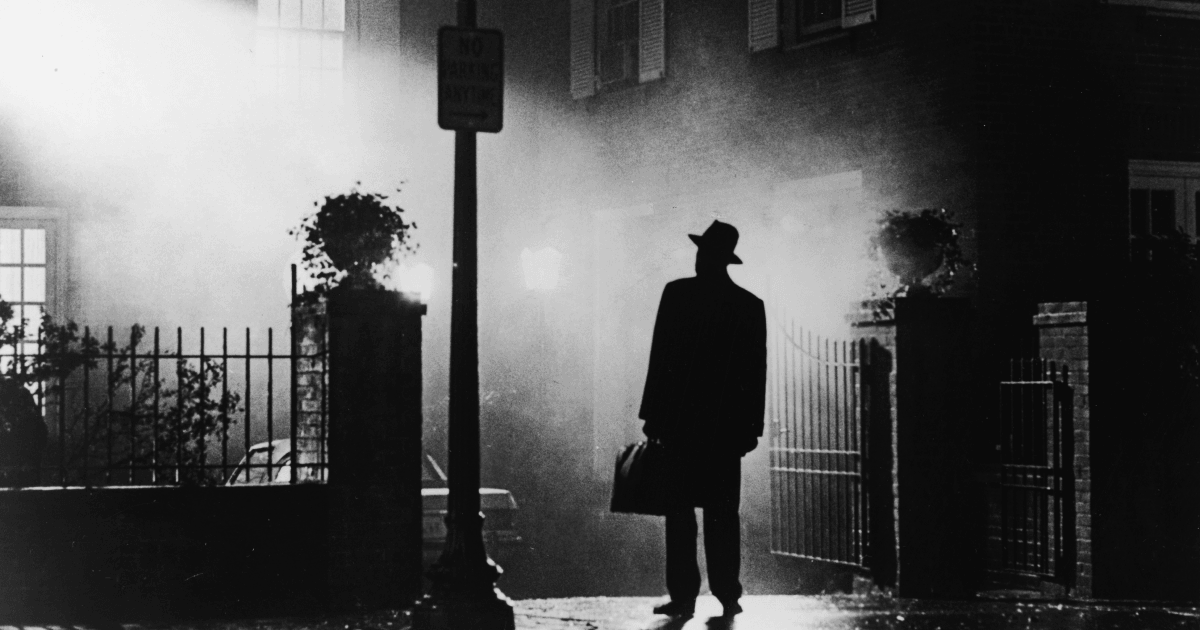
I thought about this recently while rewatching William Friedkin’s The Exorcist, a film many Catholic friends of mine would probably be surprised to hear me defend. My mother was a young girl when it first came out, and remembers being warned against it in a priest’s homily. When I first mentioned that I was thinking of watching it, she raised this with understandable concern.

That concern was not unfounded. The Exorcist is violent, obscene and blasphemous. It is not a film for children – nor for anyone inclined to treat the demonic as entertainment. But to dismiss it as merely shocking is to miss what is most interesting about it. For all its notoriety, it is one of the most profoundly Catholic films ever made, and perhaps more effective as a work of Catholic imagination than many productions which are far more obviously trying to be explicitly religious.

The reason is that it does not behave at all like propaganda, but it presents Catholicism as true. Its central claim is almost intolerable to the modern mind: evil exists, it is personal, it hates innocence, and against it modern expertise is not enough.

This is one of the film’s great strengths. The doctors, psychiatrists and technicians are not portrayed as fools. They examine Regan, scan her brain, observe her symptoms and pursue the available explanations. But they cannot name what is happening because their world has no category for it. They can see that something is wrong, but they cannot see the soul.

Regan is not surrounded by cruelty. Her mother loves her and is desperate to save her. But the world around her is spiritually defenceless. Her parents are separated, her father is absent, the home is comfortable and liberal but without sacramental protection, and the supernatural first enters not through some gothic doorway but through a child’s game with a Ouija board. Nobody treats it seriously until it is too late.

Fr Damien Karras is a Jesuit psychiatrist, exhausted, grieving and close to unbelief. He wears the collar, but his faith has become thin. He is very much a priest of the modern age: clever and compassionate perhaps, but spiritually hollowed out. Against him stands Fr Merrin, the older priest, ascetical and grave, who understands at once what he is facing. He does not posture, theorise or attempt to domesticate the demonic. He enters the room and fights.

The drama of the film is therefore not only Regan’s liberation, but Karras’s conversion. He begins as a priest who can barely believe in the Devil and ends as a priest who gives his life to save an innocent child. The climax is not merely horror. It is sacrifice. Evil is defeated not by argument, therapy or self-expression, but by a priest offering himself.

At this point, people often remind me that “the eyes are the window to the soul”. Quite right, but that does not mean the eyes must only ever look at what is serene. Sometimes they must look at ugliness in order to recognise it as ugly. Regan’s possessed face is horrifying precisely because the child has been obscured; the eyes do not reveal a soul made ugly by nature, but a soul under siege.

This is why the ugliness of the film matters. It is not asking us to enjoy desecration, but to hate it. The obscenity is not there to normalise blasphemy, but to make us feel its violence. Evil in the film is not glamorous, interesting or creative. It is parasitic and squalid. It mocks because it cannot bless, defiles because it cannot create, and possesses because it has no life of its own. That is a deeply Catholic vision of evil.

The wider lesson is about evangelisation. Many people are not brought to the Faith by direct appeal. I was not. In my atheist teenage years, the more obviously Christian a work of art was trying to be, the more suspicious I became. It often felt as though the conclusion had been decided before the work began, and the viewer was simply being ushered towards the approved response. Beauty works differently. It attracts before it argues, and leaves space for the soul to move.

This is why works such as Brideshead Revisited can do what apologetics sometimes cannot. They show a world haunted by grace, in which sin, charm, weakness, memory and longing all exist together. They trust the reader enough not to preach at him every five minutes. The Exorcist does something similar through horror. It reaches places that respectable religious art cannot reach, not by making Catholicism pleasant, but by making the viewer suspect that Catholicism may be true.

Catholics should therefore be more careful before dismissing difficult art simply because it does not behave itself. Of course there are limits. But we should not confuse piety with truthfulness, or assume that art must be safe in order to be Christian. Christianity itself is not safe in that sense. It is consoling, certainly, but it is also terrifyingly serious. It speaks of sin, judgement, demons, sacrifice, grace and the eternal destiny of souls.

That is why The Exorcist still matters. It is not a perfect film, nor a film for everyone, and it should be approached with caution. But beneath the profanity and terror is a profoundly Catholic vision: evil is real.

Continue reading with a free account

Create a free account to read up to five articles each month
Create free account

You have # free articles remaining this month.

Subscribe to get unlimited access.
Sign up

subscribe to the catholic herald today

Our best content is exclusively available to our subscribers. Subscribe today and gain instant access to expert analysis, in-depth articles, and thought-provoking insights—anytime, anywhere. Don’t miss out on the conversations that matter most.
Subscribe