

April 8, 2026

Will there be food in Heaven?

Clement Harrold
More
Related
Min read
share

A few years ago I got into a discussion with some friends on the question of whether there will be food in heaven. Looking back, I realise I probably argued with more passion than the subject deserved. Be that as it may, the conviction I displayed in that debate stemmed not merely from the pleasure I derive in eating a McDonald’s double cheeseburger, but more fundamentally from my understanding of what a proper theology of the Resurrection entails.

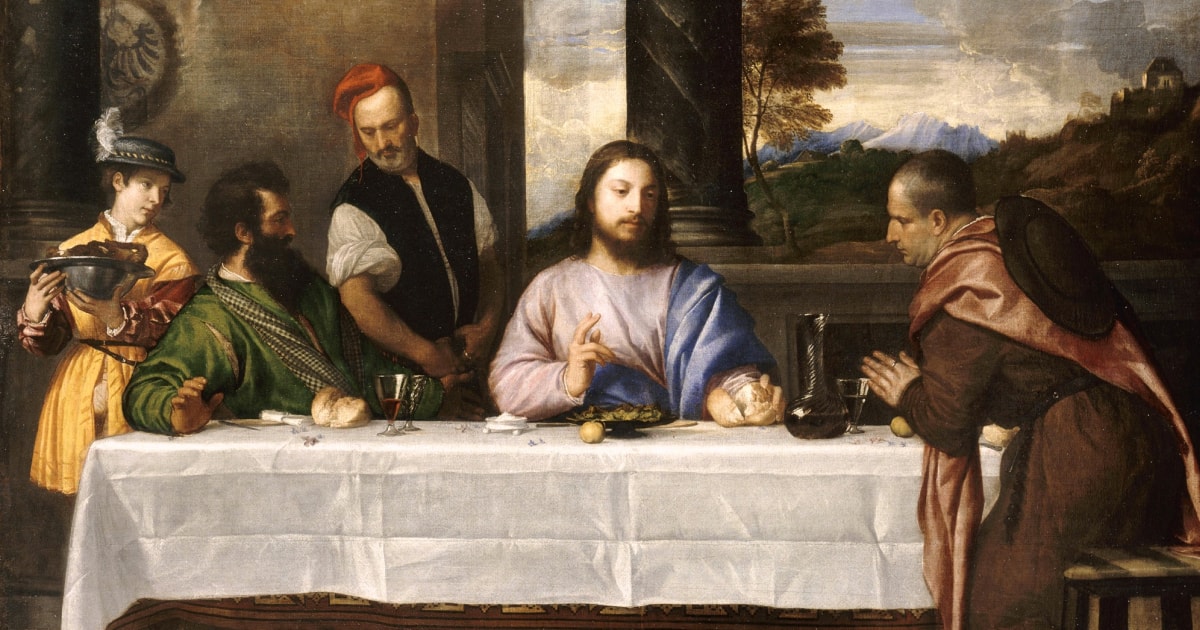
For starters (pun intended), we should pay heed to the multiple Scriptural texts that describe the risen Jesus enjoying food with his disciples. On the evening of Easter Sunday, Our Lord meets Cleopas and his companion on the road to Emmaus, and he proceeds to sit at table and break bread with them before vanishing from their sight.

A little later on, St Mark tells us Jesus appears to the eleven in Jerusalem ‘as they sat at table’ (Mark 16:14). St Luke goes further, noting how Jesus explicitly asks his disciples, ‘Have you anything here to eat?’ (Luke 24:41). He receives a piece of broiled fish in return.

Fast forward to the appearances in Galilee, and again we find Jesus eating. After seeing him on the beach, the disciples come ashore where they discover ‘a charcoal fire there, with fish lying on it and bread’ (John 21:9). The Saviour’s first instruction to his stunned followers is to bring over their miraculous catch of fish. His second instruction is even simpler: ‘Come and have breakfast’ (John 21:12).

My position is not that these Scriptural episodes conclusively prove that there will be food in heaven. But I do insist they make it untenable to dismiss that position out of hand, as if it were somehow theologically unsophisticated. For the truth is that such humble realities as food and drink lie at the very heart of our Catholic faith, and the fact that the risen Jesus is depicted as eating on no less than three separate occasions provides a powerful corrective to the perennial Gnostic temptation to downplay or outright deny the goodness of our physical bodies.

A similar point was made by CS Lewis in Mere Christianity. ‘God never meant man to be a purely spiritual creature,’ observes the English writer. ‘That is why He uses material things like bread and wine to put the new life into us. We may think this rather crude and unspiritual. God does not: He invented eating. He likes matter. He invented it.’

There are, I would propose, at least two key lessons to be drawn from this line of thought. The first is one that most of us understand at a conceptual level but which we need to be frequently reminded of. Our bodies are good. And not just good, but meaningful. There is meaning in the fact that my body is shaped one way and a woman’s body is shaped another.

Another way to frame this is that my body says something both about who I am (‘The body expresses the person,’ wrote Karol Wojtyła) and what – or rather, whom – I am made for. As such, I am forbidden from treating my body as a mere tool or toy or hunk of flesh. In this respect our faith corroborates what natural reason could propose but struggled to prove: my body is me. And not only that, for our faith also reveals another, yet more wondrous truth: the Creator of the universe has Himself assumed a body, and He will keep it forever.

A second lesson is one that Catholics spend less time reflecting on. The Christian emphasis on the goodness of the physical, so marvellously encapsulated in the mystery of the Resurrection, implies that the material things of this world are destined to be not so much cast aside as made new. This is something the characters in Lewis’s The Last Battle discover after they die, when they learn that the England they left behind continues to exist in heaven in a far truer and richer form. ‘And in that inner England,’ explains Mr Tumnus, ‘no good thing is destroyed.’

This is the hope the Resurrection gives us. There will be food in heaven, I believe, insofar as food is good. And the same holds true for all the other good things of life. Our God is not a wasteful deity, and He is not in the habit of discarding the things He has made. He came to fulfil the law and the prophets, not to abolish them. And when the five thousand had eaten their fill, He instructed His disciples, ‘Gather up the fragments left over, that nothing may be lost’ (John 6:12). In the wake of the Resurrection, this command takes the form of a promise: that all the good things of this world will one day be gathered up, redeemed and renewed.

A few years ago I got into a discussion with some friends on the question of whether there will be food in heaven. Looking back, I realise I probably argued with more passion than the subject deserved. Be that as it may, the conviction I displayed in that debate stemmed not merely from the pleasure I derive in eating a McDonald’s double cheeseburger, but more fundamentally from my understanding of what a proper theology of the Resurrection entails.

For starters (pun intended), we should pay heed to the multiple Scriptural texts that describe the risen Jesus enjoying food with his disciples. On the evening of Easter Sunday, Our Lord meets Cleopas and his companion on the road to Emmaus, and he proceeds to sit at table and break bread with them before vanishing from their sight.

A little later on, St Mark tells us Jesus appears to the eleven in Jerusalem ‘as they sat at table’ (Mark 16:14). St Luke goes further, noting how Jesus explicitly asks his disciples, ‘Have you anything here to eat?’ (Luke 24:41). He receives a piece of broiled fish in return.

Fast forward to the appearances in Galilee, and again we find Jesus eating. After seeing him on the beach, the disciples come ashore where they discover ‘a charcoal fire there, with fish lying on it and bread’ (John 21:9). The Saviour’s first instruction to his stunned followers is to bring over their miraculous catch of fish. His second instruction is even simpler: ‘Come and have breakfast’ (John 21:12).

My position is not that these Scriptural episodes conclusively prove that there will be food in heaven. But I do insist they make it untenable to dismiss that position out of hand, as if it were somehow theologically unsophisticated. For the truth is that such humble realities as food and drink lie at the very heart of our Catholic faith, and the fact that the risen Jesus is depicted as eating on no less than three separate occasions provides a powerful corrective to the perennial Gnostic temptation to downplay or outright deny the goodness of our physical bodies.

A similar point was made by CS Lewis in Mere Christianity. ‘God never meant man to be a purely spiritual creature,’ observes the English writer. ‘That is why He uses material things like bread and wine to put the new life into us. We may think this rather crude and unspiritual. God does not: He invented eating. He likes matter. He invented it.’

There are, I would propose, at least two key lessons to be drawn from this line of thought. The first is one that most of us understand at a conceptual level but which we need to be frequently reminded of. Our bodies are good. And not just good, but meaningful. There is meaning in the fact that my body is shaped one way and a woman’s body is shaped another.

Another way to frame this is that my body says something both about who I am (‘The body expresses the person,’ wrote Karol Wojtyła) and what – or rather, whom – I am made for. As such, I am forbidden from treating my body as a mere tool or toy or hunk of flesh. In this respect our faith corroborates what natural reason could propose but struggled to prove: my body is me. And not only that, for our faith also reveals another, yet more wondrous truth: the Creator of the universe has Himself assumed a body, and He will keep it forever.

A second lesson is one that Catholics spend less time reflecting on. The Christian emphasis on the goodness of the physical, so marvellously encapsulated in the mystery of the Resurrection, implies that the material things of this world are destined to be not so much cast aside as made new. This is something the characters in Lewis’s The Last Battle discover after they die, when they learn that the England they left behind continues to exist in heaven in a far truer and richer form. ‘And in that inner England,’ explains Mr Tumnus, ‘no good thing is destroyed.’

This is the hope the Resurrection gives us. There will be food in heaven, I believe, insofar as food is good. And the same holds true for all the other good things of life. Our God is not a wasteful deity, and He is not in the habit of discarding the things He has made. He came to fulfil the law and the prophets, not to abolish them. And when the five thousand had eaten their fill, He instructed His disciples, ‘Gather up the fragments left over, that nothing may be lost’ (John 6:12). In the wake of the Resurrection, this command takes the form of a promise: that all the good things of this world will one day be gathered up, redeemed and renewed.

subscribe to
the catholic herald

Continue reading your article with a subscription.
Read 5 articles with our free plan.
Subscribe

subscribe to the catholic herald today

Our best content is exclusively available to our subscribers. Subscribe today and gain instant access to expert analysis, in-depth articles, and thought-provoking insights—anytime, anywhere. Don’t miss out on the conversations that matter most.
Subscribe