

February 12, 2026

A survey of English churches named after the great martyr

Michael Hodges
More
Related
Min read
share

The Feast Day of St Thomas of Canterbury is celebrated on 29 December each year, between Christmas and the New Year, following St Stephen on the 26th, St John the Evangelist on the 27th and the Holy Innocents on the 28th. (The latter happens to be my birthday and I am often distressed that Athelstan Riley’s translation of Salvete flores martyrum by Aurelius Prudentius (348–413) is not more widely sung: “All hail, ye little martyr flowers, sweet roses built in dawning hours”)

St Thomas à Becket was born in either 1119 or 1120 of Norman descent at Cheapside in the City of London on 21 December, the then Feast Day of St Thomas the Apostle. His father had been a successful merchant and Sheriff of the City of London. Becket was educated initially at Merton Priory in Surrey and later a grammar school in London. In due course he acquired a position in the household of Theobald of Bec, the Archbishop of Canterbury, who sent him on various missions to Rome and also to study canon law in Auxerre and Bologna. In 1154, although not a priest, he became Archdeacon of Canterbury. A year later he was appointed Lord Chancellor and enforced the traditional sources of revenue including those from the Church.
In 1162 he was ordained priest on 2 June and consecrated as Archbishop of Canterbury the following day. He resigned the chancellorship, became an ascetic (wearing a hair shirt) and a devoted defender of the rights of the Church. In 1164 he went into self-exile fleeing the wrath of King Henry II, spending two years at the Cistercian abbey of Pontigny, and then living in Sens.

In 1170, after papal intervention, he returned to England but soon fell again with Henry II who is supposed to have uttered the words, “will no one rid me of this turbulent priest?” Four knights obliged him and murdered Becket in Canterbury Cathedral on 29 December of that year.

Europe was horrified and the faithful rapidly began venerating Becket as a martyr. On 21 February 1173 he was canonised as a saint by Pope Alexander III. The cult spread rapidly: The Church of St Thomas Cantuariense in Salamanca was built as early as 1175.
In 1220, the bones of St Thomas were translated from the crypt of Canterbury Cathedral to a new shrine in the Trinity Chapel. This became a major pilgrimage centre, to be ranked on a level with Jerusalem and Compostela by the Catholic faithful of Europe. Geoffrey Chaucer in the prologue to his Canterbury Tales wrote: “Of Engelonde to Caunterbury they wende, the hooly blisful martir for to seeke.” The shrine became decorated with gold and magnificent jewels.

Henry VIII paid a personal detestation of Becket, confiscated for defying royal authority, and in 1538 destroyed the shrine. The bones of the martyr were burnt. He ordered that all mention of the name of St Thomas of Canterbury should be eliminated.

Some 69 Anglican churches are now dedicated to St Thomas of Canterbury. Many of these are of Victorian foundation but the medieval ones most seem to have dropped the “of Canterbury” at the Reformation and then later re-adopted the name. The Anglican Cathedral of Portsmouth became the Church of St Thomas the Apostle at the Reformation but on being raised to cathedral status in 1927 was dedicated to both saints.

Some 100 relics of St Thomas of Canterbury have survived. The Catholic Church of St Thomas of Canterbury, Canterbury has a finger, formerly at Gubbio. Southwark Catholic Cathedral has a relic in a splendid reliquary designed by AWN Pugin. Stonyhurst has part of his skull. A fragment of his arm can be found at Esztergom in Hungary.

A fair number of Catholic churches have been dedicated to St Thomas of Canterbury since the Second Catholic Relief Act in 1791, which, inter alia, allowed Catholic churches to be detached buildings. These include the following:

St Thomas of Canterbury, Newport, Isle of Wight (1791). Mrs Elizabeth Heneage was quick off the mark. She paid for the church, which has the external appearance of a Methodist chapel, being a single rectangle with a pedimented gable on the street and a handsome white Tuscan porch with columns. The charming interior has galleries, supported by green composite columns with box pews. The sanctuary is a shallow recess with a baldachino. She built another church at Cowes, a similar Georgian chapel but altered by the Victorians. This was originally dedicated to the Holy Trinity but the dedication was changed to St Thomas of Canterbury when an Anglican church in Cowes dedicated to the Holy Trinity was opened in 1832.

St Thomas of Canterbury, Rylston, Fulham, London (1847–8). This is AWN Pugin's only complete parish church in London, in his favourite "Middle Pointed" style. There is glass by Hardman designed by Pugin and much carving designed by the latter. A major scheme of reordering and redecoration completed in 2010 undid much of the harm caused by an earlier reordering in the 1970s. Rich stencil decoration in the manner of Pugin has been reinstated, as has an encaustic tile pavement in the sanctuary.

St Thomas of Canterbury, Exton Hall, Rutland (1857–65). The chapel was built by Charles Alban Buckler for the Oxford Movement convert Viscount Campden (subsequently 2nd Earl of Gainsborough). It has tall geometric tracery. A private tribune leads to the house for the benefit of the Noel family. The high altar is by Earp, and there is interesting stained glass.

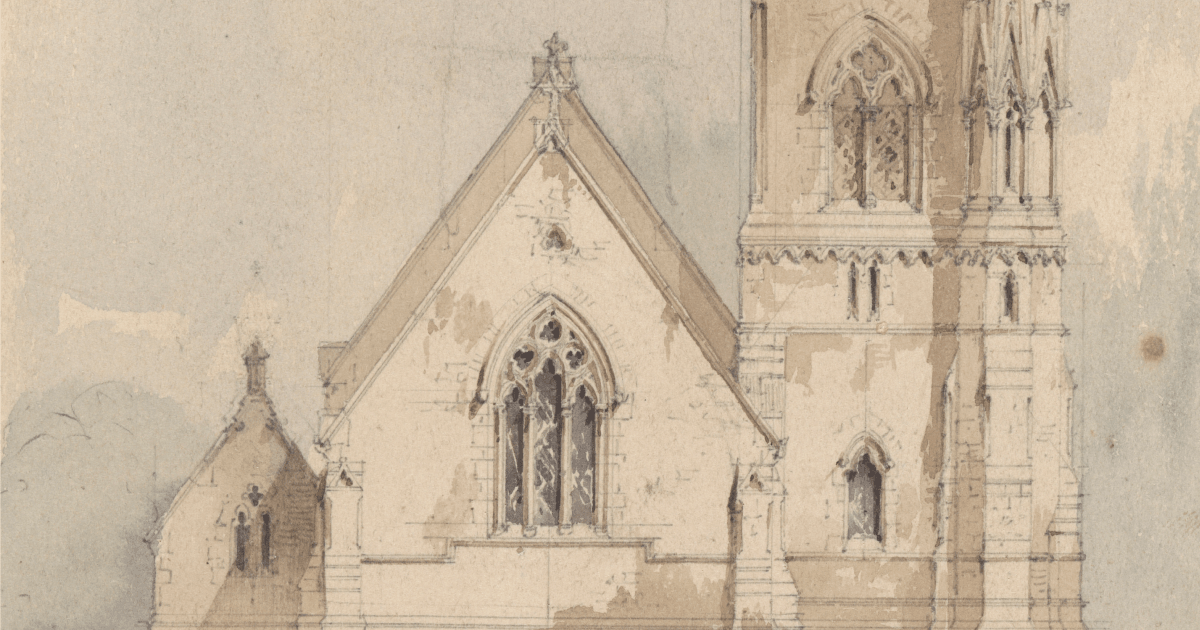
St Thomas of Canterbury, Canterbury (1874–5). The church is an exercise in High Gothic style in Kentish ragstone, much in the manner of WE Pugin. The architect was in fact a local man, John Green Hall. He was not a Catholic and the design for the altar and the Lady Chapel seems to have been entrusted to EA Purdie. A statue of St Thomas of Canterbury adorns the west front. The church was opened in 1875 with Cardinal Manning preaching. In the early 1960s a large new, rather hideous addition was built on the north side of the church. The sanctuary was reordered in 1989. (Kent has other churches dedicated to St Thomas of Canterbury at Deal, Rainham and Sevenoaks).

St Thomas of Canterbury, Wroxton, Oxfordshire (1887). This small thatched church was founded by the convert Lord North. It was much remodelled in 1948. It has a good collection of Victorian stained glass by Alexander Gibbs and others.

St Thomas of Canterbury and the English Martyrs, St Leonards-on-Sea, East Sussex (1889). The architect again was Charles Alban Buckler. The austere Early English exterior hides a richly painted and decorated interior by Nathaniel Westlake in the early 20th century.

Other Catholic churches dedicated in whole or in part to St Thomas of Canterbury include ones in Fairford (1845), Wolsingham (1854), Preston (1863–7), Waterloo (1877), Harrow (1894), Woodford (1895–6) and Goole (1912).

The Cathedral of Our Lady and St Thomas of Canterbury, Northampton was completed in 1864.

On 7 July 2025, the Feast of the Translation of the Relics of St Thomas of Canterbury, the Apostolic Nuncio Archbishop Miguel Maury Buendia, celebrated a Catholic Mass at the high altar of Canterbury Cathedral for the first time since the Reformation. He was fortunately spared the sight of the graffiti transfers more recently inserted by the Dean and Chapter in the building...

The Feast Day of St Thomas of Canterbury is celebrated on 29 December each year, between Christmas and the New Year, following St Stephen on the 26th, St John the Evangelist on the 27th and the Holy Innocents on the 28th. (The latter happens to be my birthday and I am often distressed that Athelstan Riley’s translation of Salvete flores martyrum by Aurelius Prudentius (348–413) is not more widely sung: “All hail, ye little martyr flowers, sweet roses built in dawning hours”)

St Thomas à Becket was born in either 1119 or 1120 of Norman descent at Cheapside in the City of London on 21 December, the then Feast Day of St Thomas the Apostle. His father had been a successful merchant and Sheriff of the City of London. Becket was educated initially at Merton Priory in Surrey and later a grammar school in London. In due course he acquired a position in the household of Theobald of Bec, the Archbishop of Canterbury, who sent him on various missions to Rome and also to study canon law in Auxerre and Bologna. In 1154, although not a priest, he became Archdeacon of Canterbury. A year later he was appointed Lord Chancellor and enforced the traditional sources of revenue including those from the Church.

In 1162 he was ordained priest on 2 June and consecrated as Archbishop of Canterbury the following day. He resigned the chancellorship, became an ascetic (wearing a hair shirt) and a devoted defender of the rights of the Church. In 1164 he went into self-exile fleeing the wrath of King Henry II, spending two years at the Cistercian abbey of Pontigny, and then living in Sens.

In 1170, after papal intervention, he returned to England but soon fell again with Henry II who is supposed to have uttered the words, “will no one rid me of this turbulent priest?” Four knights obliged him and murdered Becket in Canterbury Cathedral on 29 December of that year.

Europe was horrified and the faithful rapidly began venerating Becket as a martyr. On 21 February 1173 he was canonised as a saint by Pope Alexander III. The cult spread rapidly: The Church of St Thomas Cantuariense in Salamanca was built as early as 1175.
In 1220, the bones of St Thomas were translated from the crypt of Canterbury Cathedral to a new shrine in the Trinity Chapel. This became a major pilgrimage centre, to be ranked on a level with Jerusalem and Compostela by the Catholic faithful of Europe. Geoffrey Chaucer in the prologue to his Canterbury Tales wrote: “Of Engelonde to Caunterbury they wende, the hooly blisful martir for to seeke.” The shrine became decorated with gold and magnificent jewels.

Henry VIII paid a personal detestation of Becket, confiscated for defying royal authority, and in 1538 destroyed the shrine. The bones of the martyr were burnt. He ordered that all mention of the name of St Thomas of Canterbury should be eliminated.

Some 69 Anglican churches are now dedicated to St Thomas of Canterbury. Many of these are of Victorian foundation but the medieval ones most seem to have dropped the “of Canterbury” at the Reformation and then later re-adopted the name. The Anglican Cathedral of Portsmouth became the Church of St Thomas the Apostle at the Reformation but on being raised to cathedral status in 1927 was dedicated to both saints.

Some 100 relics of St Thomas of Canterbury have survived. The Catholic Church of St Thomas of Canterbury, Canterbury has a finger, formerly at Gubbio. Southwark Catholic Cathedral has a relic in a splendid reliquary designed by AWN Pugin. Stonyhurst has part of his skull. A fragment of his arm can be found at Esztergom in Hungary.

A fair number of Catholic churches have been dedicated to St Thomas of Canterbury since the Second Catholic Relief Act in 1791, which, inter alia, allowed Catholic churches to be detached buildings. These include the following:

St Thomas of Canterbury, Newport, Isle of Wight (1791). Mrs Elizabeth Heneage was quick off the mark. She paid for the church, which has the external appearance of a Methodist chapel, being a single rectangle with a pedimented gable on the street and a handsome white Tuscan porch with columns. The charming interior has galleries, supported by green composite columns with box pews. The sanctuary is a shallow recess with a baldachino. She built another church at Cowes, a similar Georgian chapel but altered by the Victorians. This was originally dedicated to the Holy Trinity but the dedication was changed to St Thomas of Canterbury when an Anglican church in Cowes dedicated to the Holy Trinity was opened in 1832.

St Thomas of Canterbury, Rylston, Fulham, London (1847–8). This is AWN Pugin's only complete parish church in London, in his favourite "Middle Pointed" style. There is glass by Hardman designed by Pugin and much carving designed by the latter. A major scheme of reordering and redecoration completed in 2010 undid much of the harm caused by an earlier reordering in the 1970s. Rich stencil decoration in the manner of Pugin has been reinstated, as has an encaustic tile pavement in the sanctuary.

St Thomas of Canterbury, Exton Hall, Rutland (1857–65). The chapel was built by Charles Alban Buckler for the Oxford Movement convert Viscount Campden (subsequently 2nd Earl of Gainsborough). It has tall geometric tracery. A private tribune leads to the house for the benefit of the Noel family. The high altar is by Earp, and there is interesting stained glass.

St Thomas of Canterbury, Canterbury (1874–5). The church is an exercise in High Gothic style in Kentish ragstone, much in the manner of WE Pugin. The architect was in fact a local man, John Green Hall. He was not a Catholic and the design for the altar and the Lady Chapel seems to have been entrusted to EA Purdie. A statue of St Thomas of Canterbury adorns the west front. The church was opened in 1875 with Cardinal Manning preaching. In the early 1960s a large new, rather hideous addition was built on the north side of the church. The sanctuary was reordered in 1989. (Kent has other churches dedicated to St Thomas of Canterbury at Deal, Rainham and Sevenoaks).

St Thomas of Canterbury, Wroxton, Oxfordshire (1887). This small thatched church was founded by the convert Lord North. It was much remodelled in 1948. It has a good collection of Victorian stained glass by Alexander Gibbs and others.

St Thomas of Canterbury and the English Martyrs, St Leonards-on-Sea, East Sussex (1889). The architect again was Charles Alban Buckler. The austere Early English exterior hides a richly painted and decorated interior by Nathaniel Westlake in the early 20th century.

Other Catholic churches dedicated in whole or in part to St Thomas of Canterbury include ones in Fairford (1845), Wolsingham (1854), Preston (1863–7), Waterloo (1877), Harrow (1894), Woodford (1895–6) and Goole (1912).

The Cathedral of Our Lady and St Thomas of Canterbury, Northampton was completed in 1864.

On 7 July 2025, the Feast of the Translation of the Relics of St Thomas of Canterbury, the Apostolic Nuncio Archbishop Miguel Maury Buendia, celebrated a Catholic Mass at the high altar of Canterbury Cathedral for the first time since the Reformation. He was fortunately spared the sight of the graffiti transfers more recently inserted by the Dean and Chapter in the building...

subscribe to
the catholic herald

Continue reading your article with a subscription.
Read 5 articles with our free plan.
Subscribe

subscribe to the catholic herald today

Our best content is exclusively available to our subscribers. Subscribe today and gain instant access to expert analysis, in-depth articles, and thought-provoking insights—anytime, anywhere. Don’t miss out on the conversations that matter most.
Subscribe