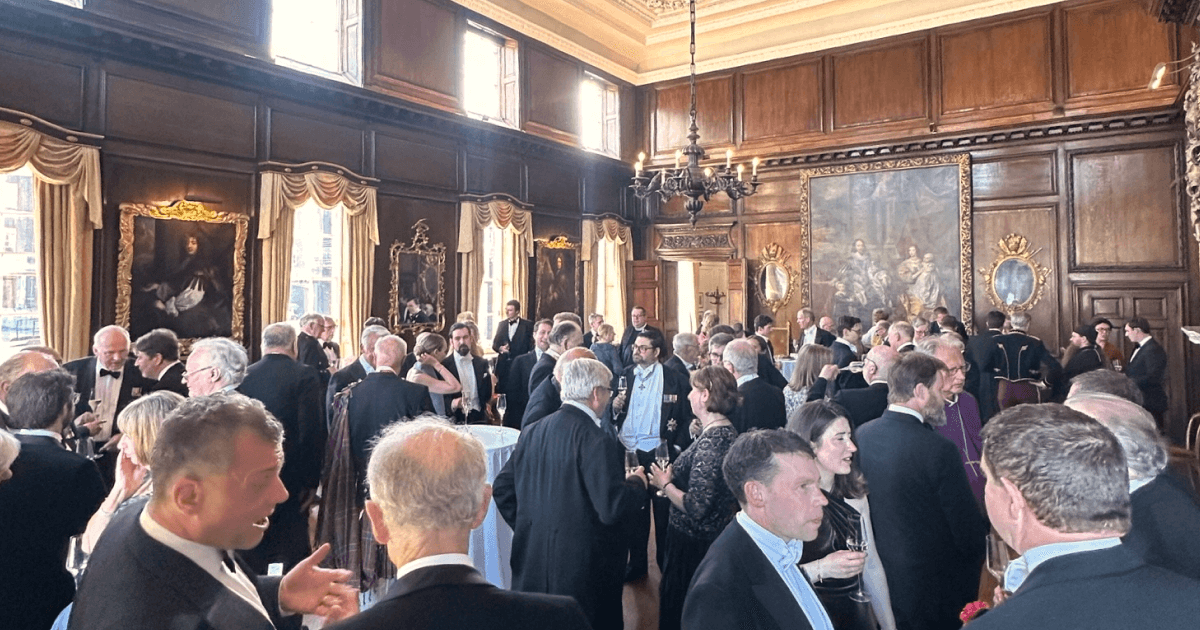


There can be few countries where people still feel an attachment to a dynasty which ceased to reign in 1714, but that is the guiding spirit of the Royal Stuart Society that held its Centenary Dinner in the hall of the Royal Hospital, Chelsea, on May 29, 2026. Even more awkward for the Society’s cause is the fact that the Stuarts themselves died out in 1807, and the notional heir to their claim (as against the Act of Settlement, which in defiance of legitimate succession excluded Catholics from the throne) is Franz, Duke of Bavaria, who at the age of 93 is not planning any dynastic challenge to King Charles III.
Nor were any subversive plots hatched over dinner on Friday night, even if we had been in a fit state to execute them by the time the port arrived. The inspiration of Jacobites nowadays is monarchist principle rather than advocacy of an exiled line. The after-dinner speeches included a tribute to the late Governor-General of the Society, the 14th Duke of St Albans, who was a lineal descendant of Charles II and Nell Gwynn. Among those present was the Prince of Stolberg-Stolberg, a descendant of the family of Louise of Stolberg, who in 1771 became the wife of Bonnie Prince Charlie and thus, for Jacobites, Queen of England, Scotland and Ireland. One of the Vice-Presidents of the Society is Lady Antonia Fraser.
I confess that I came to the Society’s dinner as an outsider, being myself rather a tenuous Jacobite. I can claim as a direct ancestor Robert Gillow, who was living as an ordinary Catholic in Lancashire in 1715 and felt, when the Jacobite Rising occurred, that it was his duty to fight for his legitimate king. He was taken prisoner at the Battle of Preston and immured in Lancaster Castle, where he died after two years’ captivity. On the whole, however, English Catholics were not the mainstay of the Jacobite movement. They had enough trouble keeping their heads down under religious persecution without espousing a risky political cause. The active Jacobites were drawn more from the Scots, loyal to their native dynasty, and in England from High Church Tories, whose doctrine of Divine Right would not allow them to accept the Whig Revolution.

One could say that the Old Chevalier, James III, was the rightful king officially recognised by the English Catholics during his lifetime, for he was allowed by the Pope the right of appointing England’s four missionary bishops, and he was duly prayed for in their clandestine chapels. But the right of appointment lapsed on his death in 1766. In 1778, under the pressure of the American War of Independence, Parliament granted the first measure of Catholic Relief from the oppressive penal laws, and Bishop Challoner of the London District suggested that Catholics should in gratitude begin to pray for George III, thus making the Catholic flock officially Hanoverian.
I imagine that few modern-day Jacobites, even if Catholics, feel a great attachment to James II, who lost his throne by political bone-headedness. They are not even likely to approve his personal idea of kingship, which was the absolutism of his mentor Louis XIV, a kind of hereditary Führerprinzip. The reason for deploring the Revolution of 1688 is that it introduced the rule of systems instead of traditional institutions, and, worse still, the rule of classes hiding behind systems. It ushered in government by an oligarchic Parliament whose claim to represent the English people was only exploded a century and a half later. By then the myth that 1688 represented the victory of popular rule was too ingrained to be killed off. When conservatives in 1832 defended the merits of the unreformed Parliament, they argued that key elements of the British Constitution, including the transfer of the royal succession to the House of Hanover, had only passed into law through the votes of the pocket boroughs. Yet that does not stop people from assuming that the House of Stuart was thrown out by the people of England, when it is the opposite of the truth.
Jacobitism today is the declaration of a Catholic philosophy which rejects the dominance of artificial systems of government and instead looks to traditional institutions. It goes with a preference for a society that grows and is not manufactured, for the natural hierarchy of life over capitalist strata, for parchments of nobility over celluloid celebrity. It can rightly be seen as a nostalgia for an older civilisation, and is not to be condemned for that reason.

.png)

.png)
.png)
.png)
.png)