




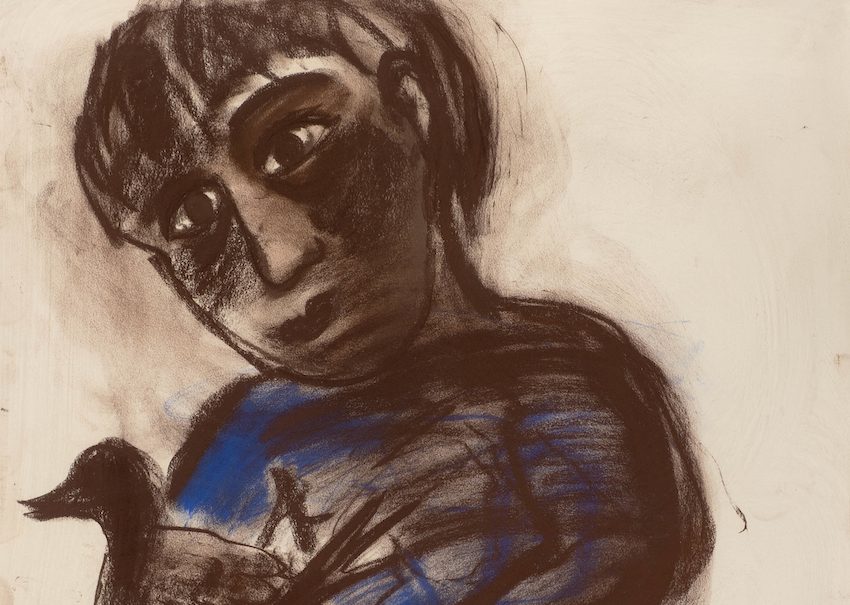
Hide and Seek Drawings by Eileen Cooper RA Royal Academy, until August 23 You can practically hear the Saturday crowd whisper, “My daughter did a picture just like this last week, I’ve got it up on the fridge.” Eileen Cooper is the first female Keeper of the Royal Academy, which is about as prestigious as it gets. Looking at a new exhibition of her drawings, however, it can be hard to see what all the fuss is about. Her figures are naïve, with thick black charcoal outlines and strange proportions. The heads are almost always too big for the bodies, and the bodies have a disconcerting lack of ligaments. They contort themselves into impossible shapes, as if they were made from rubber. As for Cooper’s use of perspective? Plain wrong. In one of her pencil drawings it looks as though she has really tried to get it right, too. An artist’s desk recedes into the picture plane, but as it does so it tilts clumsily towards us. If this were a study from life, it would be wholly unconvincing. So why is Cooper so acclaimed? It’s down partly to artistic intention, partly to the idea that you need to know the rules in order to break them. Cooper’s methods of rule-breaking transform her drawings from amateur sketches to inspiring, finished forms. In Jump, for example, a pastel and gouache drawing on Japanese paper of a naked man leaping over a naked woman, she bends space so that it fits around her subjects. This pushes them to the fore. The viewer, meanwhile, looking up at them from ground level, is forced into an uncomfortable face-off with the woman as she scoops to gather a plant from the soil. The effect is one of primal force. Cooper’s earthy pastels call to mind African art, or more particularly Picasso’s take on African art. “It took me four years to paint like Raphael, but a lifetime to paint like a child,” Picasso once said. Cooper has the same aim, engineering ways to eschew the rudimentary rules of perspective in order to present the earth as though she has only just arrived on it. Her drawings are sometimes described in terms of magical realism, recalling Marc Chagall, but her main themes, womanhood, childbearing, movement and dance, are more primeval than otherworldly. Although Cooper works from her imagination rather than life, her pictures make strong allusions to the life cycle. A highlight of this small show, which occupies the two rooms opposite the Summer Exhibition space, is Boy with Bird. It is sensitive and full of life, a flash of blue emanating through the thick layers of black charcoal and focusing the eye on the child’s arms. Wide-eyed, pensive, he nurtures the lively bird, fearful of the moment it will take flight. This article first appeared in the latest edition of the Catholic Herald magazine (19/6/15). Take up our special subscription offer – 12 issues currently available for just £12!
11:00 AM
Art review: Naïve artist who knows how to break the rules
It can be hard to see what the fuss about Eileen Cooper is all about
Daisy Dunn

3 min read



Already a subscriber? Sign in
5freearticles every month
Continue reading with a free account. No card needed.
- Five free articles every thirty days, on any device you sign in on
- The Catholic Herald newsletter, every morning
- Subscribe whenever you like for everything: every article and the magazine
Related articles
 Newsroom
Church leaders urge Drumcree dialogue: ‘Too much is at stake’
The Catholic and Church of Ireland Archbishops of Armagh have urged a renewed commitment to peace and reconciliation amid the Drumcree stand-off
Corrie Douglas-Young Newsroom
Thousands of Irish children to join global Rosary campaign
Corrie Douglas-Young Newsroom
TikTok priest urges young people to stand with persecuted Christians
Nathalie Raffray Newsroom
Baby born at 25 weeks reunites with neonatologist two years after leaving hospital
The Catholic Herald Newsroom
Joe Biden honoured by Planned Parenthood after defending abortion rights
Christine Rousselle
subscribe to the catholic herald today
Our best content is exclusively available to our subscribers. Subscribe today and gain instant access to expert analysis, in-depth articles, and thought-provoking insights—anytime, anywhere. Don’t miss out on the conversations that matter most.
Subscribe



