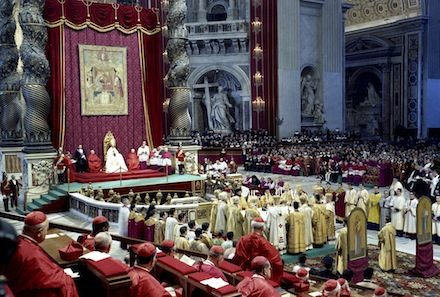




It is inevitable that the 60th anniversary of the Second Vatican Council this year has attracted less interest and controversy than the 50th. As the generation that participated in the Council has passed away (Pope Emeritus Benedict being a welcome exception), the sense of what the Council actually entailed is diminishing.
For many Catholics of a conservative bent, the Council meant above all the introduction of Mass in the vernacular and the loss of a sense of reverence in the liturgy that has not been recovered. But it was, of course, a much larger undertaking: an ecumenical council that addressed the place of the Church in the scheme of salvation; the Church’s relationship with non-Catholics, Jews and unbelievers; familiarity with holy scripture; and the place of the Church in a rapidly changing world. For the world the Council engaged with was both more volatile (the threat of nuclear war was more immediate then) and more stable (in its understanding of human relations) than our own.