
July 6, 2026

‘Backrooms’ and the horror of postmodernism

David Hahn
More
Related
Min read
share

On Monday evening I went to the cinema with my brother-in-law to watch Backrooms. There has been a great deal of buzz around the film, and although indie horror is not normally my genre, I can honestly say it was excellent. Whether intentionally or not, Backrooms serves as a devastating critique of postmodern storytelling. It captures the terror of a world emptied of meaning, and the kind of soul enchanted and seduced by such a horror. (If you would like to watch this film, please be advised that spoilers follow.)

One criterion of good art, of beautiful art, is that it must contain the truth. This truth does not ultimately depend upon the director’s intention; sometimes it emerges despite it, as truth cannot help but manifest itself wherever nature is accurately depicted by art. JRR Tolkien once wrote that he strongly disliked allegory – a one-to-one representation of truth – in favour of applicability, as in the case of history, real or feigned. Backrooms may not have been intended as a criticism of postmodern storytelling, but it lends itself remarkably well to such an application.

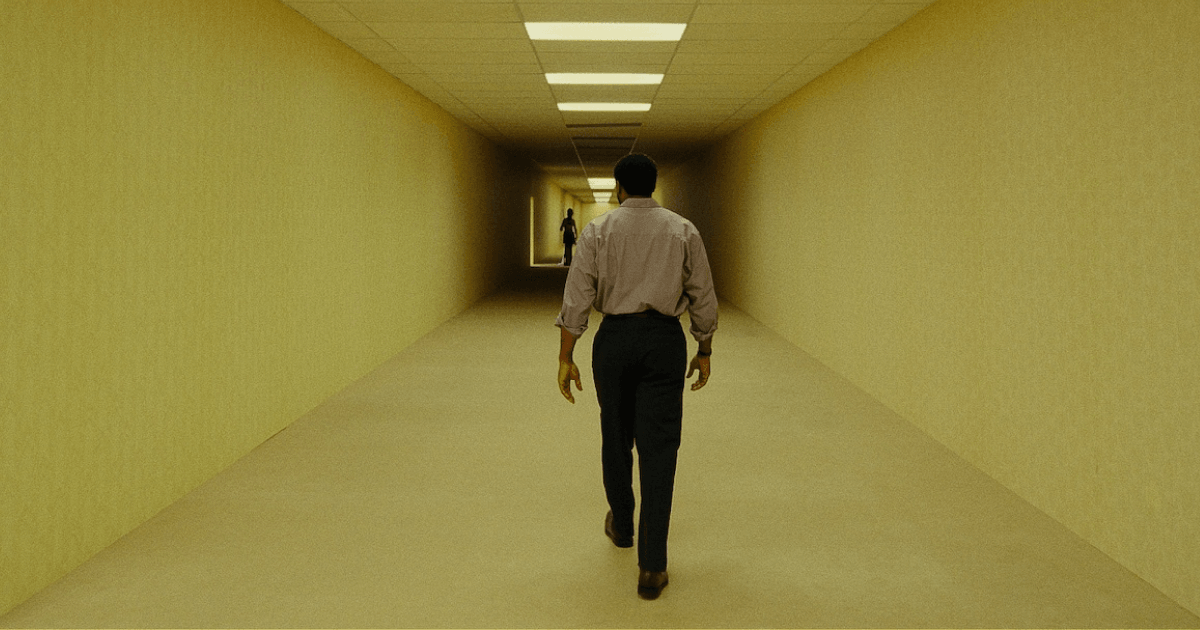
We are introduced to the main character, Clark – a trained architect who owns a floundering furniture store where he effectively lives following the collapse of his marriage. He seeks help from a psychiatrist, Dr Mary Kline, with little success. One night, while investigating a power issue, Clark stumbles across a doorway into the titular Backrooms – a never-ending series of faded, monochromatic yellow wallpaper, scattered furniture, stained carpeting, drop-tile ceilings and the constant, monotonous hum of buzzing fluorescent lights.

His architectural instincts are immediately fascinated by the sheer irrationality of the place, and he begins mapping and exploring it despite mounting evidence that something deadly inhabits it. Clark rashly involves two young employees who never return. In the end, Clark succumbs to his own inner darkness and intentionally lures his psychiatrist, Dr Kline, into the Backrooms. Clark is destroyed by the monster, which we learn bears a grotesque resemblance to him. Dr Kline is left to flee the monster and attempt her escape.

On the surface, this appears to be little more than a conventional monster film, but beneath it lies a striking critique of postmodernism and the person who takes refuge in it. In one of Clark’s therapy sessions, he tells Dr Kline that he is simply the kind of man “who is better off alone.” Yet when a simple role-playing exercise provokes an explosive reaction, Clark reveals himself to be a man wallowing in anger and self-pity, unwilling to take responsibility for his own defective character.

There is at least an attempt at self-examination. Yet his stubbornness betrays his pride – he refuses to admit fault. So long as he refuses repentance, healing remains impossible. It is shortly after this that he discovers the Backrooms. After a failed attempt to share his discovery with Dr Kline, he disappears into them, never to return.

Clark is a soul who cannot face reality, especially the reality of his own inner life and moral failure. Rather than confront reality, he escapes into the Backrooms. As Christ says in John 3:19: “The light has come into the world, and men loved darkness rather than light, because their deeds were evil.”

In a similar way, postmodern philosophy often turns to deconstruction in an attempt to free itself from fixed meaning, objective truth and moral clarity, often reducing stories to endlessly shifting interpretations rather than vehicles of truth. Like each successive level of the Backrooms, every narrative becomes increasingly unstable – what Clark calls “misremembered”. Rather than illuminating reality, postmodernism destabilises meaning itself.

Evil rarely remains private. The darkness of sin seeks company. Likewise, postmodernism was never content merely to doubt philosophical realism; it sought to replace it altogether. Clark cannot keep the Backrooms to himself. He must draw Dr Kline into them as well.

There is a deeper truth in this film: it not only depicts the horror of a world emptied of purpose and structure, but also how the heart that prefers darkness ultimately embraces the false self. Self-acceptance apart from truth becomes self-annihilation. What Clark embraces is not his authentic self, but a monster bearing his own likeness.

The film, sadly, does not go on to promote a full return to philosophical realism. Like Dr Kline, the audience longs simply to return to ordinary reality. The experience leaves us wanting to return to a world where things make sense. Even Dr Kline’s escape is only partial, since all of her rescuers care about is learning “a little bit more” about the Backrooms so that they can finally “figure it out”, convinced that this is “the greatest thing in human history”. Postmodern deconstruction ultimately destroys not only stories and selves, but confidence in reason itself and therefore the pursuit of wisdom.

Backrooms is an excellent film, not because this meaning is necessarily what its creators intended, but because art cannot help revealing truth whenever it faithfully imitates nature. While I believe the film can be read as a critique of postmodernism, I do not think it fully prepares the heart to seek the truth. Instead, like Dr Kline, the audience simply longs to escape and return to reality.

Christianity answers the Backrooms not by offering another abstraction, but by insisting that ultimate reality became flesh. The Christian does not escape the world in order to find God; he discovers that God entered the world to redeem it. Catholicism has always been the safeguard of the real world because ours is an incarnate religion, founded upon an incarnate God.

It may be that the rejection of postmodernism will simply lead many towards hedonism and ever smaller satisfactions. Or perhaps the exhaustion produced by postmodernism will once again dispose men towards philosophy – and ultimately towards Christ, who is Truth made flesh, the meaning of the world, and the only true escape from sin rather than from reality.

Continue reading with a free account

Create a free account to read up to five articles each month
Create free account

You have # free articles remaining this month.

Subscribe to get unlimited access.
Sign up

subscribe to the catholic herald today

Our best content is exclusively available to our subscribers. Subscribe today and gain instant access to expert analysis, in-depth articles, and thought-provoking insights—anytime, anywhere. Don’t miss out on the conversations that matter most.
Subscribe