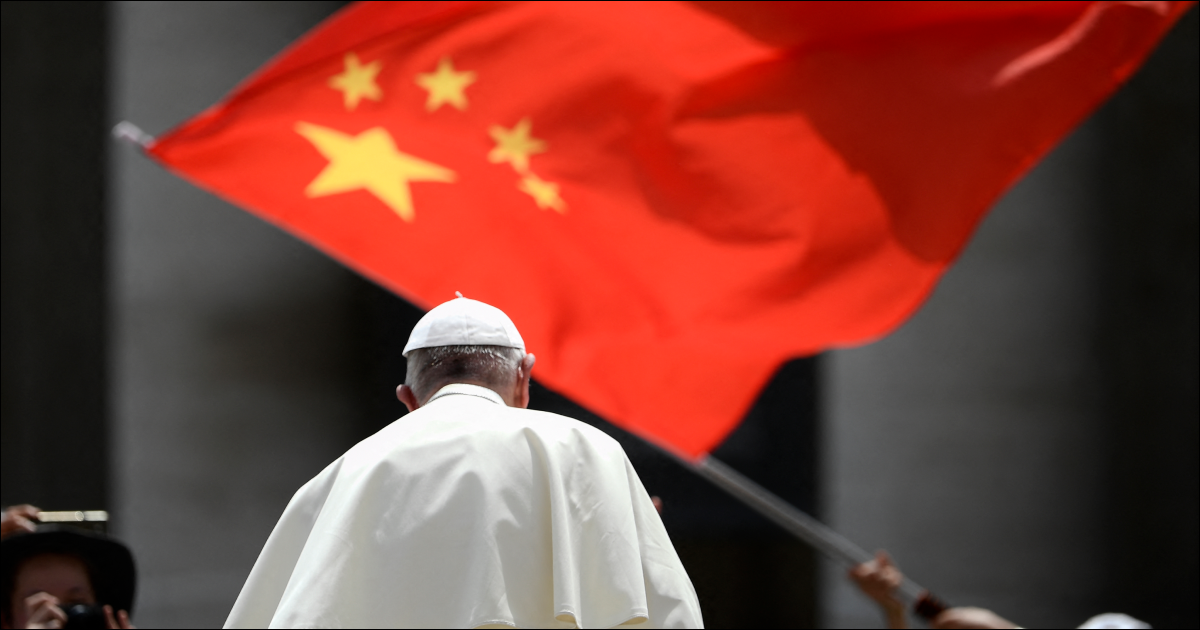


Baroness Nuala O’Loan has said that the Vatican’s deal with China, which gives its Government a role in the selection of bishops via a state-run organisation, has emboldened the Chinese Communist Party (CCP) “in its attempts to control, limit, even destroy Catholicism”.
Writing for the Irish Catholic, O’Loan cited Human Rights Watch’s April report that clergy are subjected to intense political or ideological training, and are required to pledge loyalty to the Communist Party in order to minister.
O’Loan, who was appointed to the House of Lords in 2009, wrote: “There is state control over religious materials; priests’ homilies and teaching must be approved by the CCP. In some areas Mass times have been changed, to make it difficult for people to attend. Children may not enter churches at all.”
“Every aspect of religious life is regulated,” she wrote, including requiring state identification before people can belong to the Church. Churches are forbidden from naming parishes after sects or personal names and priests cannot leave the country without permission from the Communist Party.
She stated that a series of laws adopted by the Chinese Communist Party to regulate religious groups were intended to “Control the Catholic Church in China and, in many situations, to regulate it so that Catholicism will inevitably diminish, and communism will flourish”.
The agreement between the Holy See and the Chinese government was signed in September 2018, though its contents have not yet been made public. However, it is understood to give a leading role to the state-approved Chinese Catholic Patriotic Association (CCPA) church in the appointment of bishops. It is also believed to nominally give the Pope a right to veto episcopal candidates, though it is seldom exercised.
The CCPA supports the policy of Sinicisation, which Chinese President Xi Jinping described as the process of all religious communities being led, controlled, and supported by the Chinese Communist Party.
O’Loan called for the Holy See to review the experiences of Catholics in China “and of the extent to which Catholic dogma and doctrine is being replaced by CCP ideology in the Chinese Catholic Patriotic Association”.
“The 2018 Agreement seems to have emboldened the CCP in its attempts to control, limit, even destroy Catholicism. It does not seem to have benefited the Catholic Church in China at all, rather it has empowered the CCP.”
In July, another bishop was consecrated under the terms of the Sino-Vatican deal with Papal approval. Bishop Joseph Chang Yanfeng, who was the director of the CCPA of Chifeng City, was appointed to the Diocese of Chifeng, which the Vatican said was “within the framework of the Provisional Agreement between the Holy See and the People’s Republic of China”.
However, the CCPA did not mention the Holy See’s involvement but only the Chinese Government’s approval. China’s state-approved religious bodies do not recognise the primacy of the Vatican.
Later that month, Father Francis Xavier Duan Yongkun was consecrated for the Diocese of Bameng, serving as coadjutor. He now has the right of succession to Bishop Matthias Du Jiang who was consecrated in secret for the Underground Church in 2004. Both of the previously appointed bishops are among the youngest in the Catholic Church, meaning that their tenure will likely secure the CCPA’s leadership in their respective dioceses for decades to come.
The deal has come under repeated criticism since its introduction as members of the underground Catholic Church, which does not have state approval, and commentators warned that it would see the takeover of Catholicism by the Chinese Government. Members of the underground Church face harsh persecution, including imprisonment and being disappeared.
In her article, O’Loan referenced the suspicious death of Fr Yu Heping, whose body was found in a river in 2015 and ruled a suicide by the Chinese authorities. Members of the Underground Church, as well as his family, disputed the ruling.
Cardinal Joseph Zen, Bishop Emeritus of Hong Kong, following the death of Fr Yu questioned why the authorities would not open an investigation, stating that he believed “they are hiding something”.
He said: "The authorities claimed Father Yu had committed suicide. If his family does not sign the official documents, agreeing on the conclusion, they cannot get back his body," the cardinal said.
One member of the priest’s relatives relented and his ashes were returned to the family.