




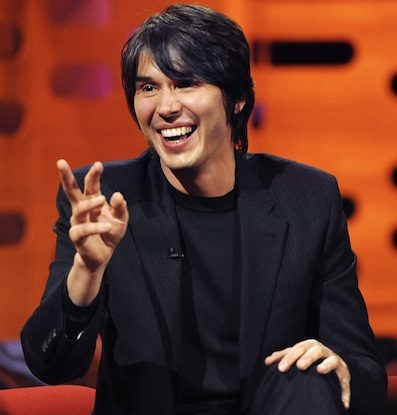
I have just been reading Professor Steven Pinker’s new book: The Sense of Style - a new manual on the rules for good writing. Early on he quotes the opening lines of Richard Dawkins’s book, Unweaving the Rainbow, making the comment that “In the opening lines ... the uncompromising atheist and tireless advocate of science explains why his worldview does not, as the romantic and the religious fear, extinguish a sense of wonder or an appreciation of life.” These opening lines (which an atheist scientist friend once quoted to me with approval), run: “We are all going to die, and that makes us the lucky ones. Most people are never going to die because they are never going to be born. The potential people who could have been here in my place who will in fact never see the light of day outnumber the sand grains of Arabia. Certainly those unborn ghosts include greater poets than Keats, scientists greater than Newton...” They set me thinking – along slightly different lines from Pinker (like Dawkins, an atheist and scientist) who approves of the passage for merely stylistic reasons. As a Christian I am not as shocked as Pinker by the assertion that we are all going to die or that, paradoxically, this makes us “lucky”. If you see life as a journey towards the infinite source of life and love – God – death, though to be feared from a human perspective, does not hold the terrors that unbelievers imagine. Indeed, if you die in the peace of Christ, you might look forward to it. Another thought that occurred is that Dawkins, back in August, told a woman on Twitter that it would be "immoral" to not have an abortion if she knew the baby she was carrying had Down's syndrome. It makes good eugenic sense, after all; survival of the fittest and all that. But it made me mourn for unborn human life in a way that Dawkins would not have envisaged: for all those aborted babies routinely slaughtered in hospitals and clinics throughout the world, not least in this country, including disabled babies; they too are unlucky not to have the chance of life, and their parents are also unlucky never to come to know and love them. I don’t doubt that Dawkins, looking through a microscope, finds the natural world wonderful in all its beauty and complexity. Speaking as both a romantic and a religious person (how weird is that?), I do too and so do all the other romantic and religious people I know. We don’t think that Dawkins and his ilk lack imagination or an aesthetic sense; we simply wish they would not pontificate on subjects about which they know nothing, for example theology or the numinous. This last thought has been prompted by reading an interview in the Telegraph today with Professor Brian Cox, the physicist. I have never watched him on television but I warm to him for a quality he possesses that Dawkins seems to lack: humility. Cox doesn’t pretend to have the answer to the question of “God”. Indeed, he states that “These things...need novelists and artists and philosophers and theologians and physicists to discuss them.” Although not a believer himself, Cox believes that “There is naivety in just saying there’s no God; it’s b---s. People have thought about this. People like Leibniz and Kant. They’re not idiots. So you’ve got to at least address that.” I agree, and hope that Dawkins will have taken note of his colleague’s comments. I rather wish Cox had mentioned a few other God-fearing thinkers, not just Kant and Leibniz who, I understand, thought about Him in rather abstract, philosophical terms. People, as great in their own way as Keats or Newton: people such as St Augustine or St Thomas Aquinas, or Pascal, or Kierkegaard, or Dostoyevsky, or Dante or Shakespeare (and so on). None of them were idiots either. I suggest Professors Cox and Dawkins should go on a reading holiday together in the Lake District, perhaps with Professor Pinker to advise them on style, with some volumes of profound Christian thinkers and artists in their knapsacks.
7:41 PM
Books blog: Why Brian Cox really needs to read some St Augustine
Unlike Richard Dawkins, the physicist displays a winning humility when discussing God's existence
Francis Phillips

5 min read



Already a subscriber? Sign in
5freearticles every month
Continue reading with a free account. No card needed.
- Five free articles every thirty days, on any device you sign in on
- The Catholic Herald newsletter, every morning
- Subscribe whenever you like for everything: every article and the magazine
Related articles
 Newsroom
Church leaders urge Drumcree dialogue: ‘Too much is at stake’
The Catholic and Church of Ireland Archbishops of Armagh have urged a renewed commitment to peace and reconciliation amid the Drumcree stand-off
Corrie Douglas-Young Newsroom
Thousands of Irish children to join global Rosary campaign
Corrie Douglas-Young Newsroom
TikTok priest urges young people to stand with persecuted Christians
Nathalie Raffray Newsroom
Baby born at 25 weeks reunites with neonatologist two years after leaving hospital
The Catholic Herald Newsroom
Joe Biden honoured by Planned Parenthood after defending abortion rights
Christine Rousselle
subscribe to the catholic herald today
Our best content is exclusively available to our subscribers. Subscribe today and gain instant access to expert analysis, in-depth articles, and thought-provoking insights—anytime, anywhere. Don’t miss out on the conversations that matter most.
Subscribe



