

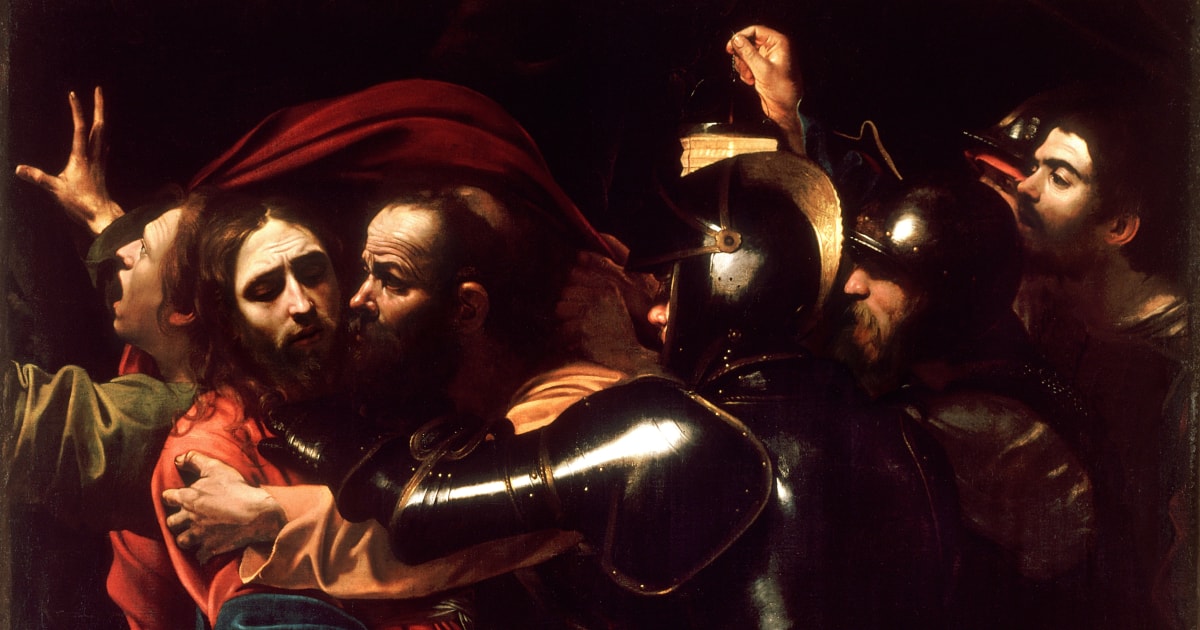
Caravaggio’s Taking of Christ is overshadowed by violence, in its pre-existence: in the life of the artist himself, in its subject matter – the violent arrest of Jesus in the Garden of Gethsemane – and finally in the Irish leg of its history. Already by the time The Taking of Christ was painted in 1602, Caravaggio’s life was overshadowed by his own tempestuous personality: he was a brawler spoiling for fights, something which culminated in a murder four years after the work was painted. This same violent energy marks the painting – three soldiers in full armour, the deceitful Judas seizing Jesus, and St John who flees the scene in horror-filled panic. Strangely enough, it was violence which brought the painting to Ireland and ultimately to the National Gallery. On September 15, 1920, District Inspector Percival Lea-Wilson was shot dead on the streets of Gorey by the IRA. His widow, Dr Marie Lea-Wilson, purchased the painting – then not known to be an original Caravaggio – at an auction in 1924 and apparently found solace in contemplating it, and subsequently gave the painting to the Jesuit Order in the 1930s in gratitude for its support for her after her husband was killed. Only in the 1990s was it found to be a lost Caravaggio.
9:30 AM
Caravaggio's the taking of Christ: a masterpiece shaped by violence
Caravaggio’s The Taking of Christ is shaped by violence: in the life of its creator, in the brutal arrest it depicts, and in the turbulent Irish history through which the painting eventually came to light
Fr Gavan Jennings

4 min read



Already a subscriber? Sign in
5freearticles every month
Continue reading with a free account. No card needed.
- Five free articles every thirty days, on any device you sign in on
- The Catholic Herald newsletter, every morning
- Subscribe whenever you like for everything: every article and the magazine

subscribe to the catholic herald today
Our best content is exclusively available to our subscribers. Subscribe today and gain instant access to expert analysis, in-depth articles, and thought-provoking insights—anytime, anywhere. Don’t miss out on the conversations that matter most.
Subscribe



