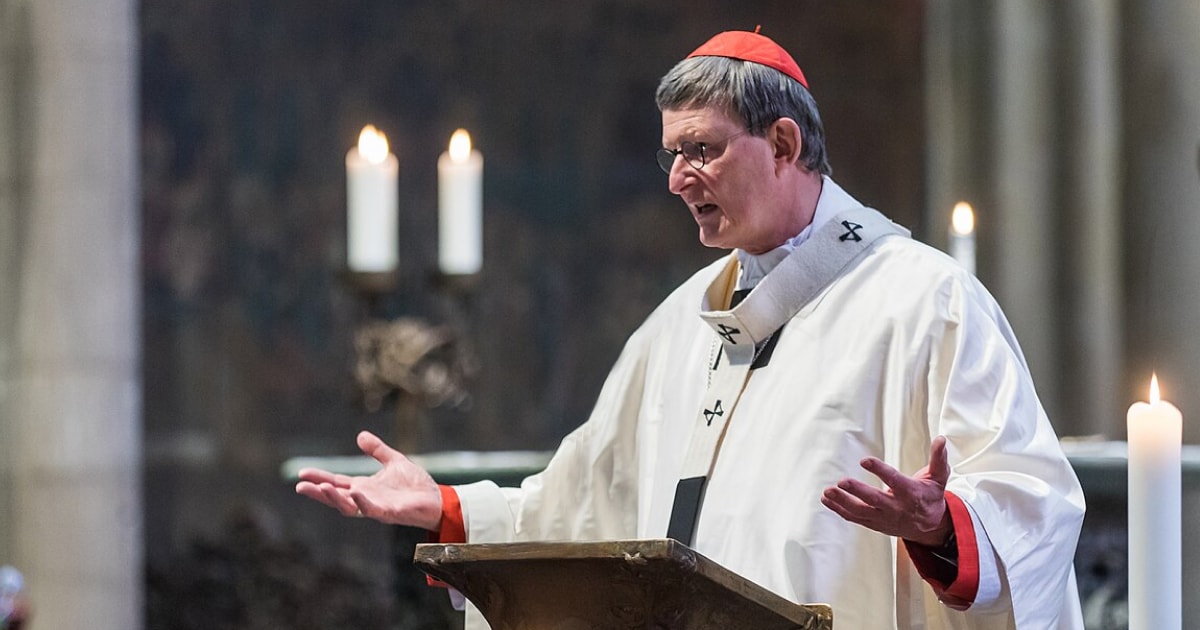
Cardinal Rainer Maria Woelki has said he will not attend the sixth assembly of the German Synodal Way, which begins in Stuttgart this week, stating that for him the process has reached its conclusion.
In an interview with the German outlet Domradio.de, the Archbishop of Cologne said that the Synodal Way had fulfilled the task originally set for it and that the forthcoming meeting, intended to assess how synodal resolutions are being implemented in dioceses, went beyond that mandate. “For me, the Synodal Way has come to an end,” he said, noting that five assemblies had been envisaged and that he had taken part in all of them.
Despite his decision not to attend, the cardinal stressed that he did not doubt the good intentions of those involved. He said that all participants wanted “what is best” for the Church, while adding that genuine dialogue required clarity about shared foundations.
Reflecting on the meaning of synodality, Cardinal Woelki warned against treating every aspect of Church life as open to unlimited debate. “To give a deliberately extreme example: we cannot vote on whether Jesus rose from the dead,” he said. At a certain point, he added, he gained the impression that the process had become focused on advancing particular church-political positions rather than deepening communion in faith.
Cardinal Woelki has previously distanced himself from some of the synod’s resolutions. In 2023, he abstained from voting on a proposal concerning the blessing of same-sex unions, while reiterating his commitment to remain in communion with the universal Church and the Pope.
Asked whether differing positions within the German Church could yet be reconciled, the cardinal said that dialogue remained essential, but only if its basis was clear. That foundation, he said, must include fidelity to the faith and teaching of the Church, unity with the Holy Father and an ecclesiology shaped by the Second Vatican Council, particularly Lumen Gentium. “We need to agree on a common set of values again,” he said.
He extended this concern beyond ecclesial debates to society more broadly, arguing that cohesion depended on shared moral principles. Dialogue instead of violence, reliability, the protection of the weak, solidarity and justice were indispensable, he said, warning that when the “law of the strongest” prevails, human dignity and personal rights are eroded, leading to a brutalised and dehumanised society.
Turning to his own archdiocese, Cardinal Woelki said that elements of the Synodal Path had already been taken up in Cologne, including efforts to strengthen safeguarding, address past failures and promote a more responsible sharing of authority. He described an ongoing process of structural reform aimed at ensuring that the Church’s life and organisation were fit for future generations, not as an end in itself but as a service to mission.
On the question of women in leadership, a recurring theme in German Church debates, Cardinal Woelki said that women already held a significant proportion of senior roles within the Archdiocese of Cologne, with 36 per cent of leadership positions in the vicariate general occupied by women. Promoting women in positions of responsibility was, he said, a practical commitment rather than a slogan.
Cardinal Woelki’s absence from the Stuttgart assembly is indicative of the continuing tensions surrounding the German Synodal Way as it enters a new phase, raising questions about whether the national process can continue to claim ecclesial legitimacy once it moves beyond its original mandate.
The German experiment has become a test case for the universal Church. Developments in Germany are closely watched elsewhere, particularly in progressive Catholic contexts such as parts of South America, but also more broadly, not least because they touch on doctrine, authority and the relationship between local churches and Rome.
As Cardinal Woelki has said, the synodal process in Germany has reached what he regards as its natural end. Five assemblies were envisaged, and five were held. The current meeting, focused on monitoring and enforcing implementation within dioceses, marks a qualitative shift from discussion to governance. This is not the language of rejection, but of limits. Cardinal Woelki has been careful to insist that those involved in the process are acting in good faith and with a desire to serve the Church. Yet he has also warned that synodality cannot mean that everything is permanently open to renegotiation.
Since its launch in 2019, the German Synodal Way has generated increasingly ambitious proposals, some of which sit in clear tension with Catholic teaching and universal discipline. Repeated interventions from Rome have urged caution, reminding German bishops that no national body has the authority to alter doctrine or binding ecclesial norms. Cardinal Woelki is not alone in his unease. Other bishops, including figures such as Bishop Stefan Oster of Passau, have articulated scepticism about the synodal trajectory. Although such bishops remain a minority, their presence complicates the narrative of consensus often presented by synodal advocates.
The global synodal process has clarified that synodality is not a licence for doctrinal innovation. Cardinal Woelki’s refusal to lend his presence to an open-ended continuation of the German project can therefore be read as an act of fidelity rather than defiance. His decision matters because his absence speaks more forcefully than attendance ever could in signalling opposition to certain interpretations of synodality.


.jpg)
.jpg)

.jpg)