

April 10, 2026

Christ’s Jewishness is not up for debate

Georgia L. Gilholy
More
Related
Min read
share

If asked whether Jesus was a Jew, the only response a Christian may offer consists of one word, and a sole syllable: ‘Yes’. Just as no serious theologian or historian would dispute that Jesus did indeed exist on earth, equally, they would not suggest that he was born into any other nation than the Jewish one. Nor would any Catholic familiar with the most basic teachings and practices of our Church argue otherwise.

Various branches of Christianity are never short of things to fiercely contest, but whether or not Jesus was a Jewish man, as well as being fully God, is not up for question. Aside from fringe heresies, 20th-century totalitarianism made the biggest attempt to distort this and many other truths. Heinrich Himmler, one of the key architects of the Holocaust, referred to the early Christians as the forerunners of ‘Bolshevik, Jewish scum’. Adolf Hitler regarded the faith as a ‘symptom of decay’ and wrote in Mein Kampf that the Mosaic Law is ‘nothing else than the doctrine of the preservation of the Jewish race’. The Third Reich even launched the pseudo-Protestant ‘Institute for the Study and Elimination of Jewish Influence on German Church Life’, in an attempt to ‘de-Judaise’ Christianity. This dismal organisation went so far as to distribute editions of the Bible which fully censored the Old Testament and the detailing of Jesus’s Davidic descent.
Now, a crackpot gang of internet celebrities presenting as Christians – and presumably riding the wave of surging anti-Jewish conspiratorialism – appear to be positioning themselves as the heirs to these villains, whether consciously or not.

This recent eruption of the non-controversy of Jesus’s Jewishness came via a podcast conversation between Joel Webbon, founder of Right Response Ministries, and ex-UFC fighter Jake Shields. Neither of these men is a Catholic, but the fact that they are laundering bizarre theories about Our Lord to millions of Christians and non-Christians should be of grave concern to anyone who troubles themselves with truth.

Shields – who boasts over 900,000 followers on X/Twitter – denies that ‘a single Jew died in gas chambers’, and told Webbon: ‘I refuse to say Jesus is Jewish’. Webbon responded: ‘I don’t have a problem with that. It doesn’t matter.’ Shields also suggested that Christians attempt to placate ethnonationalists who dismiss their faith as a ‘Jewish psy-op’ by ‘just’ stating that ‘he [Jesus] is not Jewish’. When Shields noted, ‘I don’t think the Bible ever says Mary is Jewish, does it?’ Webbon weaselly waffled in response: ‘I… um… uh… genealogies are very complicated.’

The effort to infuse this settled matter with non-existent ‘complexities’ is tantamount to either extreme ignorance or moral cowardice. Given that Webbon stylises himself as some kind of ‘pastor’, as dim as he seems, the former explanation still seems unlikely.

What Christian could be unaware of the fact that the entire premise of our belief system is that Jesus is the Jewish messiah born to a Jewish mother and therefore into the Jewish nation, who fulfils Jewish prophecy, and who came to die for all mankind’s sins, Jew and gentile alike?

While I cannot speak for all of my Protestant and Orthodox friends, the Catechism of the Catholic Church – a straightforward summary of the Faith which draws upon scripture, the Church Fathers and our ancient magisterium – is far from vague about this:

‘We believe and confess that Jesus of Nazareth, born a Jew of a daughter of Israel at Bethlehem at the time of King Herod the Great and the emperor Caesar Augustus, by trade a carpenter, who died crucified in Jerusalem…’ It also states: ‘Jesus, Israel’s Messiah and therefore the greatest in the kingdom of heaven, was to fulfil the Law…’

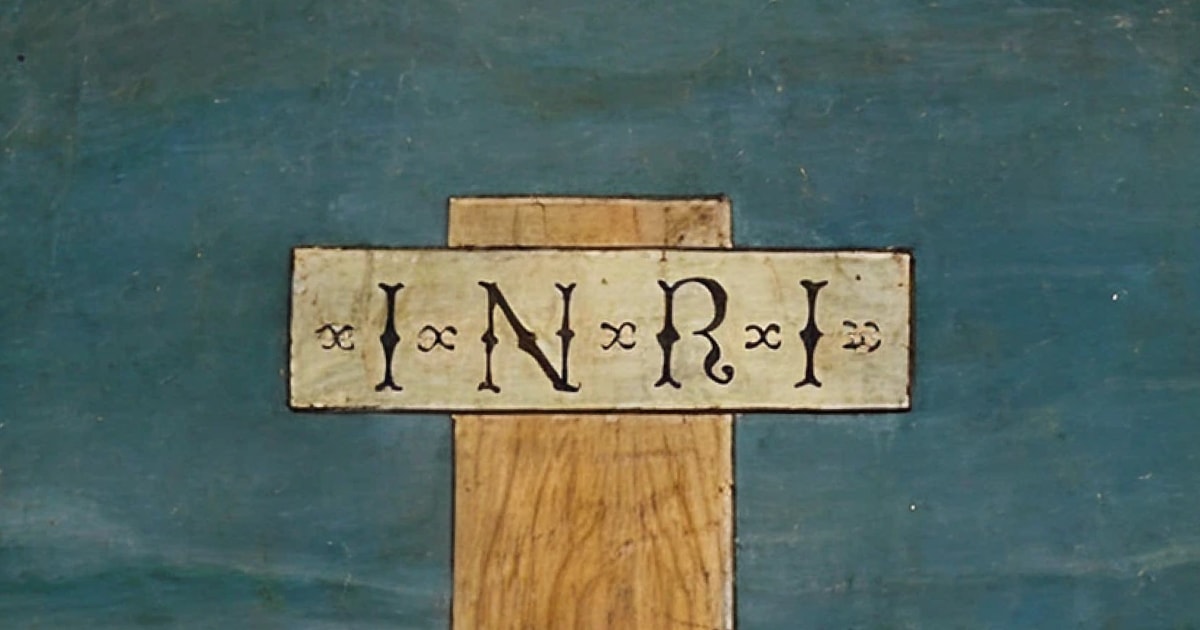
In John’s Gospel, the Samaritan woman explicitly recognises and describes Christ as a Jew. After his Crucifixion, he was buried immediately prior to the Sabbath, according to the Jewish commandments. The placard placed atop the Cross by the Roman authorities, in an attempt to mock Christ’s claim to lead his people, read in Hebrew, Latin and Greek: ‘Jesus the Nazarene, King of the Jews’. The Latin abbreviation ‘INRI’ is visible in countless works of Christian art throughout the ages. So embedded is this motif in Christian life, that one might wander into any unassuming parish church in England and encounter it within seconds.

While some would-be pedants might hit back that Jesus never explicitly identifies himself as ‘King of the Jews’ in the Gospels, we must remember that pre-modern Jews often, but not always, preferred the self-designation ‘Israel’ when speaking or writing to other Jews. The New Testament identification of Jesus, by Jews, as ‘King of Israel’ in both Mark’s and John’s Gospels does not invalidate his Jewishness, even if for much of Church history, Christians viewed themselves as a ‘new Israel’. Plastering today’s assumptions about Jewish identity, and how it is referred to by Jews and non-Jews, onto the 1st century AD is naturally unhelpful.

As Catholics, whenever we pray the Rosary, we must recall Jesus’s participation in Jewish festivals and customs as detailed in the Gospels. When praying the Luminous Mysteries, we reflect on the Institution of the Eucharist at a Passover feast. During the Joyful Mysteries, we are instructed to consider Christ’s Presentation in the Temple in Jerusalem, in which the Christ Child was circumcised, and before which his mother Mary completed her post-childbirth ritual purification, both of which were demanded of Jews under the Mosaic commandments, which non-Jews were not required to follow. And so on.

Does this growing sect of internet contrarians, who often boast of their traditional Christian credentials, simply think the Gospels – which Christians must accept as the Word of God – were mistaken? Or are they, like many a sleazy political operator before them, picking and choosing what aspects of Christianity they deem to be acceptable to their worldly priorities? Or perhaps which aspects will generate them the most social media plaudits?

Of course, we are all sinners, and which one of us has not erred? But this does not mean that sins themselves ought to be beyond criticism. Anyone claiming to publicly confess Christianity while knowingly rejecting Christ’s Jewishness, likely for reasons of ethnic hatred, is not merely guilty of bearing false testimony – a mortal sin – but guilty of doing so against He who we are commanded to place above all else.

In the words of the renowned Yiddish scholar Ruth Wisse, ‘Organising politics against the Jews offers many advantages’, but helping one move closer to truth, justice and therefore God is surely not one of them.

Persons seeking to reshape Christianity narcissistically in their own image as if it were a political programme to be tinkered with will fail. In St Paul’s Letter to the Romans, he asserts: ‘I am not ashamed of the gospel, for it is the power of God for salvation to everyone who believes, to the Jew first and also to the Greek.’ Self-declared Christians who are ashamed to stand by the fact that Jesus Christ was both God and a Jewish man, must be strongly urged to consider the Apostle’s words.

Continue reading with a free account

Create a free account to read up to five articles each month
Create free account

You have # free articles remaining this month.

Subscribe to get unlimited access.
Sign up

subscribe to the catholic herald today

Our best content is exclusively available to our subscribers. Subscribe today and gain instant access to expert analysis, in-depth articles, and thought-provoking insights—anytime, anywhere. Don’t miss out on the conversations that matter most.
Subscribe