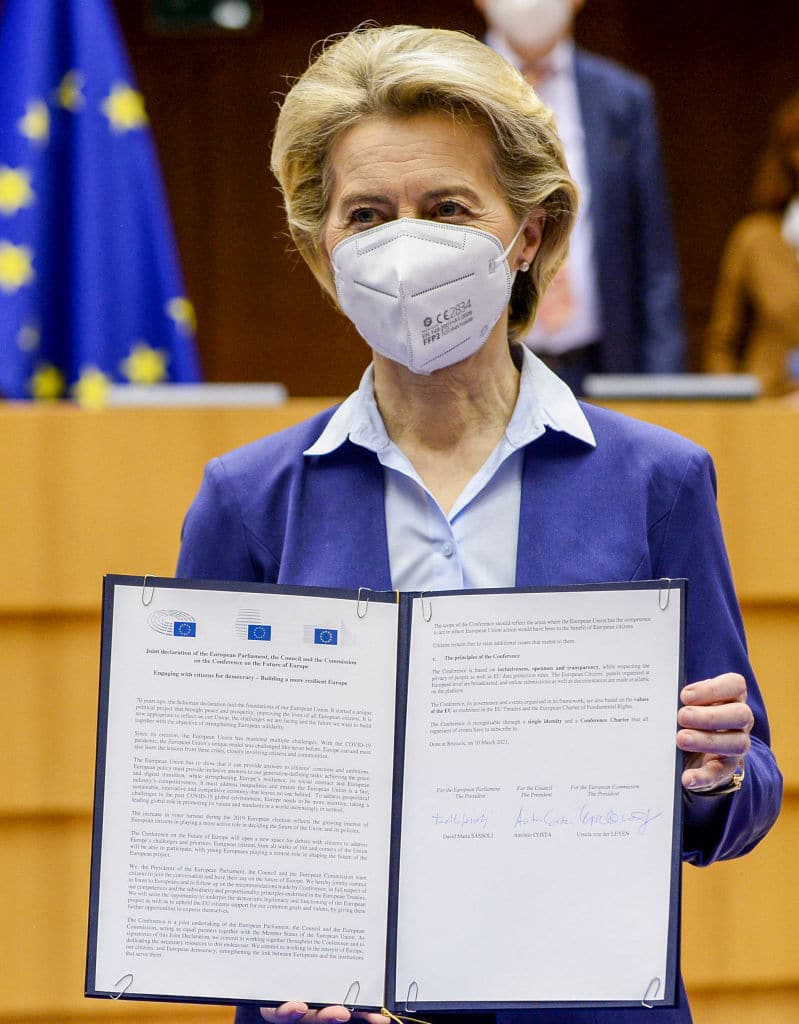



European Commission President Ursula von der Leyen with documents related to a joint declaration on the sidelines of the Conference on the Future of Europe in Brussels on March 10, 2021. (JOHANNA GERON/POOL/AFP via Getty Images)
Europe's bishops are urging an EU body tasked with assessing the challenges and prospects facing the Union and its peoples not to forget the Churches.In a letter dated 8 April and addressed to newly appointed members of the Executive Board of the Conference on the Future of Europe, the Commission of the Bishops’ Conferences of the European Union (COMECE) and the Conference of European Churches (CEC) maintain “Churches have an important message and value to add” to the Conference.
The letter, signed by Fr. Manuel Barrios Prieto and Dr Jørgen Skov Sørensen, respective general secretaries of COMECE and CEC, advocates for “the integration of Churches in the Conference Plenary as distinct key stakeholders,” in accordance with EU agreements concerning Churches and religious associations or communities within the Member States. A joint statement announcing the letter cites Article 17 of the Treaty on the Functioning of the European Union, which states, “Recognising their identity and their specific contribution, the Union shall maintain an open, transparent and regular dialogue with these churches and organisations.”
A press release issued 14 April says COMECE and CEC are “strongly committed to further developing the European project on the basis of the Christian ideals of justice, peace, and the integrity of creation.” It goes on to say that the two organizations “highlighted the need to continuously strengthen our common European values ‘in order to reaffirm commitment to the vision of the EU as a true community of values that contribute to a peaceful, prosperous, free, just, inclusive and sustainable Europe for all’.”
As examples of the contributions Churches can offer the Conference on the Future of Europe, the letter mentions “arranging discussions with special focus on values, sustainability and social justice, particularly involving young people at the regional and national levels.”
COMECE is made up of Bishops delegated by the Catholic Bishops Conferences of the 27 Member States of the European Union, and is charged with monitoring the political process of the European in all areas of interest to the Church. Approximately 44.5% of the 750 million people in the EU are Catholic.
The CEC is a “fellowship” of 114 churches and ecclesial communities representing Orthodox, Protestant and Anglican traditions from all parts of Europe. The group promotes dialogue, advocacy, and joint action to “strengthen common witness, act in service to Europe, and the world, promote peace, and work for the unity of the Church.”