Michelangelo Buonarroti (1475–1564) was a past master in looksmaxxing long before it became a thing for men. All you have to do is look at God’s freshly minted Adam on the ceiling of the Sistine Chapel: look at that jawline, that clear skin and, above all, that bulging musculature. This is the look many of today’s young men seek to maximise through bodybuilding, skincare, dieting, posture training, supplementation or even cosmetic procedures and jawline enhancement. And who can deny that the creature who languidly stretches out his hand to touch the finger of the Father is maximally beautiful?
Well, perhaps the one artist who would deny this is El Greco. After all, it was he who – unsuccessfully – floated the idea that he could paint over Michelangelo’s Last Judgement and produce a much better work. For El Greco, Adam may be ribbed, his skin and jawline perfect, but something is missing: his body is not yet a temple of the Holy Spirit. Where Michelangelo presents the beautiful perfection of created nature, El Greco works to present nature transformed by divine grace.
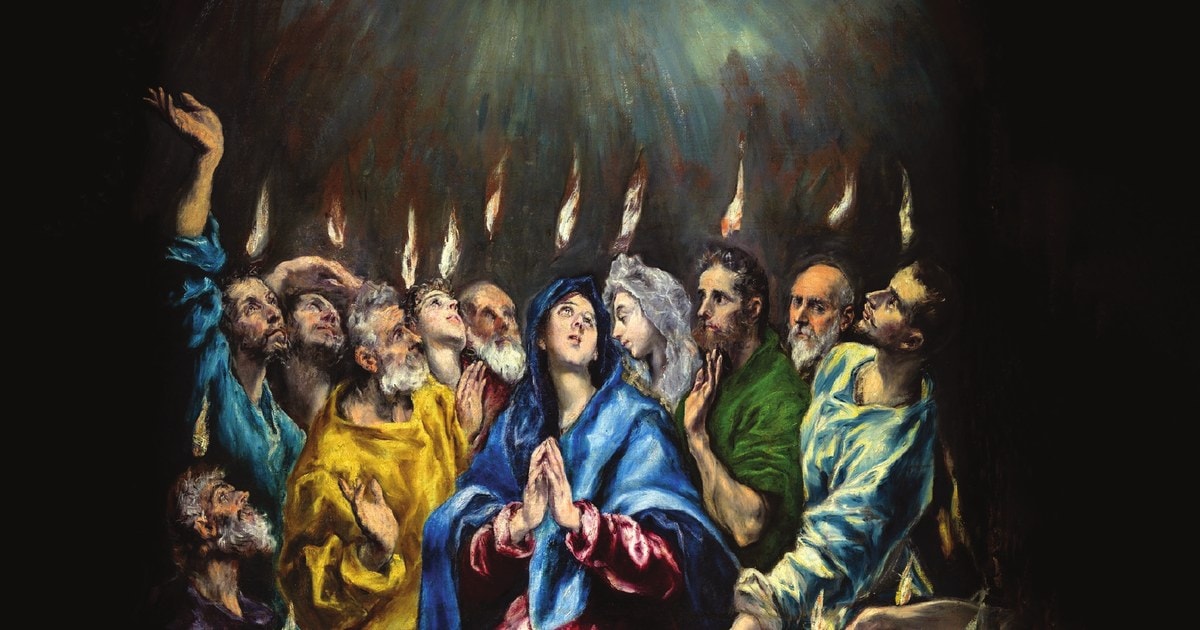
In his painting Pentecost (c 1596–1600; Toledo, Spain; now in the Museo del Prado, Madrid), El Greco presents us with the moment described by St Luke in the Acts of the Apostles:
“When the day of Pentecost had come, they were all together in one place. And suddenly a sound came from Heaven like the rush of a mighty wind, and it filled all the house where they were sitting. And there appeared to them tongues as of fire, distributed and resting on each one of them. And they were all filled with the Holy Spirit and began to speak in other tongues, as the Spirit gave them utterance” (Acts 2:1–4).
The 14 figures – the Virgin Mary in the centre, 12 Apostles and a woman traditionally identified as Mary Magdalene or another holy woman – transcend purely physical attractiveness; they have been divinised by the Holy Spirit. Their very bodies have been transformed. Those bodies are elongated, attenuated and seem almost weightless, resembling the very tongues of fire of the Holy Spirit hovering above each of their heads. Even the delicately pointed fingers on the elongated hands are like little flames of flesh. The faces radiate with a light which appears to come from within. Several of the Apostles in the painting appear to be caught up in mystical contemplation, their stretched bodies drawn along with their souls’ ascent to God.
At times, El Greco was dismissed as a quirky Mannerist painter, but we see here how he is conveying the whole mystical thrust of the Counter-Reformation spirit in which he was so immersed in the city of Toledo, still the religious capital of Spain in the 16th century, if no longer the political capital. His adoptive city was, in the late 16th century, home to the spirituality of the giants of Spanish mysticism: St Teresa of Ávila (1515–1582) and St John of the Cross (1542–1591). El Greco’s famous elongated figures and radiant faces can be seen as visual analogues – almost icons – of mystical transformation.
But not only that, El Greco, Doménikos Theotokópoulos by birth, came from the island of Crete, which, while by then politically Venetian, spiritually remained Byzantine. The young El Greco was trained in the island’s Byzantine icon tradition and so was already habituated to a more theological vision of art than that marking the art of the Renaissance West. His was a vision which saw that the body is not “maxxed” by physical and biological means, but only by spiritual ones. The change brought about by the Spirit is not cosmetic but transformative, allowing St Paul to teach in 1 Corinthians 6:19: “Do you not know that your body is a temple of the Holy Spirit within you, whom you have from God?”
In Pentecost, El Greco presents us with a portrayal in colour and form of the Eastern Christian emphasis on divine transformation – body and soul – of the human being: theosis. For El Greco, beauty is not the perfection of proportion alone, but the transfiguration of matter by grace. Flesh becomes luminous when penetrated by divine life. And so it is the beauty of the Blessed Trinity itself that shines through the 14 flickering bodies on El Greco’s canvas, and this is produced not by the working out of man, but by the work of the Holy Spirit.