May 19, 2026

Fianna Fáil and the loss of de Valera’s vision

Ruadhan Jones
More
Related
Min read
share

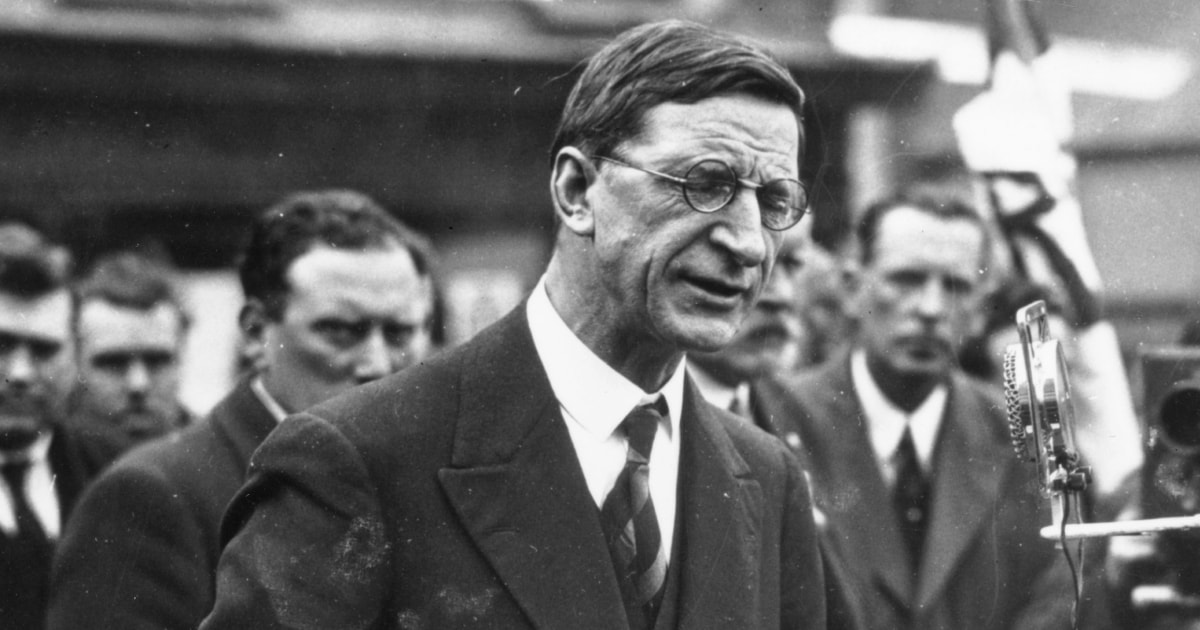
It has long been the standard in Ireland to pour scorn on Éamon de Valera, the former Irish prime minister, president and rebel whose career stretched from the 1910s into the 1970s. It is typical of life that the revolutionary of one era is the reactionary of the next, and it is no different for “Dev”, as he is often called. In his lifetime, he was recognised as one of the key figures of the new Irish state, a revolutionary and statesman of great political acumen and a Catholic of genuine faith. Now, he is a representative of that cruel Catholic past, with his “Legion of Mary pieties”, his inward nationalism and his repressive social and economic policies.

It is a great shame, not only for the injustice it does to a complex national figure, but also for the harm it does to Ireland itself and to the party he founded 100 years ago this month: Fianna Fáil. It would be no overstatement to say that de Valera must be turning in his grave looking at his party now. I don’t refer here to its dreadful polling – at an all-time low of 15 per cent – but to its abandonment of the vision central to its founding. That vision is probably best expressed in a much criticised and mocked speech Dev gave 83 years ago on St Patrick’s Day. If you have heard the speech referenced, it is likely only to be through the famous misquotation describing “comely maidens dancing at the crossroads”. But here is an excerpt from de Valera’s “The Ireland That We Dreamed Of”, which is much subtler than its caricature:

“The ideal Ireland that we would have, the Ireland that we dreamed of, would be the home of a people who valued material wealth only as a basis for right living, of a people who, satisfied with frugal comfort, devoted their leisure to the things of the spirit – a land whose countryside would be bright with cosy homesteads, whose fields and villages would be joyous with the sounds of industry, with the romping of sturdy children, the contest of athletic youths and the laughter of happy maidens, whose firesides would be forums for the wisdom of serene old age. The home, in short, of a people living the life that God desires that men should live.”

It is for this vision that de Valera is most criticised, the one that both animated his desire for an Ireland free from the British yoke and grounded him when he met pressure to give in. This is the strange thing about ideals: they set a man free, but also keep him grounded. The modern career politician is frightened of them for that reason. On the one hand, he dismisses them as impractical or not the remit of the politician, who must embody the liberal ideal of a neutral arbiter between competing claims. But he also dislikes the constraints they place on him, forcing the politician to take account of his conscience on key issues that will make him unpopular with the voters, like gay marriage or abortion.

It is exactly this kind of thinking that has left Fianna Fáil where it is, its one-time majority ebbing away into – on the current trajectory – ultimate oblivion. Having once been pro-marriage, it very quickly turned to support divorce and gay marriage. Having once been pro-life, the same party abandoned its principles to keep up with the crowd. Having once been animated by higher things of the spirit, it became the party of profit and material gain – not bad things in their own right, but corrosive if they become your god. While none of these things were seen by the party as essential to its core, it is clear that continually shifting ground to chase popular opinion has left it with nowhere to go now that it finds the people turning their backs on it.

It is completely against the grain to say that it is de Valera’s vision, or something like it, that Fianna Fáil should return to if it wanted to regain its status. But contained in it is the right mix of populism and idealism that appears to be in the ascendant in Ireland’s political life and the West more broadly. What a modern de Valera could offer is a principled and thought-out neutrality; a nationalism that loves the island’s traditions and life, its language, its communal orientation; and a vision of the good life, balancing material gain with the goods of leisure and faith. It would be a strange mix of the Right and the Left; neither socialist nor capitalist, communal but not communist.

It is easy to dismiss such an idealised vision of Ireland, but what is the point of being a politician and lawmaker if you have no ideal to offer your voters? What good are all the skills of a technocrat if you don’t know what you are making? Fianna Fáil is not alone in this, but it is emblematic of the problem facing Ireland’s political elites as they try to grasp why they are so unpopular. Aside from economic considerations, a significant milestone such as its hundredth anniversary is surely a time to reflect and realise that, if you do not have ideals of your own, you are going to fail to inspire others.

Whatever else you say about Éamon de Valera, he was a man of ideals, who inspired a generation of Irish men and women to pursue a better life for the nation. The degree to which he realised these ambitions is another matter; what concerns us here is that he knew what he was aiming for and could bring others along with him as a result.

Continue reading with a free account

Create a free account to read up to five articles each month
Create free account

You have # free articles remaining this month.

Subscribe to get unlimited access.
Sign up

subscribe to the catholic herald today

Our best content is exclusively available to our subscribers. Subscribe today and gain instant access to expert analysis, in-depth articles, and thought-provoking insights—anytime, anywhere. Don’t miss out on the conversations that matter most.
Subscribe