February 12, 2026

Forty years of clashing with the Church

Dan Hitchens
More
Related
Min read
share

A famous leftist revolutionary, hoping to shore up electoral support, backs a strict pro-life law. A government minister genuflects in front of the Pope. A radio station is punished for replacing a presidential address with the rosary. Welcome to the politics of Nicaragua, where Catholicism and revolutionary socialism have clashed amid a national tragedy.

That drama has thrilled and horrified the world, as the archives of this magazine can attest. From 1979, when Daniel Ortega’s socialist Sandinistas seized power from the oligarchic Somoza regime, our coverage, along with that of other publications, grew and grew. In 1979, we were reporting that “the bishops were particularly concerned by reports that some followers of the Somoza government had been executed or were missing, that private property was being nationalised indiscriminately and that the system of relief distribution did not help the most needy”. The bishops believed the Sandinistas were trying to suborn the Church to political ends.
But some clergy were right behind the government. Liberation theologians took part in Ortega’s revolution. In breach of Church law, four priests became ministers, including the hirsute poet Fr Ernesto Cardenal. In 1983, when St John Paul II stepped off the plane, Fr Cardenal greeted him reverently, theatrically removing his beret and genuflecting. John Paul gently told him: “Regularise your position with the Church.”

The Pope’s visit confirmed his fears about the Sandinistas. At an open-air Mass, the crucifix was replaced by banners of Marx and Nicaraguan revolutionaries. Militants disrupted the Mass with political slogans.

John Paul II’s opposition to liberation theology helped to exacerbate tensions between the bishops and the Sandinista government. In 1984, the government claimed that one priest was conspiring to overthrow Ortega’s regime. The priest said the video allegedly proving the claim was a fabrication, and in scenes redolent of current events, Archbishop Miguel Obando y Bravo of Managua led a protest march. In response, the government threw 10 foreign priests out of the country. Later a bishop was expelled for his vocal opposition.

That was a microcosm of a bigger, bloodier conflict. A loose coalition of rebels (the “Contras”), heavily backed by the Reagan administration, took up arms. The cost of warfare, combined with US sanctions and the Sandinistas’ botched economic reforms, drove the country to its knees.

The Church hierarchy played a part in undermining Ortega. Obando y Bravo emerged as a leading critic of the Sandinistas – particularly their alleged human rights abuses and use of censorship. (The Catholic radio station was shut down for defying Ortega – on one occasion, it broadcast the rosary instead of the president’s New Year message.) While leftist theologians enthused about “the people”, Obando y Bravo banned the newly invented “Nicaraguan Peasants’ Mass” and denounced the Sandinistas’ “godless communism”. He eventually became a supporter of the Contras and John Paul II made him a cardinal.

In 1990, it all came to a sudden end, after the Sandinistas unexpectedly lost the election to the right-wing Violeta Chamorro, who was on much friendlier terms with the bishops. Ortega spent the next decade-and-a-half in opposition. In a further twist, it was the Church which helped him back into power.

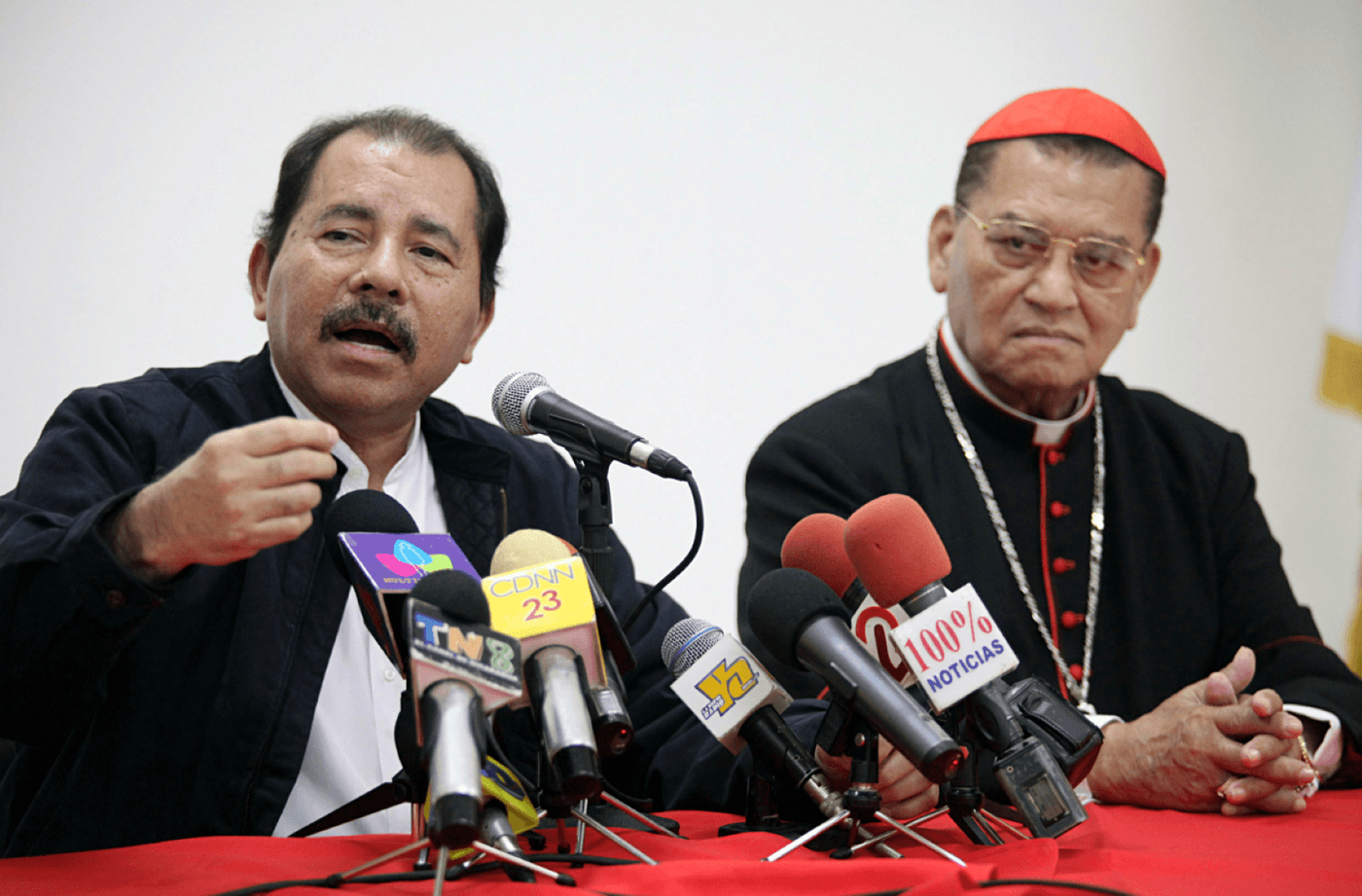
In 2006, he renewed his marriage vows in front of Cardinal Obando y Bravo, softened his Marxism and supported a popular bill outlawing abortions. But now, after four decades on the political frontline, Ortega finds himself back where he began: in a crisis, and on the wrong side of the Church.

Dan Hitchens is deputy editor of the Catholic Herald

A famous leftist revolutionary, hoping to shore up electoral support, backs a strict pro-life law. A government minister genuflects in front of the Pope. A radio station is punished for replacing a presidential address with the rosary. Welcome to the politics of Nicaragua, where Catholicism and revolutionary socialism have clashed amid a national tragedy.

That drama has thrilled and horrified the world, as the archives of this magazine can attest. From 1979, when Daniel Ortega’s socialist Sandinistas seized power from the oligarchic Somoza regime, our coverage, along with that of other publications, grew and grew. In 1979, we were reporting that “the bishops were particularly concerned by reports that some followers of the Somoza government had been executed or were missing, that private property was being nationalised indiscriminately and that the system of relief distribution did not help the most needy”. The bishops believed the Sandinistas were trying to suborn the Church to political ends.
But some clergy were right behind the government. Liberation theologians took part in Ortega’s revolution. In breach of Church law, four priests became ministers, including the hirsute poet Fr Ernesto Cardenal. In 1983, when St John Paul II stepped off the plane, Fr Cardenal greeted him reverently, theatrically removing his beret and genuflecting. John Paul gently told him: “Regularise your position with the Church.”

The Pope’s visit confirmed his fears about the Sandinistas. At an open-air Mass, the crucifix was replaced by banners of Marx and Nicaraguan revolutionaries. Militants disrupted the Mass with political slogans.

John Paul II’s opposition to liberation theology helped to exacerbate tensions between the bishops and the Sandinista government. In 1984, the government claimed that one priest was conspiring to overthrow Ortega’s regime. The priest said the video allegedly proving the claim was a fabrication, and in scenes redolent of current events, Archbishop Miguel Obando y Bravo of Managua led a protest march. In response, the government threw 10 foreign priests out of the country. Later a bishop was expelled for his vocal opposition.

That was a microcosm of a bigger, bloodier conflict. A loose coalition of rebels (the “Contras”), heavily backed by the Reagan administration, took up arms. The cost of warfare, combined with US sanctions and the Sandinistas’ botched economic reforms, drove the country to its knees.

The Church hierarchy played a part in undermining Ortega. Obando y Bravo emerged as a leading critic of the Sandinistas – particularly their alleged human rights abuses and use of censorship. (The Catholic radio station was shut down for defying Ortega – on one occasion, it broadcast the rosary instead of the president’s New Year message.) While leftist theologians enthused about “the people”, Obando y Bravo banned the newly invented “Nicaraguan Peasants’ Mass” and denounced the Sandinistas’ “godless communism”. He eventually became a supporter of the Contras and John Paul II made him a cardinal.

In 1990, it all came to a sudden end, after the Sandinistas unexpectedly lost the election to the right-wing Violeta Chamorro, who was on much friendlier terms with the bishops. Ortega spent the next decade-and-a-half in opposition. In a further twist, it was the Church which helped him back into power.

In 2006, he renewed his marriage vows in front of Cardinal Obando y Bravo, softened his Marxism and supported a popular bill outlawing abortions. But now, after four decades on the political frontline, Ortega finds himself back where he began: in a crisis, and on the wrong side of the Church.

Dan Hitchens is deputy editor of the Catholic Herald

subscribe to
the catholic herald

Continue reading your article with a subscription.
Read 5 articles with our free plan.
Subscribe

subscribe to the catholic herald today

Our best content is exclusively available to our subscribers. Subscribe today and gain instant access to expert analysis, in-depth articles, and thought-provoking insights—anytime, anywhere. Don’t miss out on the conversations that matter most.
Subscribe