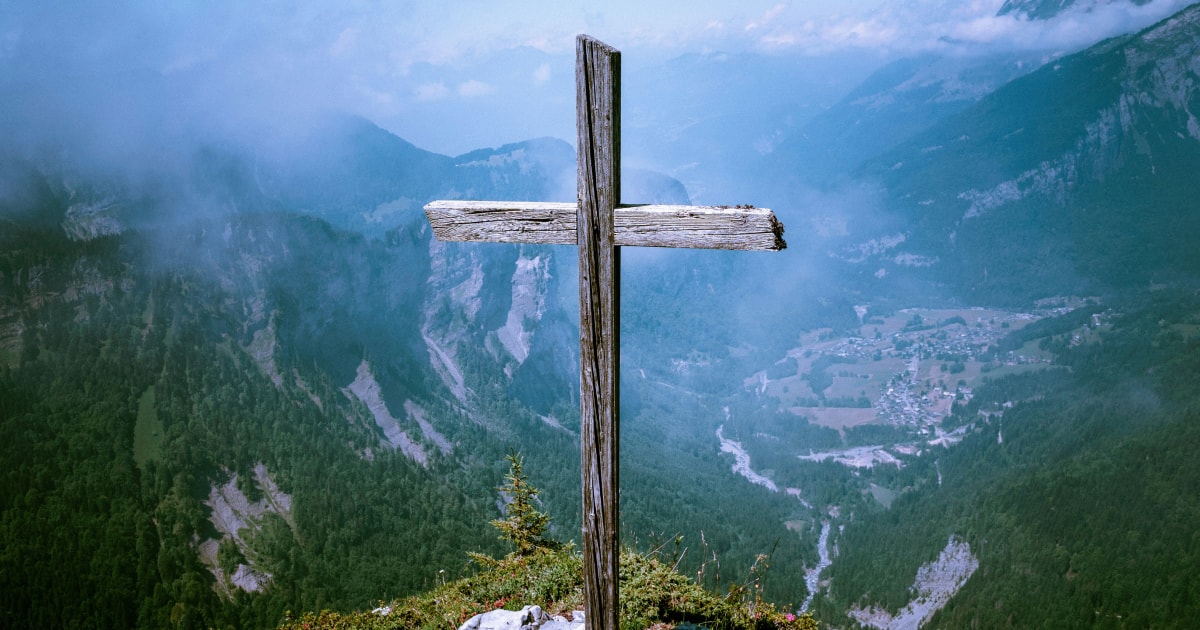
In the 18th century, Saint Louis de Montfort, priest and author of True Devotion to Mary, encouraged the faithful of France to adorn their countryside with roadside calvaries, depictions of Christ on the Cross. Pre-revolutionary France took kindly to the cleric’s call, and the statues quickly appeared across the land, becoming a defining feature of rural French landscapes, found at crossroads, village entrances, and along paths.
At the end of the century, the French Revolution overthrew the Catholic monarchy, dissolved monasteries, and launched an assault on Christian heritage through a “Reign of Terror” which sought to rid the faith from France’s corporate identity. Church buildings were destroyed, land was confiscated, and priests and nuns were sent to the guillotine. Roadside crosses often went the same way. Yet on those same spots, the faithful would rebuild what was destroyed, in defiance of revolutionary tyranny.
The 1905 Law on the Separation of Church and State, or laïcité, prohibited public funding for religious symbols and brought an end to any state-sponsored care of the calvaries, even when they stood on public land. The tens of thousands of roadside items of devotion that dotted the French countryside were left to the care of parishes or generous volunteers, but there was little in the way of formal protection.
More than eight decades later, in 1987, SOS Calvaires was formed, opening a new chapter in the history of these objects of public devotion. Founded in a small town in the Pays de la Loire region of western France, the organisation was established to maintain local roadside calvaries. In 2014, a carpenter who had previously helped restore many of them took over leadership, and the organisation began attracting younger members. In 2020, when the current president, Julien Le Page, took the reins, the association decided to go further still, setting itself a challenge: to restore or build a roadside crucifix every month.
Since 2023, the group has averaged more than one restoration per day and now has 65 regional affiliate groups across the country. It has been instrumental in reversing the decay of France’s Catholic heritage and has become a beacon of visible revival. To date, the organisation has carried out more than 1,800 restorations and has over 4,000 volunteers spread across 120 local branches.
Alongside its significant efforts to maintain hundreds of calvaries across the country, the group also offers an extensive catalogue of new-build options for private land. Landowners can choose from 13-foot-tall crucifixes to two-foot statues of Our Lady.
In 2026, the group remains ambitious as it begins a new chapter in its work, one that will reawaken a lost French craft. In the early stages of calvary building in pre- and counter-revolutionary France, roadside crucifixes were made from stone or wood. These are the sacred statues SOS Calvaires has restored up to this point. But for the first time in more than a century, the organisation will begin producing metal Christs, similar to those erected across France in the 19th and early 20th centuries.
These calvaries were originally made from cast iron, but the group will recreate them using aluminium, a more durable and suitable metal. Where metal calvaries have decayed or rusted, or where landowners request a new installation on their property, the organisation will respond accordingly.
The need is great. France, like other parts of Europe, has found itself in the grip of anti-Christian violence, with 770 anti-Christian acts recorded by police in 2024, and criminal fires and attempted arsons at Christian places of worship rising by more than 30 per cent. Secularism, bolstered by an antagonistic far-left political ideology marked by hostility towards Christianity, has meant that such images are in even greater need of care and protection.
While SOS Calvaires ensures that France’s spiritual heritage is not lost, it is also contributing to the new evangelisation of the Church’s eldest daughter. As Jeanne Cumet, communications officer for the group, puts it: “If we don’t see the cross, we don’t think about God.” Through the quiet work of SOS Calvaires, it seems certain that the Cross will remain visible across France for years to come.