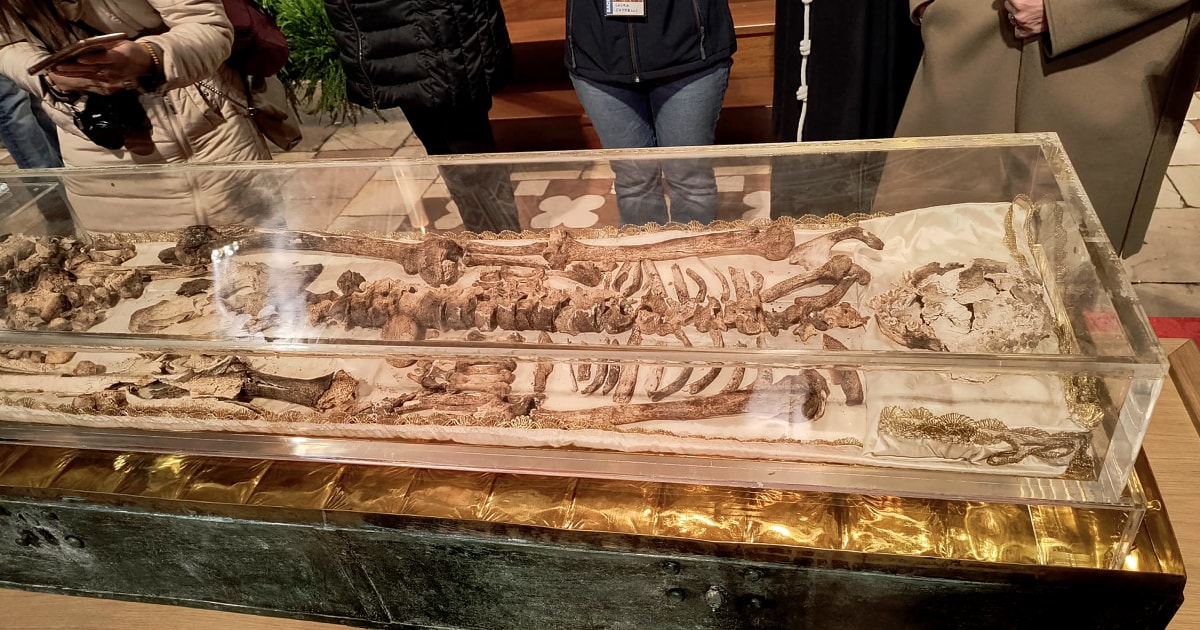
For the first time in 800 years, the mortal remains of St Francis of Assisi have been placed on extended public display, drawing hundreds of thousands of pilgrims to Assisi for a month-long period of veneration marking the eighth centenary of his death.
The bones of the saint, who died in 1226, were unveiled for public veneration on February 22 in the Lower Church of the Basilica of St Francis of Assisi. The exposition, which runs until March 22, forms part of a year-long programme of commemorations in 2026 and is expected to attract around 370,000 registered pilgrims from five continents.
Franciscan friars opened the sarcophagus on February 21 in the crypt of the basilica, exhumed the remains and placed them on a specially prepared table. The relics were then carried in procession through the Lower Church as the friars prayed the Litany of the Saints. Solemn Vespers were celebrated beneath the frescoed ceiling on the eve of the public opening.
Pilgrims began queuing outside the medieval hilltop basilica in the early hours of February 22, taking in panoramic views of the Umbrian countryside as they waited for their turn to pray before the remains of the saint known as the “Little Poor Man of Assisi”.
Organisers said approximately 80 per cent of those registered to venerate the relics were Italian. International registrations included 5,000 from the United States, 3,100 from Croatia, 2,000 from Slovakia and 1,500 each from Brazil and France. Around 400 volunteers from dozens of countries are assisting with the month-long event, which is free to attend but requires advance registration online.
Daily attendance is estimated at between 15,000 and 18,000 people. Hotels and restaurants in Assisi and the surrounding area have reported being fully booked for months as the town prepares to receive pilgrims in numbers not seen for generations.
The exposition will conclude on March 22 with Mass in the Upper Church of the basilica, to be presided over by Cardinal Matteo Maria Zuppi, Archbishop of Bologna and president of the Italian Episcopal Conference. Until then, pilgrims will continue to file through the crypt in silence, pausing before the remains of the saint whose witness, eight centuries after his death, continues to draw the faithful to Assisi.