



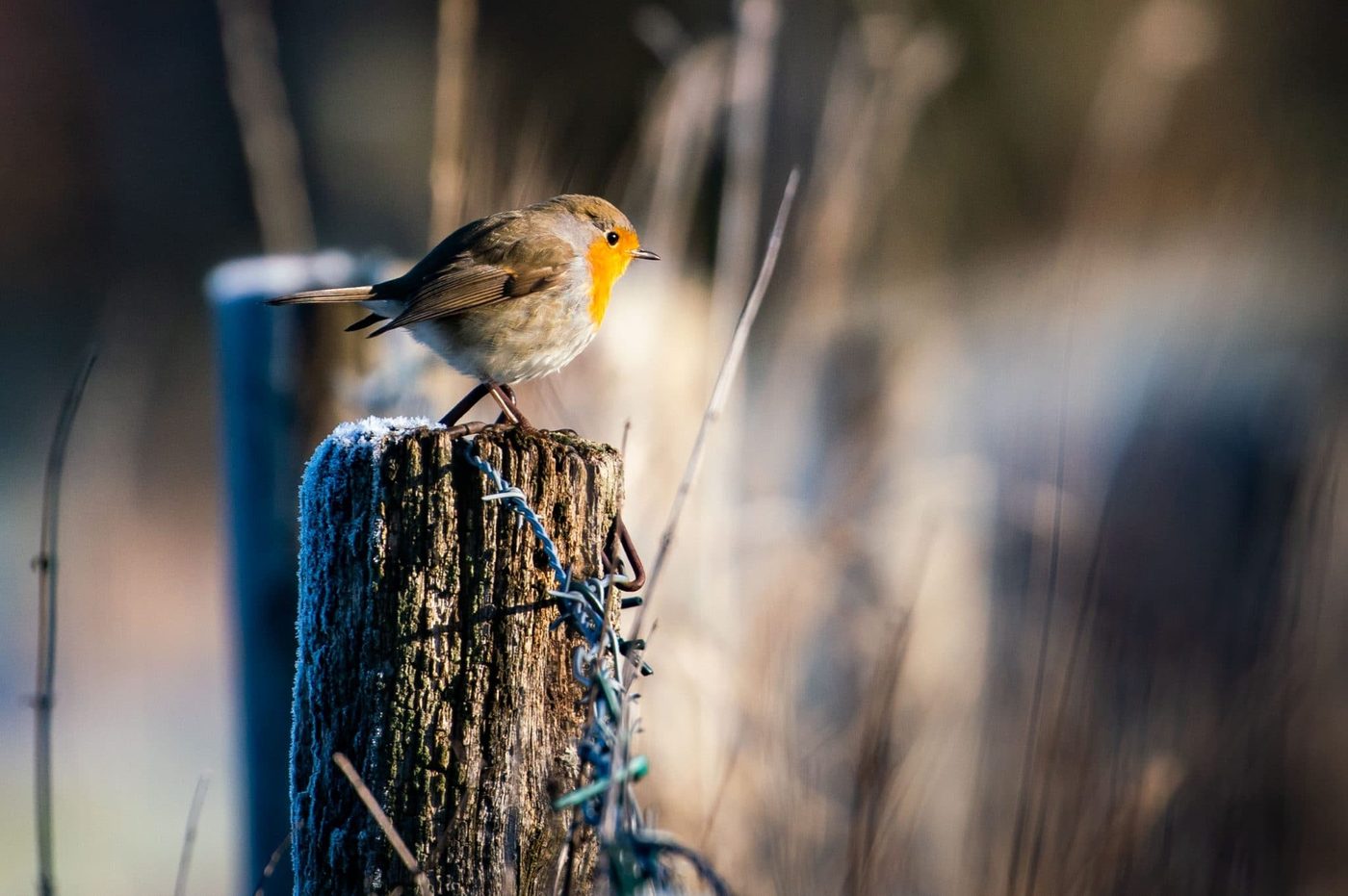
Birds and Christianity have a long and fascinating history. In the book of Genesis, Noah sent the dove out from the Ark to look for dry land. Birds are closely associated with Christ, especially the robin (pictured), whose red breast is said to symbolise the Precious Blood. There are competing explanations: in one version, the robin’s feathers were stained crimson as the bird removed the Crown of Thorns. An alternative view of the bird’s striking colouration relates to an earlier episode in Christ’s life. This suggests that the robin fanned the flames of an open fire in the Bethlehem stable to warm the newborn Jesus, and got so close that its breast was singed to red. Robins have a kind of religious significance in the classic children’s tale Babes in the Wood. Two small children are abandoned in a forest by their wicked uncle, and eventually starve to death. Robins then fly down and carefully cover up the children’s bodies with leaves, to give them a form of Christian burial. The robin’s red breast also gave rise to its close association with Christmas – but this is a secular, rather than religious, connection. During Victorian times, the first postmen wore red uniforms, and so were nicknamed “robins”. Then someone had the bright idea of producing festive cards for people to send to their friends and family; the first designs showed a robin, dressed in a postman’s uniform, carrying a card in its beak. Later on, the custom arose of charitable donors giving a free meal to poor children at Christmas; an event known as the “Robin’s Dinner”. The wren – Britain’s commonest bird – is also connected with the Christmas season, but in a more troubling way: the “Wren Hunt”. Until the middle of the 20th century, in many villages in Britain and Ireland, young men and boys would gather on the morning of St Stephen’s Day (December 26). They would then chase and catch a wren, and parade the unfortunate bird in a cage around their village, demanding money or food. Finally, they would carry the wren to the local churchyard where, repeating the fate of the earliest Christian martyr St Stephen, it would be stoned to death. What about the “partridge in a pear tree”, the culmination of the “Twelve Days of Christmas”, with its festive birds including swans and geese? In my book The Twelve Birds of Christmas, I suggest that every verse of the song actually refers to a bird. Another interpretation is that the song once had a more serious purpose. It has been suggested that it was written, in code, to teach young Catholic children the Catechism during the reign of Queen Elizabeth, when Catholicism was banned. Thus the “three French hens” symbolise the Holy Trinity, while the “four colly birds” (actually blackbirds) represent the four gospels. My latest book, The Swallow, features what is arguably the best-known, and best-loved, bird in the world. Right across the northern hemisphere, from Alaska to Japan, we welcome the swallow as a sign of the coming of spring. In several countries, the bird’s arrival is tied to a key date in the Christian calendar: March 25, the Feast of the Annunciation. Swallows are also closely linked with Easter, as even though the date varies each year, swallows tend to arrive back around that time. This led to a connection between the bird and the crucifixion of Christ: like the robin, the swallow is supposed to have acquired its brick-red forehead and throat when trying to remove thorns from Christ’s crown, and the nails from his hands and feet. According to the 19th-century folklorist Charles Swainson, the connection between the swallow and Christianity may go back even further. Following the expulsion from Eden, a swallow is supposed to have carried a strand of Adam’s hair to Eve, reconciling the couple after the Fall. According to Swainson, this explains why, henceforth, the swallow was “allowed to nestle in the dwellings of men”. All these myths and legends may be ancient, but they still have the power to move us, and strengthen that deep and longstanding connection between Christianity and some of our favourite birds. Stephen Moss is a naturalist and author based in Somerset. His many books include biographies of The Robin, The Wren and The Swallow, as well as The Twelve Birds of Christmas (all published by Square Peg)
1:03 PM
From Noah to the Twelve Days: A short history of birds and Christianity
Stephen Moss

4 min read



Already a subscriber? Sign in
5freearticles every month
Continue reading with a free account. No card needed.
- Five free articles every thirty days, on any device you sign in on
- The Catholic Herald newsletter, every morning
- Subscribe whenever you like for everything: every article and the magazine
Related articles
 Newsroom
First parish named for Bl Fulton Sheen established in Illinois
Bishop Louis Tylka of Peoria announced the new Blessed Fulton Sheen Parish two days after Sheen became the first American-born bishop to be beatified
Christine Rousselle Newsroom
Injured priest tells Poles: ‘Do not blame Ukraine’ for convent attack
Corrie Douglas-Young Newsroom
Church leaders urge Drumcree dialogue: ‘Too much is at stake’
Corrie Douglas-Young Newsroom
Thousands of Irish children to join global Rosary campaign
Corrie Douglas-Young Newsroom
TikTok priest urges young people to stand with persecuted Christians
Nathalie Raffray
subscribe to the catholic herald today
Our best content is exclusively available to our subscribers. Subscribe today and gain instant access to expert analysis, in-depth articles, and thought-provoking insights—anytime, anywhere. Don’t miss out on the conversations that matter most.
Subscribe



