



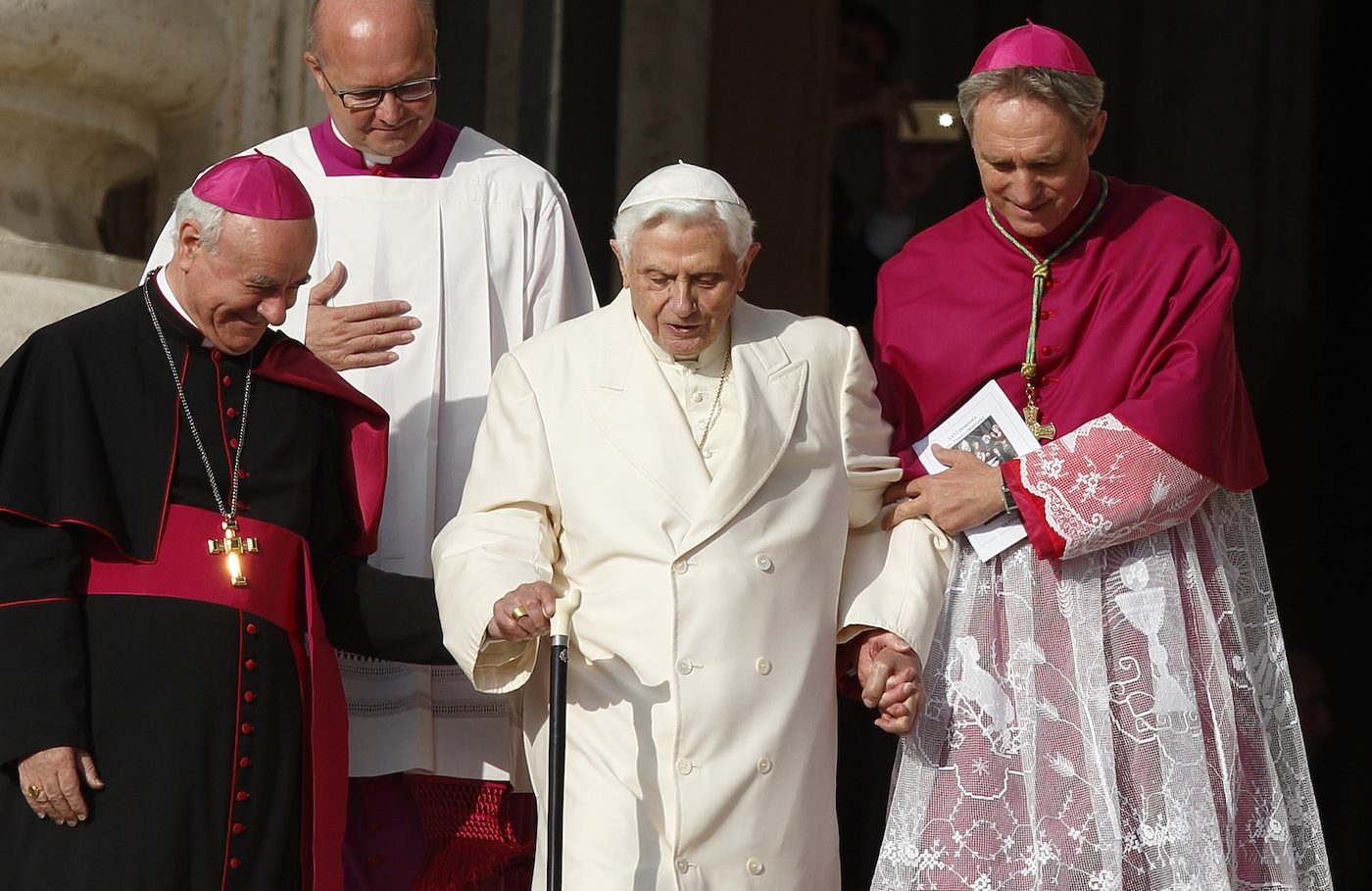
Last week, I wrote about the questions Cardinal Francis George, supposedly “America’s Ratzinger” would like to ask the Holy Father, beginning with whether he fully grasps that, in some quarters, he’s created the impression that Catholic doctrine is up for grabs. I ended with a question of my own: if “America’s Ratzinger” doesn’t really have an understanding of “what are we doing here?”, what is going through the mind of Pope Benedict himself? I think we may have part of an answer, in a little noticed but lengthy letter — an epistle, really — from Pope Benedict to the Pontifical Urbaniana University (an institution dedicated to the evangelisation of peoples) on the occasion of the dedication of its great hall to Benedict XVI. The ceremony took place on October 21, and included the reading of a message from Pope Benedict himself. Oddly, the message did not appear on the website of the university itself, and L'Osservatore Romano gave only a summary report of it. The complete text was made public on October 23 by the Austrian Catholic news agency Kath.Net, and an English translation of it can be found here under the interesting headline “The 'Evangelii Gaudium' of Pope Emeritus Benedict”. It can be seen almost as an implicit criticism of Pope Francis’s doctrine-lite attitude to his teaching ministry, to precisely the fact that “he’s created the impression that Catholic doctrine is up for grabs”. Let me be clear: I don’t think that Pope Benedict set out to criticise his successor. He would never do that: as Pope Francis has said of his predecessor, “he is discreet, humble, he doesn’t want to get in the way”. But really, the very fact of the existence of a corpus of writings like that of Pope Benedict, as pope, as cardinal prefect, and before that as academic theologian, is an implicit standing reminder to Pope Francis that smiling and personal attractiveness aren’t enough to sustain a papal ministry, that doctrine can’t be “up for grabs”, and that it’s part of his function to make sure that everyone knows that. The real question is whether the two really do have intrinsically different attitudes to the Catholic Church’s possession of the absolute and objective truth about human existence, a truth which Benedict profoundly believes is essential to “the joy of the gospel” and its proclamation, but which Pope Francis gives the impression of thinking that it can be a barrier between the Church and other religions, not to mention non-believers and that “proselytism” is a falsification of authentic Christian mission, which should be “by attraction”. And certainly, a lot of people (not me), especially non-believers, do seem to think that Francis is a much more attractive figure than Pope Benedict: though you have to ask whether as a result they are any closer to embracing the Christian gospel. Pope Benedict, if he is to say anything characteristic of his own thinking, is going to convey his love of Catholic truth and his deep instinct that this truth has to be passed on. The only way this is not going to emerge is if he now says nothing at all, as a matter of principle: but Pope Francis has said he doesn’t want him to do that and that he wants to know his views: “It feels like having grandpa at home,” he says “because of his wisdom. It does me good to listen to him. And it also encourages me a great deal.” Well, grandfathers can be clear-minded and even quite tough, as well as encouraging. And they can have a disconcerting way of carrying on saying what they have always thought. That’s what Pope Benedict does in his message to the Urbaniana University, in which, as he says, “young people from practically all the countries of the world are preparing for the service of the Gospel in today’s world”:
10:02 AM
Here is Benedict’s Evangelii Gaudium: will Francis take it to heart?
The joy of the gospel, says Pope Benedict, lies in the authentic truth about God
William Oddie

6 min read



Already a subscriber? Sign in
5freearticles every month
Continue reading with a free account. No card needed.
- Five free articles every thirty days, on any device you sign in on
- The Catholic Herald newsletter, every morning
- Subscribe whenever you like for everything: every article and the magazine
Related articles
 Newsroom
Church leaders urge Drumcree dialogue: ‘Too much is at stake’
The Catholic and Church of Ireland Archbishops of Armagh have urged a renewed commitment to peace and reconciliation amid the Drumcree stand-off
Corrie Douglas-Young Newsroom
Thousands of Irish children to join global Rosary campaign
Corrie Douglas-Young Newsroom
TikTok priest urges young people to stand with persecuted Christians
Nathalie Raffray Newsroom
Baby born at 25 weeks reunites with neonatologist two years after leaving hospital
The Catholic Herald Newsroom
Joe Biden honoured by Planned Parenthood after defending abortion rights
Christine Rousselle
subscribe to the catholic herald today
Our best content is exclusively available to our subscribers. Subscribe today and gain instant access to expert analysis, in-depth articles, and thought-provoking insights—anytime, anywhere. Don’t miss out on the conversations that matter most.
Subscribe



