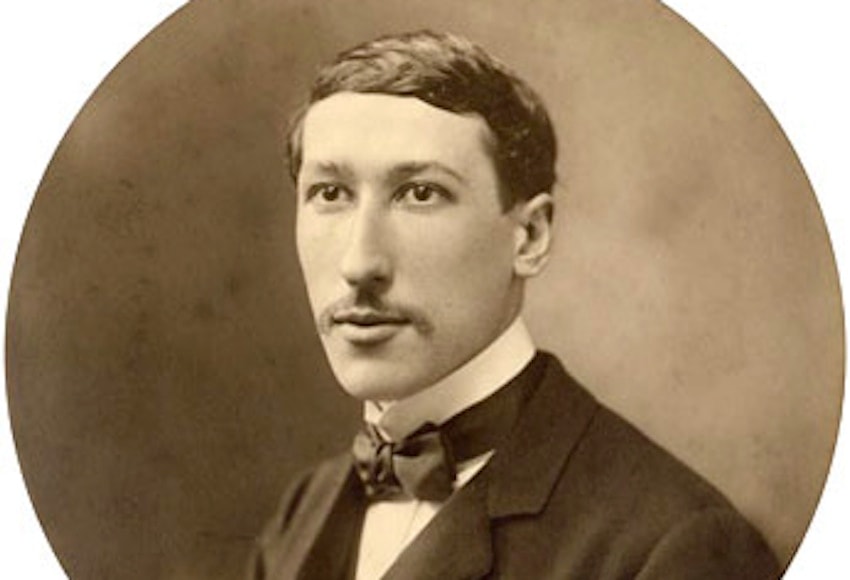


René Guénon (1886-1951) was a fallen-away Catholic and convert to Islam who is seen as father of the “Traditionalist” school – which in this context means that all existing religions are equally good and valid inheritors of a single primeval faith. This is more authentically reflected in some religions than in others – and for Guénon, at best in Islam.
Born in Blois to a Catholic family, Guénon went to Paris to study. There he fell in with members of the 19th and early 20th century Occult revival in that city, becoming (and falling out of favour with) successively a Martinist, Gnostic and Freemason.
Guénon then began to study Theosophy and Hinduism – writing several books on the latter, in one of which he critiqued the former, as well as modern materialism.
This led to a period in the 1920s of collaboration with such Catholics as Jacques Maritain and Louis Charbonneau-Lassay – going so far as to write articles for the latter’s journal, Regnabit, based in Paray-le-Moniale.
Charbonneau-Lassay saw traces in other world religions of the original Revelation from whence Judaism and then Catholicism had sprung; but for him these were to be used to draw people to the One True Faith. For Guénon, however, Catholicism fell short of being a genuine conduit – which led not only to a break with his Catholic friends (Maritain tried to have his work put on the Index of Forbidden Books), but to his own conversion to Islam and subsequent emigration to Cairo. There he died.
René Guénon has been a controversial figure, exercising great influence on such scholars of comparative religion as Huston Smith and philosophers including Frithjof Schuon. The whole idea of being “spiritual, but not religious” might be seen as a result of his work, though he probably would have disapproved. Of course, Martin Luther would not have liked Unitarianism.