Holy Week begins with the celebration of Palm Sunday. In the ancient world, palms were used in public processions as a symbol of victory and peace. As Jesus enters Jerusalem, He is greeted by the crowds, who wave their palm branches and sing ‘Hosanna’ (Hebrew for ‘save us’). Jesus is welcomed as a king, yet the days that follow will reveal that this is no ordinary king, for His steed is a colt, and His throne is a cross.
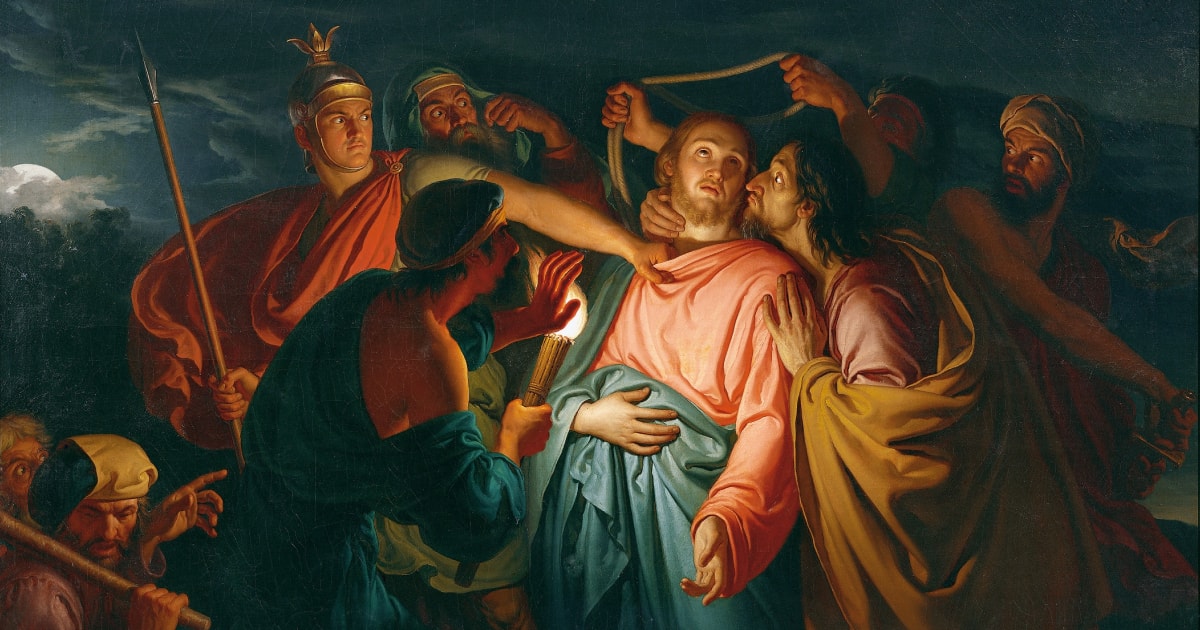
Wednesday of Holy Week is traditionally known as Spy Wednesday, for it is thought to have been on this day that Judas went to the chief priests and agreed to serve as their informant. After this, Judas ‘sought an opportunity to betray him to them in the absence of the multitude’ (Luke 22:6). Yet this was no simple task, since Jesus spent the daylight hours in the temple, where large crowds were continually present. At night, Jesus would retire to the nearby village of Bethany (see Matt 21:17; Mark 11:11, 19; Luke 21:37).
It would appear that, since Judas did not get the chance to betray Jesus on the evening of Spy Wednesday, he therefore decided to act on the evening of Holy Thursday if the opportunity presented itself. As Jimmy Akin has pointed out, Judas’s plan was complicated by the fact that Jesus kept the location of the Passover meal secret until the last moment.
Although Our Lord knew what awaited Him later that evening, He deemed it essential to celebrate the Last Supper with His disciples prior to His arrest: ‘I have earnestly desired to eat this passover with you before I suffer’ (Luke 22:15). Since Judas was unable to alert the chief priests beforehand, he was forced to slip out midway through supper. It seems that Judas learnt during dinner that Jesus would soon be heading to Gethsemane, and so he arranged for the authorities to meet Jesus there.
Traditionally Holy Thursday is also known as Maundy Thursday. The name comes from the Latin mandatum (‘commandment’), which is a reference to the instruction Christ offers His disciples at the Last Supper: ‘A new commandment I give to you, that you love one another; even as I have loved you, that you also love one another’ (John 13:34).
The morning of Holy Thursday is the usual time for the celebration of the Chrism Mass, which takes place in the diocesan cathedral. At this Mass, the bishop consecrates the holy oils that will be used in his diocese throughout the coming year. These are the oil of the catechumens, the oil of the sick and the oil used for Confirmation and for the anointing of other sacred persons and things (e.g. at a priestly ordination). The Church renews her sacramental signs on this day to underscore the truth that the Holy Eucharist, instituted by Christ on Holy Thursday, is the crowning glory of all the sacraments.
The Evening Mass of the Lord’s Supper on Holy Thursday marks the official end of Lent and the beginning of the Easter Triduum. The Triduum lasts until Vespers on Easter Sunday; it is its own liturgical season, and the shortest in the Church’s year. The Church specifically recommends a communal celebration of the Office of Readings and Morning Prayer on Good Friday and Holy Saturday.
In its 1988 document Paschalis Solemnitatis, the Congregation for Divine Worship explains that the evening Mass on Holy Thursday commemorates three mysteries: ‘the institution of the Eucharist, the institution of the priesthood, and Christ’s command of brotherly love’ (#45). To mark this occasion, the priest wears white or gold vestments, signifying the Church’s joy over the gift of the Eucharist. The Gloria is sung at this Mass.
Before the evening Mass begins, the main tabernacle of the church is completely emptied so that the only hosts that the faithful receive are those consecrated during the evening Mass. This highlights the fact that this night is a commemoration of Christ’s institution of the Eucharist. The main tabernacle remains empty until the Easter Vigil, which reminds us to fast and heightens our longing for the Resurrection. At the evening Mass, the priest also consecrates enough hosts to provide Holy Communion on Good Friday.
When the evening Mass is ended, the main altar of the church is stripped of its linens and ornaments. This is a foreshadowing of how Christ will be stripped naked on Calvary, and it reminds the Church of the desolation of the Saviour’s Passion. Next, the faithful process with the Eucharist to an altar of repose, which is distinct from the main altar. This reminds us of Christ’s journey to Gethsemane and the interior anguish He endured there.
The Church encourages us to use this opportunity to spend time in Eucharistic adoration, even though the Host is not exposed during this time. In doing this, we call to mind Our Lord’s instruction to His disciples: ‘Watch and pray that you may not enter into temptation; the spirit indeed is willing, but the flesh is weak’ (Matt 26:41). Paschalis Solemnitatis clarifies that after midnight the adoration ‘should be made without external solemnity, because the day of the Lord’s passion has begun’ (#56).
The same document reminds us that, while fasting and abstinence are required on Good Friday, the Church recommends this on Holy Saturday as well. This is traditionally known as the paschal fast, and we are called to self-denial on these days ‘because the Spouse has been taken away’ and ‘in order that the Church with uplifted and welcoming heart be ready to celebrate the joys of the Sunday of the resurrection’ (#39).
The Good Friday liturgy should take place in the afternoon at around three o’clock. On this day, the Church ‘meditates on the passion of her Lord and Spouse, adores the cross, commemorates her origin from the side of Christ asleep on the cross, and intercedes for the salvation of the whole world’ (#58). The priest wears red vestments, and a central part of the liturgy is the veneration of the cross by all the faithful. Only one cross should be used for veneration, and each member of the faithful should be given the opportunity to venerate it individually unless this is impracticable due to the number of people present.
The Good Friday liturgy is not a Mass because, while there is distribution of Holy Communion, there is no institution of the Eucharist. This can seem like a strange decision on the part of the Church, but it serves an important purpose. To see why, we should remember that the Mass is not a mere historical re-enactment of Christ’s death, but rather a sacramental re-presentation of Christ’s sacrifice on Calvary.
Just as Christ offered up His Body and Blood on the Cross, so His Body and Blood become present on the altar (under the appearances of bread and wine) and are offered up by the priest on behalf of the people. The Church does this through Christ’s power and in direct obedience to His injunction given at the Last Supper: ‘Do this in remembrance of me’ (Luke 22:19).
The upshot is that, although Christ offered Himself on the cross ‘once for all’ (Heb 10:10), the Church continues to reap the fruits of that sacrifice every hour of every day through the celebration of Holy Mass. During the Triduum, however, this practice comes to a dramatic halt. On Good Friday and again on Holy Saturday there is no celebration of Mass.
While the Eucharist is the sacramental sign of the reality of Christ’s Passion, on Good Friday we are invited to fix our gaze on the reality itself. In so doing, we are powerfully reminded of where the Eucharist comes from, what it means and how much it cost the God who bled and died for us. Likewise, on Holy Saturday the Church refrains from celebrating Mass in order to commemorate her Saviour, who lies in the tomb. This offers a poignant reminder that without the Resurrection our life as Christians, including our sacramental life, would be meaningless. Without Easter Sunday, there would be no Eucharistic feast.
In these ways, we are invited to liturgically reorient our lives each year as the Church annually renews her celebration of the sacraments. By focusing our attention on the original historical events that undergird these mysteries, we train our hearts to ponder anew the saving power of the Mass, which the Church has received through Christ’s death and resurrection, and which she endlessly celebrates down the ages until He comes again. Together with the whole people of God, we undergo the jarring experience of liturgical darkness in order to share in the darkness of Christ’s Passion and death, so as to rise again with Him at the Easter Vigil.
We might also note in passing that some Catholics deliberately choose to fast from receiving Holy Communion on Good Friday, in accordance with an ancient custom.
After Good Friday comes Holy Saturday. This is the eeriest day of the year, the day on which the Church ‘is, as it were, at the Lord’s tomb, meditating on his passion and death, and on his descent into hell, and awaiting his resurrection with prayer and fasting’ (#73). On Holy Saturday, as on Good Friday, the only sacraments permitted are Penance and Anointing of the Sick. Holy Communion may be administered only in the form of Viaticum.
Our faith tells us that sometime between sundown on Holy Saturday and pre-dawn on Easter Sunday, Jesus rose from the dead. This was in fulfilment of Hosea’s prophecy that ‘on the third day he will raise us up’ (6:2), and it was prefigured in Isaac being delivered from death on the third day, and in Jonah being in the belly of the fish for three days.
Within 20 years of the Crucifixion, St Paul wrote to the Corinthians affirming that Christ ‘was raised on the third day in accordance with the scriptures’ (1 Cor 15:4). This is according to the Jewish method of keeping time: the afternoon of Good Friday is the first day; after sundown on Good Friday is the beginning of the second day; and after sundown on Holy Saturday is the beginning of the third day.
After sunset on Holy Saturday, we celebrate the Easter Vigil. Paschalis Solemnitatis notes that the ‘full meaning of Vigil is a waiting for the coming of the Lord’ (#80). The Vigil begins outdoors, and the interior of the church is shrouded in darkness. This invokes the first Passover night on which the Hebrews were delivered from Egypt, and it calls to mind the powers of death and sin that seemed so ascendant as our Saviour lay in the earth. Yet as the liturgy progresses, we see unfolding before us the truth expressed in the prologue of John’s Gospel: ‘The light shines in the darkness, and the darkness has not overcome it’ (1:5).
As we process into the church behind the Easter candle, we remember how the children of Israel were guided by a pillar of fire by night. Now we are guided by the One who came to set a fire on the earth, and who called Himself the light of the world.
After the Service of Light (the first part of the Vigil), we move into the Liturgy of the Word, in which we receive a kind of ‘highlights reel’ of the great events of salvation history. After the Old Testament readings, the Gloria is sung and bells are rung. We then hear St Paul’s exhortation on Christian Baptism, and finally we arrive at the Gospel, which is preceded by a triple Alleluia that increases in pitch each time. (‘Alleluia’ is the Greek transliteration of the Hebrew hallēl-yah, meaning ‘praise the Lord’.)
After the Liturgy of the Word (the second part of the Vigil), there follows the rite of Baptism (third part), in which the faithful make or renew their baptismal promises. The fourth and final part of the Vigil is the Liturgy of the Eucharist.
Unsurprisingly, the priest wears white on this occasion, and the Church makes it clear that the Easter Vigil is not the conclusion of Holy Saturday but rather the beginning of Easter night. This is the night of hope and joy, of peace and gladness, the night on which Our Saviour defeated death, robbed hell of its victory and vanquished the darkness.