Entering into the second year of Pope Leo XIV’s pontificate, many have looked towards the consecrations of the Society of St Pius X (SSPX) to get a sense of how the pontiff will approach the delicate issues facing the Church. The Pope had appealed for the Society to abandon its plans to consecrate four bishops, with the Vatican warning that such an action would incur an automatic excommunication, but for a second time, consecrations in Écône have led to schism.
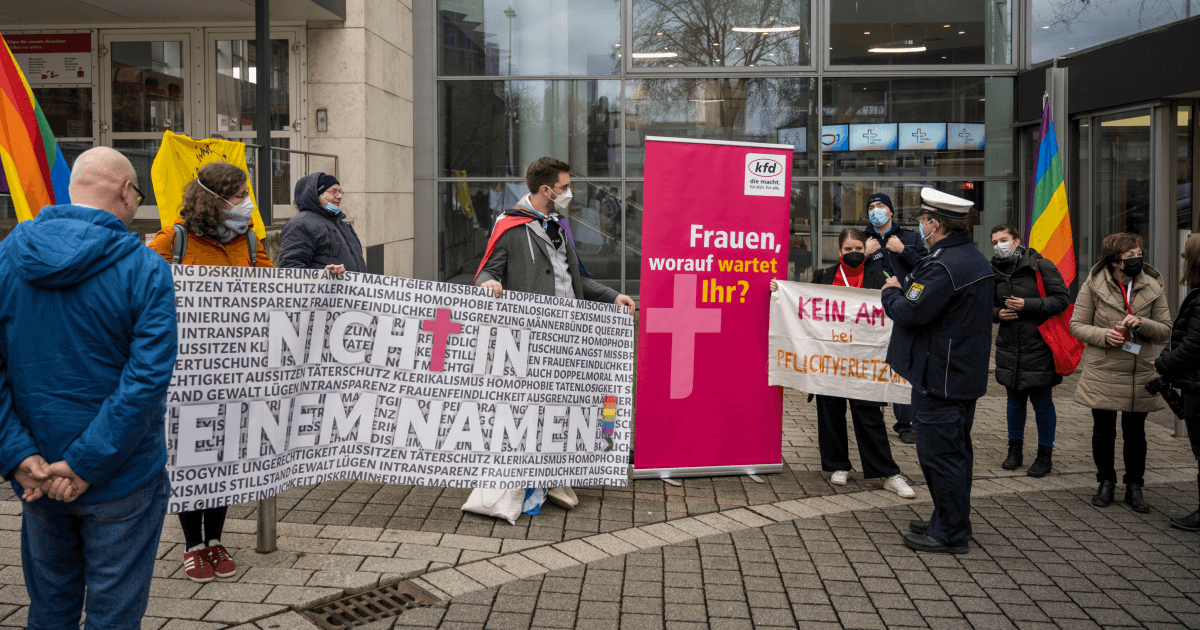
It remains to be seen how he will approach the other great concern over schism, one which defined his predecessor’s papacy: the legacy of the German Synodal Way. Having commenced on December 1 2019, the Synodal Way overlapped at points with Pope Francis’ Synod on Synodality, with the two operating separately to one another.
In the former, a series of conferences was held which sparked controversy due to their willingness to entertain a number of positions contrary to Church teaching and discipline, revolving around women’s ordination, sexual ethics, and revoking the requirement for priestly celibacy in the Latin rite. Proposal documents were prepared on these issues, requiring a two-thirds vote by delegates – made up of equal numbers of bishops and laity – to pass.
The Synodal Way re-entered the news recently following the appointment of Bishop Christian Würtz to the Diocese of Eichstätt. As auxiliary bishop of the Archdiocese of Freiburg, Bishop Würtz participated in the Synodal Way, voting on a number of the aforementioned controversial proposals.
One document, Magisterial Reassessment of Homosexuality, stated: "Same-sex sexuality – also realised in sexual acts – is therefore not a sin that separates from God, and it is not to be judged as bad in itself. Rather, it is to be measured against the realisation of the values mentioned."
Another, Women in Ministries and Offices in the Church, read: "Therefore, the question is to be addressed to the highest authority in the Church (Pope and Council), whether the teaching of Ordinatio Sacerdotalis does not need to be examined: in the service of evangelisation, it is a matter of allowing women to participate appropriately in the proclamation, in the sacramental representation of Christ and in the building up of the Church. Whether or not the teaching of Ordinatio Sacerdotalis infallibly binds the Church must then be bindingly examined and clarified at this level."
Bishop Würtz voted in favour of both documents, whilst his predecessor at the Diocese of Eichstätt, Bishop Gregor Maria Hanke OSB, voted against. His appointment raises new questions about how the Vatican will approach the German Church – and whether Rome seeks reconciliation across the Rhine.
In some parts of the German Church it may go both ways. In January, Cardinal Rainer Maria Woelki of Cologne announced that he would abstain from attending further assemblies, stating: “For me the Synodal Path is complete.”
In an interview with the German outlet Domradio.de, he said it had fulfilled the task for which it was set. He noted that the series of conferences had planned for five assemblies, and he had participated in all of them.
The Cardinal reflected that, whilst he did not doubt the good intentions of those involved, he also warned against treating Church doctrine as a matter for endless debate.
He said: “I have the impression that at a certain point the Synodal Way in Germany was primarily about implementing certain church-political positions.”
He noted that not everything could be discussed with an open mind, such as whether Christ has risen from the dead.
“If in the end a majority came to the conclusion that he was not, and I had to accept that as a bishop, that would be out of the question for me.”
In 2023, Pope Francis said of the Synodal Way: “Here the danger is that something very, very ideological trickles in. When ideology gets involved in church processes, the Holy Spirit goes home, because ideology overcomes the Holy Spirit.”
A year later, the German bishops abandoned proposals to establish a synodal council, which would have governed the Church in Germany and been made up of both bishops and laity, at the request of the Vatican.
But it may be premature to say that the tensions between Rome and the Church in Germany are history.
Last month, the Dicastery for Divine Worship and the Discipline of the Sacraments denied a request from the German Bishops’ Conference to allow “a duly commissioned lay member of the faithful to preach in place of the homily during the celebration of the Eucharist” when priests or deacons were unavailable.
In the letter, Cardinal Arthur Roche, prefect of the dicastery, and the secretary, Archbishop Vittorio Francesco Viola OFM, stated: “It is not possible to grant the indult requested.”
Cardinal Woelki had opposed the proposal, warning against separating the proclamation of the Word from presiding at the Eucharist.
“This, dear brother priests, is no longer Catholic,” he declared.
In Rome's tensions with both the SSPX and the Church in Germany, it appears increasingly challenging to keep a Church together that at times seems determined to march on opposing roads. In the case of the Society, the issue appears to have been settled until the two parties can once again enter into long-term dialogue. In Germany, faced with declining membership and repeated refusals from Rome, it is not clear how far the Synodal Path can be walked before reaching a dead-end.