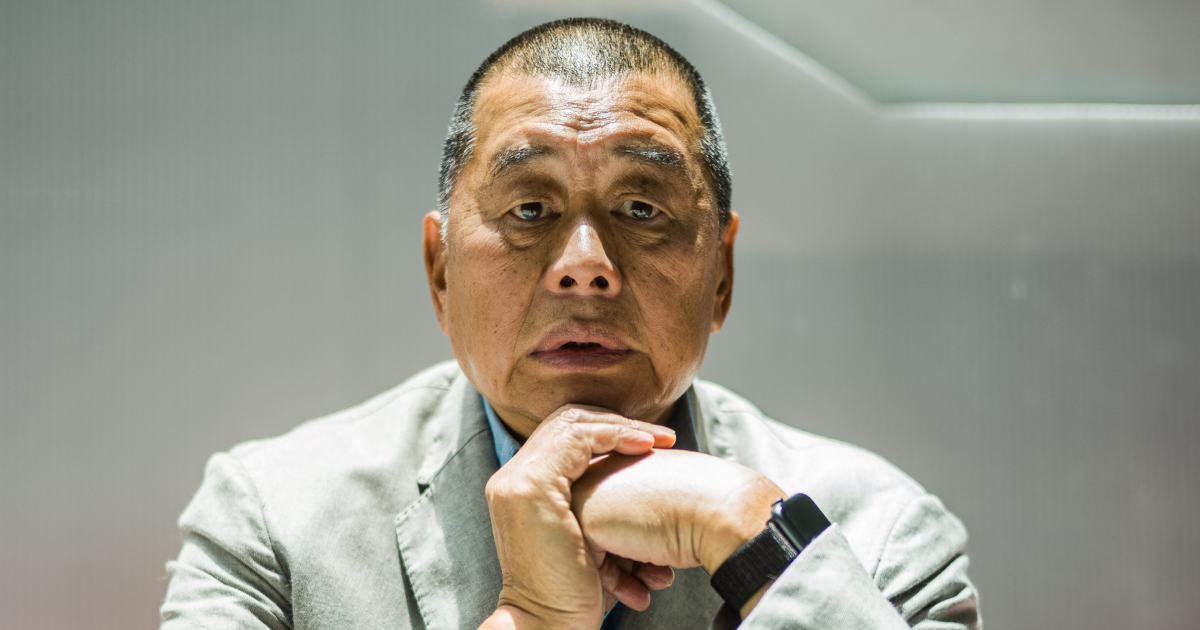


If, God forbid, my friend Jimmy Lai dies in a Hong Kong jail, the Church should immediately recognise him as a martyr. For he has been convicted this week by a Hong Kong court for exercising his freedom of conscience and expression – and his sentencing, expected in the New Year, is likely to carry a minimum 10-year prison term and potentially life imprisonment.
At 78 years old, a diabetic, with his health deteriorating, whatever the precise number of years imposed by the judge, it could in effect amount to a life sentence – unless the international community acts to secure his release.
Given that Mr Lai is a British citizen and a Catholic, there are two leaders who more than any other have a responsibility to demand his release: British Prime Minister Sir Keir Starmer and Pope Leo XIV. Pope Leo has at least sent a symbolic message by meeting Mr Lai’s wife and daughter recently. Keir Starmer has condemned the verdict. But both must now join forces to mobilise the world to free Mr Lai.
On Monday, 15 December, Jimmy Lai – a hugely successful businessman, media entrepreneur and pro-democracy campaigner – was convicted on two charges of conspiracy to collude with foreign powers and on one charge of conspiracy to publish seditious publications.
This verdict, although predictable, is one of the most outrageous miscarriages of justice of our time. He was convicted in a bogus and unfair trial, by a politically biased judge, in a kangaroo court, functioning in a highly repressive police state.
And what do these charges mean? As the head of his international legal team, Caoilfhionn Gallager KC, puts it so aptly, Mr Lai has been convicted of conspiracy to commit journalism, conspiracy to discuss politics with politicians and conspiracy to discuss human rights with human rights defenders. In short, he has been prosecuted and jailed for his opinions and beliefs.
In the 855-page judgment, I was among a number of “foreign forces” Mr Lai allegedly “colluded” with. Apparently, I am named at least 95 times.
I have indeed had the privilege of knowing Mr Lai – and his wonderful family – for over almost a decade, and met with him on various occasions in London, Taiwan and New York. We also communicated regularly by phone and WhatsApp, I appeared on his podcast show, I interviewed him for a YouTube series I ran, and I wrote a weekly column for the English language online edition of his Apple Daily newspaper.
But what were the topics of our conversations? Essentially, they usually revolved around five themes. Life in Hong Kong; freedom and democracy; journalism; family and friends; and our shared Catholic faith.
In any healthy, free and open society these would be normal, innocuous, largely uncontroversial themes. But somehow in present-day Hong Kong my conversations with Mr Lai, as well as his dialogues with other foreigners, amount to a violation of Hong Kong’s draconian National Security Law – even though the conversations largely predated the imposition of that law.
Mr Lai has already been in jail for five years, held in solitary confinement for more than 1,800 days, denied natural light, permitted less than an hour a day of exercise, refused independent medical care of his choice, denied the right to his first choice of legal counsel, and prohibited from receiving the Sacrament of Holy Communion.
This litany of abuse is appalling.
As his daughter Claire Lai described recently in her first ever public interview on EWTN, during her visits to her father in prison she noticed his dramatic weight loss, his dry skin and his nails falling off.
He is also suffering from a heart condition and muscular infection. In a recent op-ed in the Washington Post, Claire described her father as “shrinking to nothing”.
Mr Lai’s son Sebastien, with his international legal team, submitted a new Urgent Appeal to the United Nations and its experts in September, highlighting the serious and immediate risk to Mr Lai’s life posed by his ongoing detention.
Yet amidst this darkness is the extraordinary testimony of Mr Lai’s Catholic faith, which is absolutely central to who he is.
He converted to Catholicism in 1997, being baptised and received into the Church by Hong Kong’s courageous bishop, Cardinal Joseph Zen, with William McGurn, a senior Wall Street Journal editor and columnist and a former US presidential speech writer, serving as his godfather.
From there, his faith took off, encouraged and nurtured by his devoted and devout wife Teresa. Even in his years before arrest and imprisonment, his faith underpinned his fight for freedom and democracy.
I remember several lunches and dinners with Jimmy, Teresa and their family, in which the conversation flowed from democracy to saints, from politics to theology, and from advocacy and journalism to spirituality and religion.
I myself had become a Catholic in 2013, inspired and received into the Church by my friend Cardinal Charles Bo of Myanmar. When I first met Jimmy and his family in 2017, shortly after I had been denied entry to Hong Kong, we had a brief conversation about the circumstances of my deportation, but moved swiftly on to the stories of our respective religious conversions.
In jail, while Jimmy’s body has suffered, his soul has stayed strong. He has spent much of the past five years reading and praying.
Claire confirmed to me that he re-read St Thomas Aquinas’ Summa Theologica, as well as the works of St John Henry Newman, particularly An Essay in Aid of a Grammar of Dissent. St Augustine’s writings have also been a favourite, alongside Peter Seewald’s biographies of Pope Benedict XIV, and George Weigel’s books on Pope St John Paul II. Among the saints, besides those already mentioned, the humility and childlike trust and love for Our Lord expressed by St Therese of Lisieux gives him strength.
Jimmy also drew and painted in his prison cell. Until now I have never revealed this, but I have one of his drawings of Our Lord on the Cross on my wall. It was smuggled out of prison a few years ago and given to me, which is an enormous honour. I look at it every morning when I wake up, and it makes me pray for Jimmy and praise our Lord.
According to Claire, every time she visited her father in jail they would end with prayer. “Even when I visited with my uncle who is agnostic, and even when I go with one of my half-brothers [whom] dad has been encouraging to convert, we prayed,” she told me.
So Jimmy Lai’s life is not only one of wealth and business. It isn’t only one of publishing, protest and politics. It is a life grounded in faith, rooted in courage and conviction, and soaked in prayer.
Each time I met with or spoke to Jimmy, I never felt like I was talking to a billionaire – although of course I was and I respected him deeply.
When I visited his home in Taiwan and his apartment in London, they were comfortable but also homely and beautiful; not grand – and that epitomised the man himself. He has journeyed from a childhood of famine in China, including as a stowaway on a boat to Hong Kong, to the life of a child labourer to becoming an incredibly successful entrepreneur, and then from billionaire to prisoner – a rags to riches and back again story.
If you want to understand his story better, read Mark Clifford’s excellent biography, The Troublemaker, and watch the Acton Institute’s documentary The HongKonger.
I hope I will see Jimmy again. Throughout this article I have referred to him at times as Mr Lai, out of respect. But the reality is he will always be Jimmy to me – the man I chatted to on a weekly basis, about faith, about family and about freedom. A man I pray for daily, and a man I just call Jimmy.
Pray for him. Pray for his brave and faithful family. And join the campaign to #FreeJimmyLai.
Benedict Rogers is Senior Director of Fortify Rights, co-founder and Chair of Hong Kong Watch, and author of The China Nexus: Thirty Years In and Around the Chinese Communist Party’s Tyranny