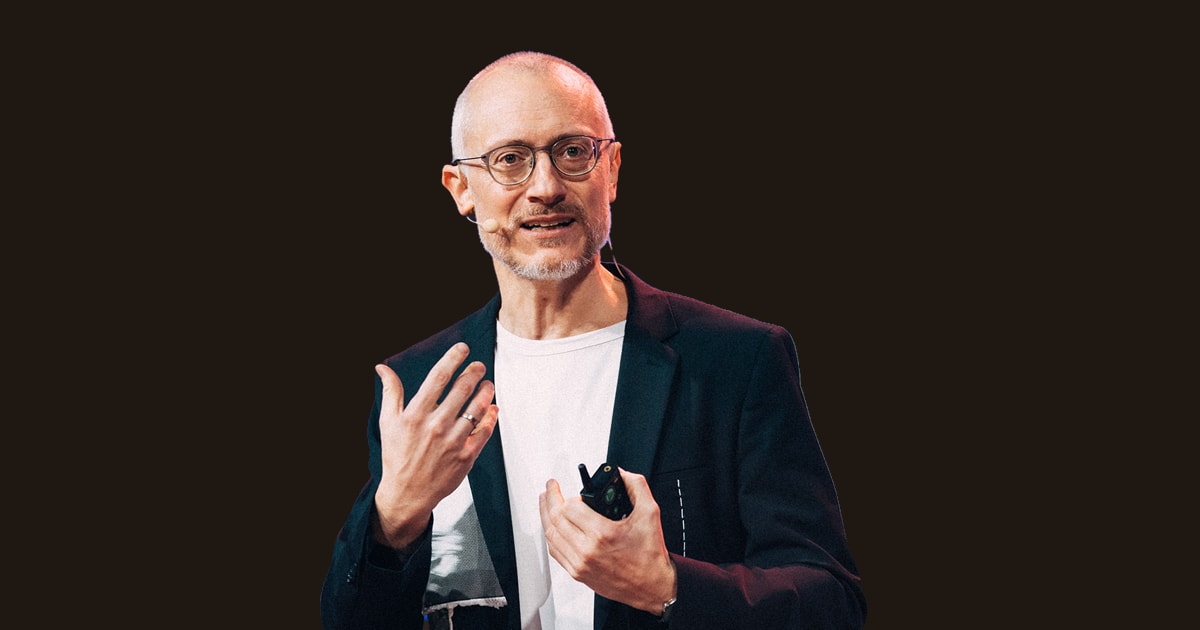



Among the most energetic and thought-provoking speakers at this year’s Alliance for Responsible Citizenship Conference 2026 (ARC) was the German theologian, evangelist and author Johannes Hartl.
Hartl is the founder of the House of Prayer Augsburg (Gebetshaus Augsburg), one of Europe’s most influential and successful ecumenical prayer movements, where continuous prayer has been maintained for well over a decade. A Catholic layman with a doctorate in theology, Hartl has become one of the most prominent Christian voices in the German-speaking world, known for combining intellectual seriousness with a passionate emphasis on prayer, spiritual renewal and evangelisation.
At ARC, where many speakers reflected on the future of Western civilisation, Hartl brought a distinctive perspective. While others focused on institutions, politics, economics or cultural renewal, he repeatedly returned to a more fundamental question: prayer.
For Hartl, the renewal of culture begins not with strategy but with encounter – an encounter with God that changes the human person from within.
After his address, the Herald spoke with him about ARC, prayer, cultural renewal and the role Christians should play in public life.
Catholic Herald: What has been your impression of ARC so far?
Johannes Hartl: I would say ARC is an interesting mixture of people coming together who are against many of the same things. That does not necessarily mean they are all for the same things.
I am not in agreement with everything that is said here. But I do think there is a cultural momentum at the moment. People are beginning to ask foundational questions again with a certain degree of curiosity, and for that reason alone I find it interesting to be here.
CH: Many people at ARC are interested in cultural renewal and social reconstruction. Do initiatives like your House of Prayer have a place in that conversation? Are they even essential?
JH: I appreciate the fact that most people at ARC would agree that religion and a return to our spiritual roots are important parts of the answer to the question of how societies avoid decline.
At the same time, I would never want my own congregation or our House of Prayer to be seen as a tool for bringing about social change. The Church and spiritual life are never merely a means to a societal end. I am here as a speaker to contribute some thoughts. But a House of Prayer is not an instrument in a culture war.
Of course, a culture war is taking place. Yet if Christians are able to shape people through the Good News of the Gospel, that can only have positive effects for everyone involved.
CH: One thing you emphasised that many other speakers did not was prayer itself. Others spoke about Christian values or Christianity more generally. You kept returning to prayer. Why?
JH: Because ultimately there is only one thing that truly changes people’s lives for the better, and that is love. People are changed when they are loved by others, when they fall in love themselves, and above all when they discover that they are loved by God. Prayer, for me, is not a duty. It is not something I simply have to do. It is a loving relationship with God.
We speak a great deal about ideas at a conference like this, and ideas are important. But ideas come from somewhere. Nothing changes a human being more profoundly than an encounter with God.
My own life was changed in that way. I was raised Catholic, and I am deeply grateful for that. But as a teenager I went through a profound conversion experience. It was like falling in love with God.
And love changes everything. When someone falls in love, he is suddenly willing to move cities, change plans, even relocate to another country. Love has that power. The same is true in the spiritual life.
CH: What would be your message to Christians concerned about the future of Western civilisation?
JH: Three things.
First, speak up and be courageous. Perhaps 20 per cent of society will laugh at you. Some may even hate you. But there are many more who are desperately searching for alternative answers. So Christians should not remain silent.
Second, go deep. We cannot afford a shallow Christianity. If someone is genuinely searching for spiritual truth, where will he find it? Will he find a living spirituality in a church? Or will he find it more easily in a yoga studio?
Sometimes people enter a church and hear only discussions about morality, politics or social questions. Important as these things are, the deeper question remains: are people actually encountering God? That is what they are searching for.
And third, Christians must participate in shaping culture. We should not simply leave that task to others. We are called into this world – not to dominate it, not to force people to think as we do, but to be present within it.
I have many friends in politics, including some who are not Christians. They often tell me the same thing: they want Christians to contribute. They want Christians to speak.
So why complain that society is moving in the wrong direction if we ourselves have stepped off the field?
CH: Some Christians feel increasingly marginalised in public life. Are you optimistic?
JH: Yes, I am. There is certainly resistance. There is scepticism. But beneath that scepticism I also see a deep spiritual hunger.
People are searching. The real question is whether Christians are willing to offer something deeper than slogans, political opinions or cultural nostalgia.
If we speak courageously, if we deepen our own spiritual lives, and if we participate constructively in the culture around us, then Christianity has much more to contribute than many people currently realise.
The Church does not lose because the world is stronger than the Gospel. Very often, the Church loses because it never enters the field. And then it complains about the outcome.