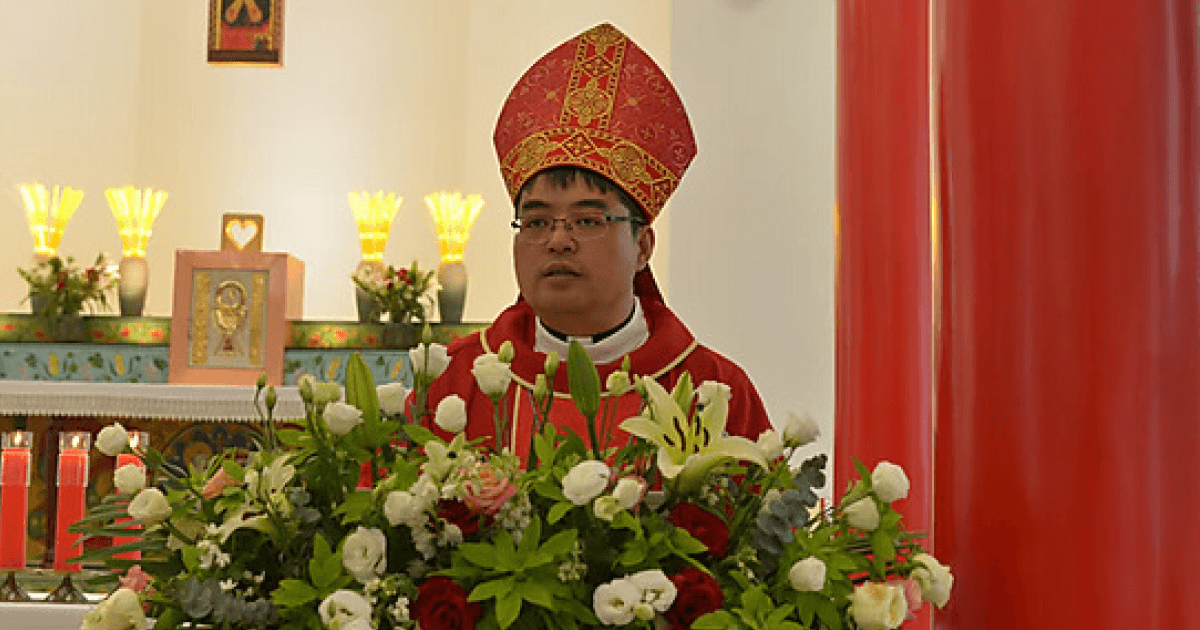
Another bishop has been consecrated in China today under the terms of the secretive Sino-Vatican deal, with Father Joseph Chang Yanfeng now leading the Diocese of Chifeng in the north-eastern corner of the nation.
A statement issued by the Holy See Press Office on 22 July noted that Fr. Chang’s episcopal consecration had been approved by Pope Leo on 15 June, and that the ceremony itself took place earlier today.
Leo’s approval of Chang’s consecration and appointment to lead the diocese was, the Vatican said, “within the framework of the Provisional Agreement between the Holy See and the People’s Republic of China”.
Details from the state-approved church – the Chinese Catholic Patriotic Association (CCPA) – made no mention of the Holy See’s involvement with the appointment, as has been the consistent practice of the Chinese in such matters.
According to the CCPA, the consecration was performed by leading figures in the state church’s various bodies: Bishop Meng Qinglu, Vice Chairman of the CCPA and bishop of Hohhot Diocese; Bishop Pei Junmin, Vice Chairman of the Chinese Catholic Bishops’ Conference and Bishop of Liaoning Diocese; and Bishop Yao Shun of Ulanqab Diocese.
Though no reference was made to Pope Leo’s approval of Chang’s candidacy, the CCPA did note that the new bishop had received the state’s approval, with the Secretary General of the Catholic Bishops' Conference of China reading the “approval letter” of the bishops’ conference.
None of China’s state-approved ecclesial bodies recognise the primacy of the Holy See and all promote the process of “Sinicization” with regard to religions present in the nation. China experts, and even Chinese President Xi Jinping, have commented that Sinicization involves having “all religious communities be led by the [Communist] Party, controlled by the Party, and support the party”.
Newly consecrated Bishop Chang is aged just 42, making him the fifth youngest bishop in the world, with two of the bishops younger than him being those consecrated by the Society of Saint Pius X earlier this month. Ordained in November 2010 for the diocese he now leads, he served as parish priest in the diocesan cathedral for six years and then as diocesan administrator of the diocese since 2021.
What was left out of the Holy See’s biographical details was the fact that he is also the director of the CCPA of Chifeng City, in the Inner Mongolia Autonomous Region – something that the Chinese were keen to highlight.
The CCPA also noted that he was elected bishop by the state church on 20 March. No mention was made by the CCPA of when the Holy See was involved in approving Chang, and it was only the Holy See’s press release which stated that Leo approved the candidate.
Leo is thus demonstrating that he is keen to continue operating under the terms of the highly secretive Sino-Vatican deal, and Change becomes one of a growing handful of Chinese bishops to be approved by the American Pope in accordance with the deal.
The Sino-Vatican deal has remained an immensely confidential arrangement, but is understood to grant the Pope veto power over a candidate chosen by the Chinese. In practice, however, the Chinese have enjoyed almost uninterrupted free reign in selecting candidates and often have proceeded to consecrate the new bishops without properly involving the Holy See. The deal is also understood to allow the removal of longstanding bishops in favour of those approved by the Chinese state.
First signed in 2018, the deal was renewed in 2024 for a four-year term although it is still described as a provisional deal. Cardinal Pietro Parolin, Vatican Secretary of State, has been consistent in his defence of the deal, as was Pope Francis. Speaking to this correspondent in November 2024, Parolin stated that “we are progressing little by little. The challenge is the dialogue – how to dialogue, but we are progressing.”
The secrecy of the text has been one of the oft-raised issues about the entire affair. But Parolin has also defended this aspect, stating in 2023 that such secrecy was “because it has not yet been finally approved.”
Throughout its nearly 8-years existence, the deal has been robustly criticised by Chinese Catholics loyal to the Holy See, by China experts, Western politicians and diplomats, and local clergy. At the time of the first signing, Catholics in the Underground Church spoke about a sense of betrayal by Rome, and such concerns remain very much alive today as immense pressure, punitive measures, and outright persecution are endured by Catholics who adhere to the Underground Church and resist the schismatic, state-approved body.
Speaking to Bitter Winter an Underground priest attested to the loyalty of Catholics to Rome rather than to Communism: “We endure suffering due to our unwavering loyalty to Rome and the Church and our refusal to submit to bishops who prioritise allegiance to the CCP over fidelity to the Pope.”
The Holy See has defended the deal as progressing dialogue with China. But others have linked it to an increase in Christian persecution. Arguably the most vocal political opposition to the deal has come from America.
The U.S. Congressional-Executive Commission on China stated in its 2020 report that the increased religious persecution witnessed in China was “of an intensity not seen since the Cultural Revolution”. The Commission described the abuse as a direct consequence of the deal, and former U.S. Secretary of State Mike Pompeo notably slated the deal in September 2020, writing that “it’s clear that the Sino-Vatican agreement has not shielded Catholics from the Party’s depredations, to say nothing of the Party’s horrific treatment of Christians, Tibetan Buddhists, Falun Gong devotees, and other religious believers.”
Brian Burch, the U.S. Ambassador to the Holy See, has already discussed the Sino-Vatican deal with Leo during their introductory meeting in September. Though no details of that discussion were released, Burch stated during his nomination hearing that he would encourage the Vatican against the idea “that a foreign government has any role whatsoever in choosing the leadership of a private religious institution.”
Even NGO’s such as Human Rights Watch and ChinaAid issued calls early in the Leonine pontificate for the deal to come to an end, and renewed those in recent months.
Though the deal continues, it does appear that in the past 14 months, China has not acted as unilaterally as in previous years, suggesting that Leo will be happy with the current relationship if it continues in this vein.
Michael Haynes is an English journalist in the Holy See Press Corps. He serves as Vatican Correspondent for the Catholic Herald, while readers can follow him at Per Mariam and on X @MLJHaynes.