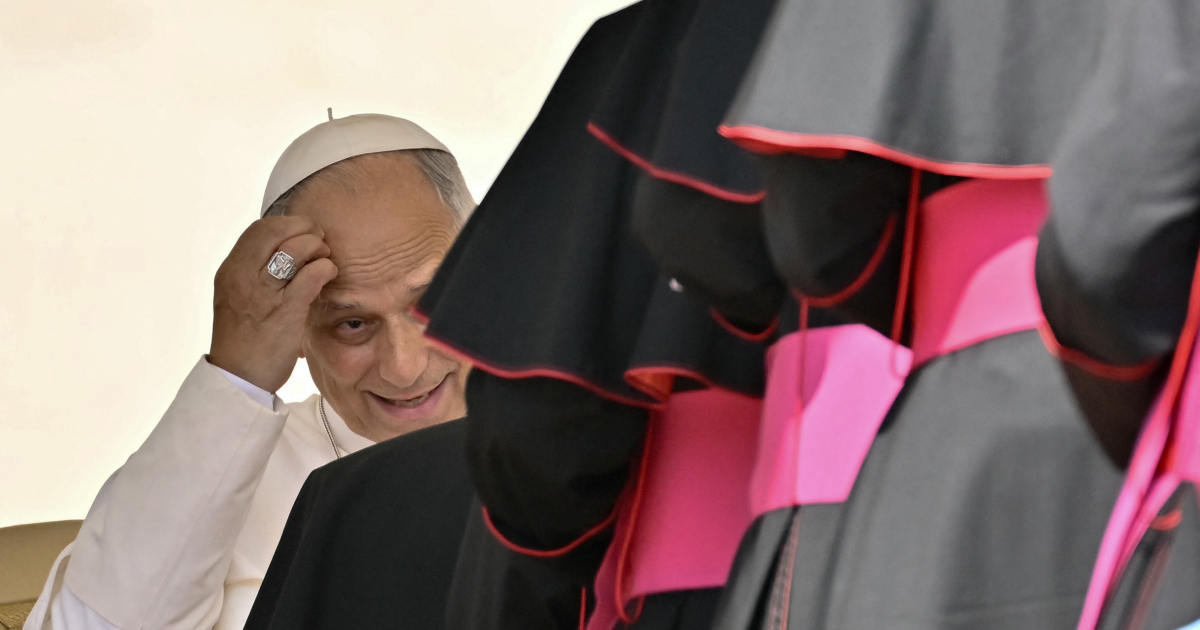


Beginning the Extraordinary Consistory, Leo XIV urged his cardinals to be honest and frank with him, whilst also highlighting the need for unity born out of obedience to Christ.
The second part of January’s consistory was how this two-day meeting was originally billed, but in recent weeks it has taken on a nature of its own, thanks to the publication of Magnifica Humanitas and the attention given to the 2028 Synodal Assembly.
Removed from the schedule was any discussion of the Just War Doctrine – which Leo wrote in his encyclical was out of date – along with discussion of the liturgy. The absence of this latter point appears to be directly due to the imminent episcopal consecrations planned by the SSPX for July 1, according to reliably sourced Vaticanist Nico Spuntoni.
Perhaps in light of the swirling controversies, therefore, Leo chose to emphasise his desire for ecclesial unity and communion when delivering two addresses to the College at the start of proceedings.
Delivering his homily during the early morning concelebrated Mass, Leo delved into three themes: “true freedom of faith”, the “gift of peace through unity” and, finally, “harmony through obedience”.
These watchwords became the Pope’s own guidance for the work ahead of the consistory, combined with his personal endorsement of the Synod on Synodality’s style as a method of achieving such goals.
“The implementation of the Synod, to which we are committed, invites everyone to move forward in unity of faith, in promoting peace, and in obedience to Jesus, the living Word,” he said. For Leo, the “collegial” working of the College of Cardinals “embodies the synodality in which all the baptised participate in the unity of the People of God”.
Collegial was certainly not an empty term. Addressing the College again at the start of the consistory meeting, Leo called on them to assist him in exercising the papal office. “The ministry that the Lord has entrusted to me cannot be carried out alone,” he noted. “It requires your experience, your pastoral wisdom, and your knowledge of the Churches and the peoples entrusted to you.”
The Pope urged the 178 cardinals present to assist him in hearing “what is emerging in the Churches, to recognise the signs of hope that often grow in silence, but also not to ignore the struggles, misunderstandings, and resistance that can slow down the journey”.
Their counsel was welcome, he added, including in its “freedom, frankness and loyalty”. “Sincere counsel is always an act of communion,” he continued. “I am counting on you to help me discern what the Spirit is saying to the Church today. I need your support: strong, explicit, and public. I need to feel supported by you as by brothers.”
Each of the four sessions of the consistory is given over to a different theme: first, the needs of the Church today; second and third, Magnifica Humanitas; and fourth, the 2028 Synodal Assembly.
This continued attention to the Synod has not been without controversy, especially given that it was already discussed in January and the liturgy has now been avoided at both consistories.
It has long been the assessment of this correspondent that Leo has utilised the language and themes of the Synod while steering it in a different direction – back to something resembling the standard work of cardinals under the Pontiff. But whether this proves to be true, one thing that is clear is his firm commitment to “synodality” as the future for the Church, and that is an element which has awakened no little concern among many commentators.
Explaining the consistory’s focus on synodality, Leo told the College that “synodality points to a way forward: listening, discerning, and jointly assuming responsibility for the choices the Lord entrusts to us”.
He rejected the idea that synodality is “a diminishment of authority”, arguing instead that “it helps us to understand more deeply the meaning of authority itself, which exists to safeguard communion, foster the participation of all, and guide the Church’s common journey”.
The Pope also dealt directly with the consistory’s organisational style, which has copied the round-table method famously employed during the Synod on Synodality and pioneered by Pope Francis in 2022. Numerous cardinals lamented the small-table format following January’s consistory, but notably Leo has chosen not to respond to their concerns. “This too is part of the journey along which the Lord is leading us,” he said in defence of the method.
Leo did add that cardinals were still at liberty to send “confidential observations or reflections” to him personally, but urged them to “enter into this ecclesial exercise with confidence”. Such a phrase points to the widespread mistrust among many Vatican observers and some cardinals, who are of the opinion that it is the Synod Secretariat which is largely responsible for running the consistories – a suspicion not helped by the curious lack of Vatican transparency when asked by journalists who organised January’s consistory.
“We learn synodality by practising it; we learn together to grow in communion,” said the Pontiff.
In many ways this June consistory is a key moment for Leo to show his strength to the College of Cardinals and prove to them that he can provide the steady leadership necessary. It comes against the backdrop of the SSPX's consecrations and the German bishops’ continued pushback against doctrine – both of which challenge Leo’s authority.
But as more than one Vaticanist has observed, the push for unity and communion at the consistory may come to pass, yet it shall do so at the cost of addressing anything of substance, since all the controversial crises needing urgent attention have been studiously left off the table.
Michael Haynes is an English journalist in the Holy See Press Corps. He serves as Vatican Correspondent and Analyst for Pelican+ and the Catholic Herald, while readers can follow him at Per Mariam and on X/Twitter @MLJHaynes.