








NEWS ...from and about Synod 2015
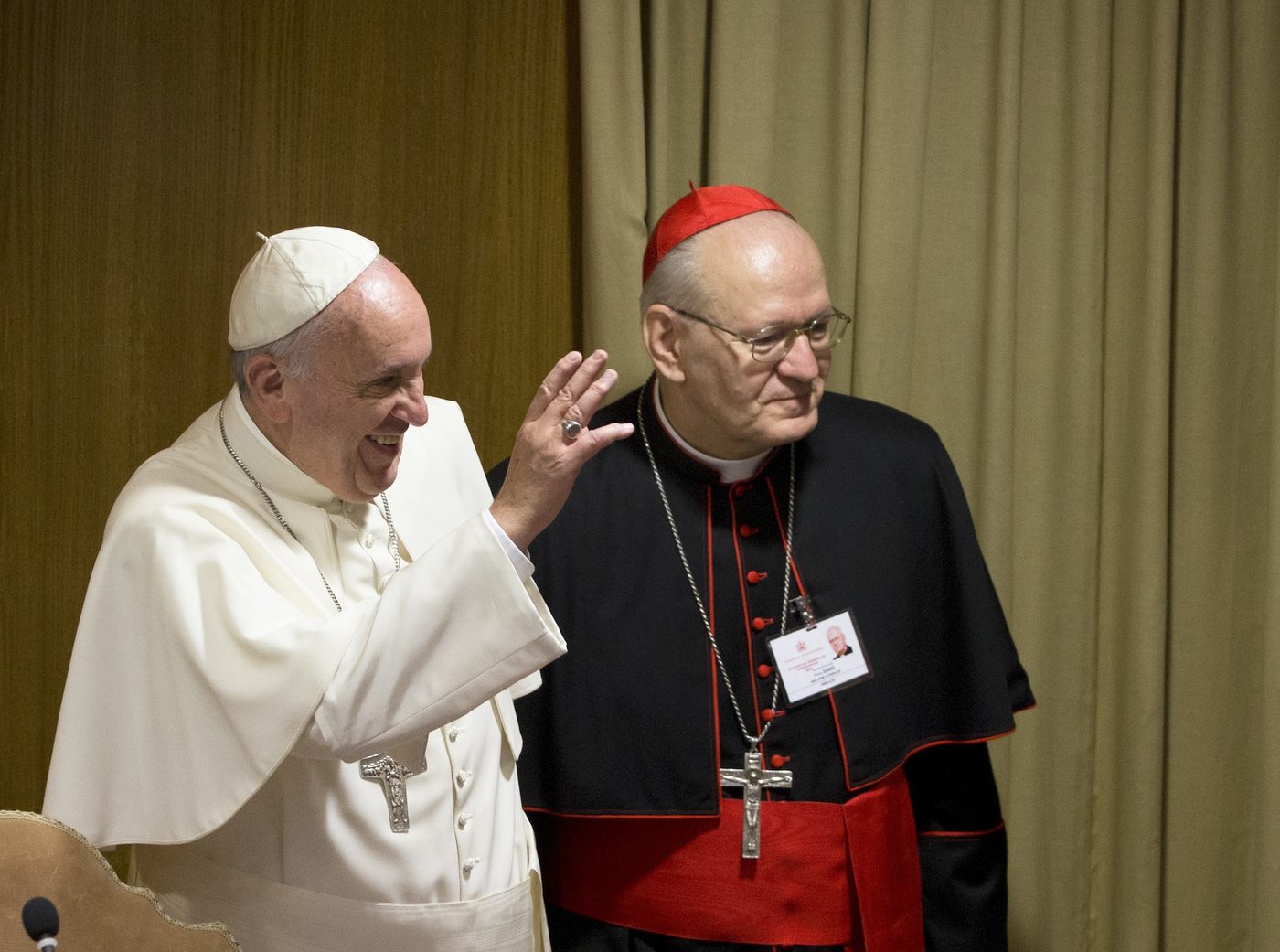
Two addresses, given on the morning of October 5, set down important markers for Synod-2015 on its first formal day of work. Pope Francis began by urging the Synod to “always keep before our eyes the good of the Church, of families, and the supreme law, the salus animarum [the good of souls].” The Holy Father then defined the unique character of a Synod: “…the Synod is neither a convention, nor a parlour, nor a parliament or senate, where people make deals and reach compromises. The Synod is rather an ecclesial expression, i.e., the Church that journeys together to read reality with the eyes of faith and with the heart of God; it is the Church that interrogates herself with regard to her fidelity to the deposit of faith, which does not represent for the Church a museum to view, nor even merely something to safeguard, but is a living source from which the Church shall drink….” The Synod, Pope Francis continued, happens within a Church in which bishops are “shepherds – which is to say…servants.” The Synod fathers must remain open to the power of the Holy Spirit; but that power will only be felt if the bishops “vest ourselves with apostolic courage, which refuses to be intimidated in the face of the temptations of the world – temptations that tend to extinguish the light of truth in the hearts of men, replacing it with small and temporary lights; nor even before the petrification of some hearts, which, despite good intentions, drive people away from God; apostolic courage to bring life and not to make of our Christian life a museum of memories…” And so, the Holy Father concluded, “the only method of the Synod is to open up to the Holy Spirit with apostolic courage, with evangelical humility, and confident, trusting prayer, that it might be He who guides us, enlightens us, and makes us put before our eyes…fidelity to the magisterium, the good of the Church, and the salus animarum.” The second defining speech was given by Cardinal Peter Erdő, Archbishop of Esztergom–Budapest and Rapporteur-General of the Synod. After reviewing the contemporary crisis of marriage and the family in its various dimensions, Cardinal Erdő spoke about marriage and family life as a vocation: institutions given by God as part of the “divine pedagogy” by which we learn the dignity of human life and human love, and the true meaning of our being made male and female. The Hungarian cardinal then looked at marriage and the family through the lens of Revelation and theology, noting that in God’s creative design, the unitive and procreative dimensions of marriage were “inscribed” as a truth-built-into-us. Christ’s work of redemption, he continued, had restored within marriage and the family “the image of the Most Holy Trinity, from which springs every true love.” Cardinal Erdő then located the Christian family in the context of the New Evangelisation, reminding the Synod fathers that “the missionary dimension of the family is rooted in the sacrament of Baptism,” through which all are commissioned to be missionary disciples, and from which the Christian family is constituted as a “domestic Church.” Thus the family, as St John Paul II taught in the apostolic exhortation Familiaris Consortio [The Community of the Family] “is the way of the Church,” a point Blessed Paul VI had also underscored in the encyclical Humanae Vitae, when he challenged the many ways in which modern technology detached marriage from family by separating “procreation from conjugal love.” Moreover, as Benedict XVI taught in the encyclical Caritas in Veritate [Charity in Truth], “the experience of love in marriage and the family” is absolutely vital to the life of society: not least, Erdő continued, because the family is the place where one learns the meaning of the common good through experience. The Synod Rapporteur-General then underscored that the “teaching of Christ on matrimony,” monogamy and the indissolubility of marriage, was a “true gospel and a font of joy” in which the human person realizes his or her “vocation to personal relationships” of freedom, mutual self-gift, and full acceptance of the other. This teaching on indissolubility, the cardinal noted, had come from the Gospels and St Paul, and has always distinguished the Christian view of marriage from others’. Cardinal Erdő then reminded the Synod fathers that mercy and revealed truth cannot be put into opposition, for “merciful love, as it attracts and unites, also transforms and lifts up. It is an invitation to conversion.” In this light, the cardinal then affirmed that “a merciful pastoral accompaniment of the divorced and civilly remarried” cannot “leave in doubt” the “truth of the indissolubility of marriage taught by Jesus Christ himself.” “The mercy of God,” he continued, “offers sinners pardon” but always “calls to conversion.” Erdő then noted that “it is not the shipwreck of the first marriage but the living-together in the second relationship that impedes access to the Eucharist.” The cardinal then referred to the teaching of John Paul II in Familiaris Consortio (#84): when those who in conscience believe that, for the sake of their children or the common life they have built in a second marriage, they must remain in that marriage, there is access to the sacraments of Penance and the Eucharist when the couple practices continence, “living their relationship as one of mutual help and friendship.” Such a requirement on the part of the Church does not, Erdő said, reduce marriage to a mere exercise in sexual expression, but rather recognizes the truth of the situation, which reflects the truth about marriage taught by Christ. As to the question of “gradualism” in an individual’s or couple’s growth in the moral life, Cardinal Erdő said that, while we all grow in the life of grace, it is also true that “between true and false, between good and evil, there is in fact no such ‘graduality’.” And while there may be “some positive aspects” to be found in irregular relationships, “this does not imply” that these relationships “can be presented as good.” Taking his text from a document of the Congregation for the Doctrine of the Faith, Cardinal Erdő then stated that “there is no foundation” in truth for making any “analogy, however remote, between homosexual unions and God’s design for marriage and the family,” while urging respect and sensitive pastoral care for people who experience same-sex attraction. The cardinal then urged the pastors of the Church to resist campaigns to affirm these new designs for building families, and stated bluntly that the pressures put on poor countries by international institutions that condition financial aid on the former’s acceptance of “same-sex marriage” are “unacceptable.” The Rapporteur-General concluded by urging the Synod fathers to continue their attentive listening to the Word of God so that the Church’s response “to the needs of our contemporaries” may be one that “offers them liberating truth” in the witness of greater mercy. [A few analytic comments: Pope Francis’s speech to the Synod made clear that the Church reads and judges the signs of the times through the lens of the Gospel; the Gospel is not judged by the signs of the times. Moreover, the Holy Father clearly affirmed that there are “sacred givens” in the life of the Church, and to ignore them is to cut oneself off from the wellsprings of the life of grace. The Pope’s subtle but unmistakable rejection of pressures from “the world” on the Synod and the Church made clear his conviction that the world does not set the agenda for the Church; thus Pope Francis quietly but unmistakably declined to follow the path trod by the World Council of Churches and Liberal Protestantism in general. Despite some spin from the Vatican Press Office, to the effect that Cardinal Erdő’s address was limited to the first third of the Instrumentum Laboris (the Synod’s working document), the cardinal in fact ranged far more widely than that section of the IL (whatever the agenda created by the Synod general secretariat may have decreed). And in doing so, the Rapporteur-General touched forcefully on many of the most controversial issues that had emerged in the pre-Synod debate and manoeuvering. By discussing the family within the context of the New Evangelisation, he tried to steer the Synod toward a discussion of the contemporary crisis of chastity, marriage, and the family that fit Pope Francis’s call for Catholicism to be a “Church permanently in mission.” His robust defence of the indissolubility of marriage and his reaffirmation of John Paul II’s teaching on Holy Communion for the divorced and civilly remarried in Familiaris Consortio seemed to many a clear indication, unlikely to have been given without Pope Francis’s approval, that what has become known as the “Kasper proposal” is off the table at Synod-2015 – an intuition confirmed by reports that Cardinal Kasper did not applaud Cardinal Erdő’s speech and seemed somewhat shocked by it. Similarly, the Erdő address seemed to make clear that the Synod would not endorse “civil unions” for same-sex couples, even as it would urge the United States Agency for International Development and various UN agencies to cease conditioning development aid in the Third World on the legalisation of “same-sex marriage.” There were indications late in the day that some Synod fathers believed that Synod-2015 would be well-served, and might proceed according to the original intention of Pope Francis, were the Erdő address to replace the Instrumentum Laboris as the foundational text for the Synod’s discussions or be used in tandem with it. Whether that happens or not, Cardinal Erdő, in sync with the opening speech of Pope Francis, oriented Synod-2015 toward that for which many, many Catholics had hoped: a Revelation-based reflection on the glory of marriage and the family, as the answer to the crisis of those basic institutions in the post-modern world. It now remains to be seen whether the message about the Synod’s work and its goals that the Holy Father and Cardinal Erdő delivered is understood, and taken to heart, by those who came to the Synod with other purposes in mind. XR2










