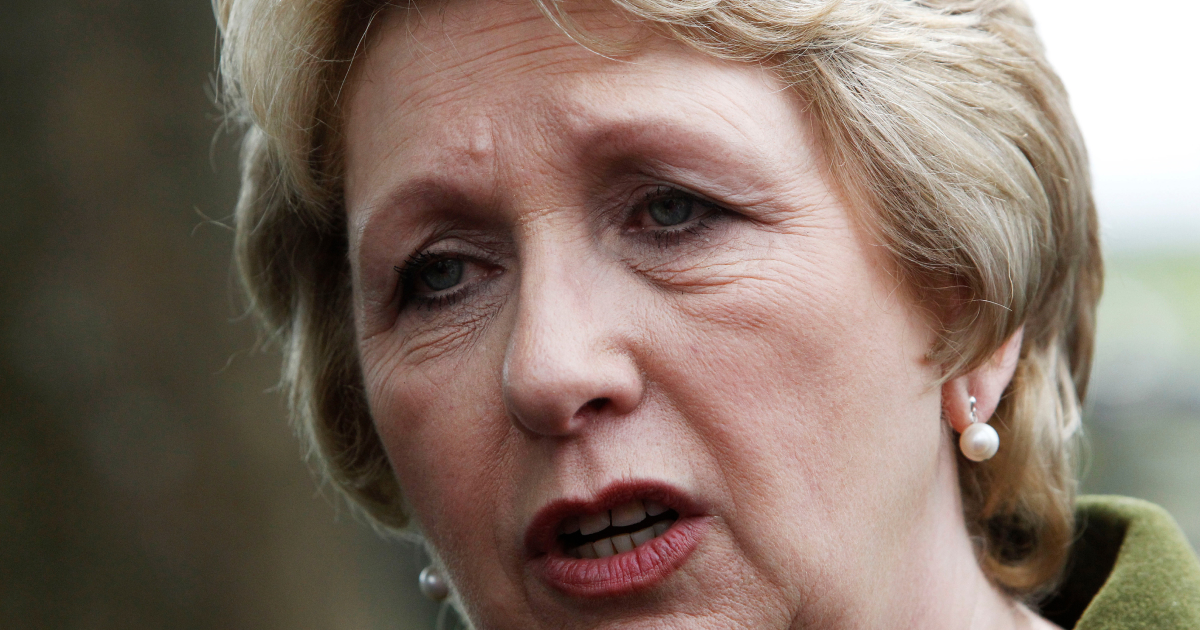


Mary McAleese, former president of Ireland, has contended that the Church is undermining the rights of the child by assuming that infant baptism implies membership of the Church. She is, admittedly, not to blame for the headline on the edited version of her text in The Irish Times which read: “Baptism denies babies their human rights”, but it is not far from the substance of her talk at University College Cork recently. In it, she says that “throughout the world, there continues a long-standing, systemic and overlooked severe restriction on children’s rights with regard to religion… [The Church] restricts children’s rights as set out in the Universal Declaration of Human Rights (UDHR) in 1948 and the United Nations Convention on the Rights of the Child (UNCRC) in 1989, to which both Ireland and the Holy See, which governs the Catholic Church and is effectively the author of canon law, are State Parties”.
It is a large charge. What she is talking about is the assumption that infant baptism equates to membership of the Church, even though the infant plainly cannot consent to the sacrament or to the baptismal promises made in his or her name by the godparents. “Church membership”, says Mrs McAleese, “is the man-made juridic effect of Baptism”. She points out that when she, as a child, was confirmed, she was asked, as children are today, to “renew our Baptismal promises”. But, she says, “the idea is risible. What possible promises could non-sentient babies make? How can they be renewed when they were never made in the first place?”
“Yet these fictitious Baptismal promises are a significant part of the foundational narrative on which the Church’s governing authorities claim authority over Church members, and claim members must honour the compulsory obligations entered into at Baptism. These mostly concern submission to magisterial control, to the authority and teachings of the Pope and bishops, rather than to Christian love of neighbour.”
Let us pass over the notion that canon law is divorced from Christian love of neighbour, something that other canon lawyers, Mrs McAleese has a degree in canon law, may dispute. What is striking here is the implication that the Church is somehow in a position to exercise “magisterial control” over the infants it baptises. I cannot think of any meaningful way in which my own children, baptised at three days old, were compelled to submit to the authority of the Pope by virtue of their baptism. Baptism has enabled them to attend Catholic schools and to be confirmed, and if they want their marriage to be recognised by the Church, it is up to them, they will have to marry in a church or obtain a dispensation. Where is the problem?
Mrs McAleese does not dispute the spiritual effects of baptism, expunging original sin and conveying grace. But she goes on to say that “imposed life membership without sentient consent can by no means be regarded as indelible or as a divinely ordained spiritual effect”. Well, it can. Christ’s words to Nicodemus, that “unless a man be born of water and of the Spirit, he cannot enter into the Kingdom of God”, have been liberally interpreted by the Church, especially in more recent times. So too has his commission to the apostles to make disciples of all nations, “baptising them in the name of the Father, the Son and the Holy Ghost”. What is not implied is the notion that baptism is something that can be rescinded at will, though of course baptism, by itself, does not entitle the baptised to enter Heaven. It is presented as a kind of rebirth rather than a legal contract, which is how Mrs McAleese seems to view it.
What is true is that in the early Church, baptism was a solemn undertaking which people tended to postpone, and it was administered to adults. But the introduction of infant baptism was the natural consequence of the belief that, without baptism, a child would be debarred from Heaven and destined for Limbo, a happy place for virtuous pagans and unbaptised infants, though without the presence of God, which oddly echoes a phrase in Virgil’s Aeneid. Mrs McAleese puts it differently: “Naturally, parental fear of the uncertain salvific consequences of those children who die unbaptised still has a powerful psychological hold which bolsters the traditional practice of infant Baptism. That practice is the single most important method of recruiting new Catholics.”
Certainly, infant baptism is the means by which most Christians, let alone Catholics, become Christian. The phrase “recruiting new Catholics” is how one might describe a sect pulling in new members, not the means by which a new Christian is given new life. It is oddly conspiratorial language to describe a gift. As she observes, “eighty four per cent of the Catholic Church’s 1.4 billion members worldwide were enrolled as full members for life of the Church as infants”. Another way of putting it is that they were baptised into the Christian community as infants, with all the grace that entails.
The problem for Mrs McAleese is that infant baptism “ignores their later rights as maturing children to freely decide for themselves their religious identity, to accept and embrace Church membership or to change religion if that is their choice”. There is, however, nothing actually stopping baptised people from apostasising, a term Mrs McAleese dislikes, and becoming Protestants or Zoroastrians, though they cannot then receive the Eucharist or other sacraments in good faith. The only penalties are ecclesial and canonical, not secular. There are, I am sorry to say, any number of baptised Catholics who have done exactly what she describes as their right and have changed religion, including adolescents, and that is their loss. The religious upbringing of a child is in the hands of his or her parents, but the same is true of the philosophical and moral assumptions of the family to which the child belongs.
Mrs McAleese speaks admiringly of a recent judgment of the UK Supreme Court whereby a child in a Northern Ireland state school may not be taught religion as truth, but as one of a menu of alternative beliefs. As she puts it, the ruling “restricts religious education and collective Christian worship in schools in Northern Ireland on the grounds of interfering with the child’s autonomous rights, [and] has potential to impact similar practices in the Republic of Ireland”. But the glaring reality is that this simply imposes a different set of beliefs on a minor. To teach a child that no one religion has any greater claim to truth than another, or is any better than another, is not a neutral position. It is itself a dogma, or at least a philosophical belief, and imposing it on a child is another kind of indoctrination, even if it is more congenial to secularists.
She does have a point that the number of baptised Catholics is not the same as the number of practising or believing Catholics. Two of my cousins were baptised. One is now an unbeliever and the other a Buddhist. Yet counting non-practising Catholics as not Catholic is tricky too. People who let their religion lie fallow for years may suddenly return to it. Confirmation takes place at the age of reason, but that too does not guarantee the practice of the faith. Finding alternatives to baptism as a measure of active Catholicism is not easy. In Germany, there is the abomination of a Church tax, the payment of which entitles individuals to receive the sacramental benefits of the Church, and refusal to pay is equated with apostasy. That strikes me as simony, and Pope Benedict, himself German, found that system repugnant.
The real problem lies not in infant baptism, but in viewing it in these peculiar terms. How entry into the life of grace can be seen as the deprivation of rights is beyond me. The trouble is that Mrs McAleese is a lawyer, and we know what Christ made of them.