


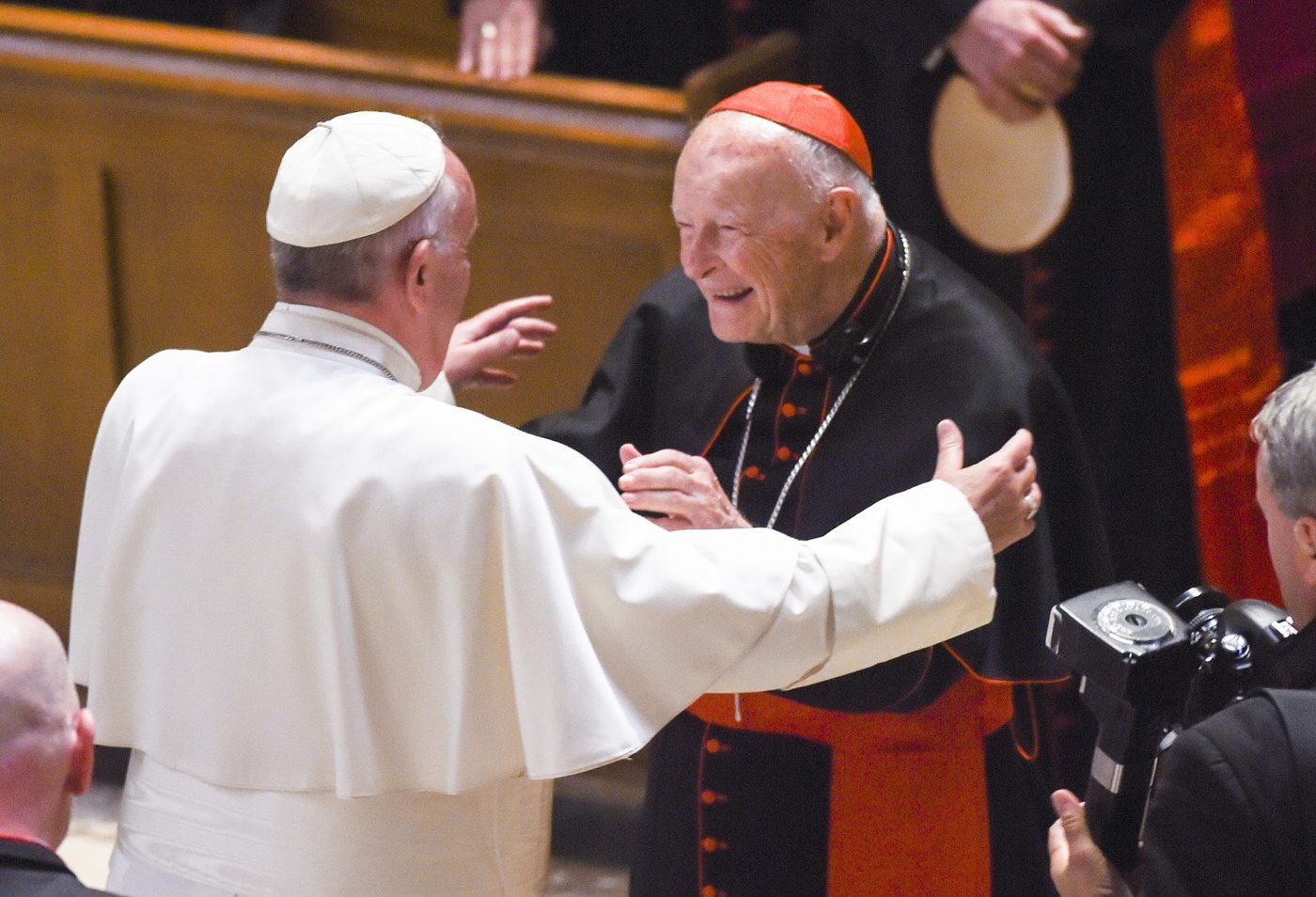
The full text of the Report Report on the Holy See’s Institutional Knowledge and Decision-Making Related to Former Cardinal Theodore Edgar McCarrick (1930 to 2017) is available on the Vatican website, here. Readers should be advised that the Report contains potentially disturbing accounts of sexual abuse. -- Catholic Herald, Rome -- The Vatican released the McCarrick Report at 2pm Rome Time on Tuesday, more than two years after announcing the inquiry into the Holy See’s institutional knowledge and decision-making process related to the rise and fall of the disgraced former Cardinal and Archbishop of Washington, DC, who was penally removed from the clerical state last year. At 449 pages, the full Report will take time to unpack. The 14-page (excluding cover matter) executive summary released to accredited journalists shortly before the Report, however, contains very little news. We learn on page 12, for example, that the Apostolic Nuncio to the United States, Archbishop Carlo Maria Viganò, received instructions from the Prefect of the Congregation for Bishops, Cardinal Marc Ouellet, “to take certain steps, including an inquiry with specific diocesan officials,” and one of McCarrick’s priest-accusers, in order to determine the credibility of the allegations the accuser had made. “Viganò did not take these steps,” we are told, “and therefore never placed himself in the position to ascertain the credibility,” of the allegations. When the executive summary discusses decisions the various popes from John Paul II through to Francis, however, the style switches to the passive voice. “Ultimately, the path of a canonical process to resolve factual issues and possibly prescribe canonical penalties was not taken,” for example, in 2006, when Archbishop Viganò wrote two memoranda on the subject of McCarrick and urged a canonical process. Cardinals Ouellet and Bertone – the latter the Secretary of State at the time – agreed with Archbishop Viganò’s assessment. The McCarrick Report is supposed to be an exercise in institutional decision-making analysis. The broad outlines tend to paint a picture in which ambiguous comportment and even sexual misconduct with adults was not considered too terribly troubling. That’s apparently true even when the persons involved were clerics or aspiring clerics. Allegations of serious turpitude if not criminal behaviour were easily dismissed. “At the time of McCarrick’s appointment [to Washington, DC],” the Report states at page 8, “and in part because of the limited nature of the Holy See’s own prior investigations, the Holy See had never received a complaint directly from a victim, whether adult or minor, about McCarrick’s misconduct.” Let that sink in. It says they never heard from victims or other witnesses, “in part” because they never looked into them very closely at all. “For this reason,” the page-8 bullet point continues, “McCarrick’s supporters could plausibly characterize the allegations against him as ‘gossip’ or ‘rumors [sic]’.” The editorial gloss from Vatican News editorial director Andrea Tornielli is quick to point out that “Pope Francis reacted promptly,” indeed, “[a]s soon as the first report was received from a victim who was a minor at the time the abuse was committed.” “This,” Tornielli declares, “is what emerges from the Report on the Holy See’s Institutional Knowledge and Decision-Making Related to Former Cardinal Theodore Edgar McCarrick (1930 to 2017) published by the Secretariat of State.” Only, that’s not what emerges from the Report. That is what we already knew. What emerges from the Report is all the times people in the Vatican heard things, and did very little. What emerges from the report is that almost anything not meeting the “smoking gun” level of evidence, or specific, on-the-record testimony from multiple accusers or other eyewitnesses, was “rumour” or “gossip” that did not trigger any sort of real closer look. The summary section also contains a paragraph explaining:
12:00 AM
McCarrick Report: first look
At 449 pages, the full Report will take time to unpack, but here are a few highlights from the executive summary and Vatican gloss.
Christopher R. Altieri

4 min read



Already a subscriber? Sign in
5freearticles every month
Continue reading with a free account. No card needed.
- Five free articles every thirty days, on any device you sign in on
- The Catholic Herald newsletter, every morning
- Subscribe whenever you like for everything: every article and the magazine
Related articles
 Newsroom
Church leaders urge Drumcree dialogue: ‘Too much is at stake’
The Catholic and Church of Ireland Archbishops of Armagh have urged a renewed commitment to peace and reconciliation amid the Drumcree stand-off
Corrie Douglas-Young Newsroom
Thousands of Irish children to join global Rosary campaign
Corrie Douglas-Young Newsroom
TikTok priest urges young people to stand with persecuted Christians
Nathalie Raffray Newsroom
Baby born at 25 weeks reunites with neonatologist two years after leaving hospital
The Catholic Herald Newsroom
Joe Biden honoured by Planned Parenthood after defending abortion rights
Christine Rousselle
subscribe to the catholic herald today
Our best content is exclusively available to our subscribers. Subscribe today and gain instant access to expert analysis, in-depth articles, and thought-provoking insights—anytime, anywhere. Don’t miss out on the conversations that matter most.
Subscribe



