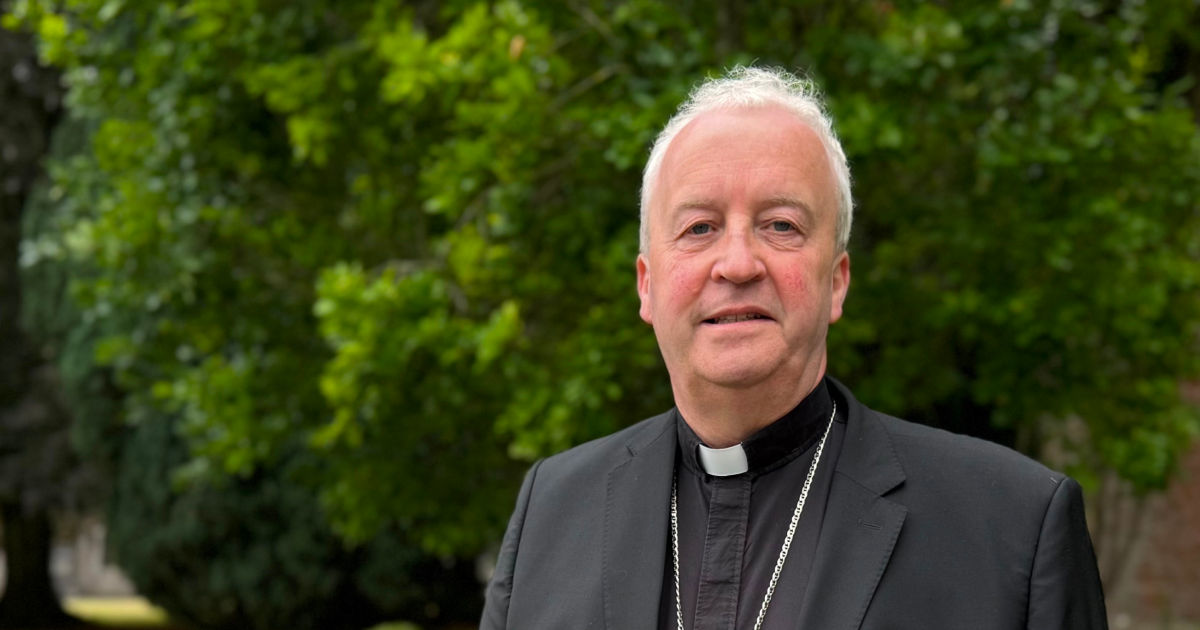


Bishop Michael Router of Derry said during his installation Mass that in the face of a “realistic awareness of decline and change” in the Church, there is also a “conviction that considerable spiritual resources remain”. Speaking on September 20, he noted that the diocese possessed a “recognisable ecclesial culture and identity that will endure”.
Bishop Router succeeded Bishop Dónal McKeown as Bishop of Derry, who resigned from the position following his 75th birthday as required by canon law. The installation was led by Archbishop Eamon Martin of Armagh, Primate of All Ireland.
In his homily, Bishop Router pointed to priests and laity within the diocese whom he had spoken to in the weeks preceding the installation who “recognised a strong resilience in the face of difficulties”.
“Church scandals and the changing patterns of practice are prominently mentioned, yet all speak of ‘pockets of hope' and a ‘strong foundation to build upon’. The common picture is that of a diocese whose spiritual life is sustained not only by formal liturgy but by a broad culture of popular prayer and devotion,” he said.
“Both the priests and the laity I listened to in the formal meetings and in casual encounters valued inherited traditions but they also recognise the need for renewal, for new approaches that speak to people immersed in a modern culture so completely different from anything experienced before in history. Much of what emerged from these brief consultations are the foundations upon which a future pastoral strategy can realistically be built.”
The bishop emphasised that the faithful could not “stay any more within the safe confines of a Church building or in a particular holy huddle” as he urged them to leave their “comfort zones and strive to help others to encounter Jesus Christ where they are”.
He noted that the modern world had presented new challenges to evangelisation. “We cannot ignore the realities we face today,” he said, “but neither can we simply wish ourselves back to another time, no matter how idyllic we believe that time to have been.”
“The Lord does not ask us to live yesterday’s mission, but to proclaim the Gospel in the here and now. To proclaim it, not just to those who have arrived early in the vineyard, but also to those who wilfully and stubbornly stay outside the gate,” he said.
“If the Church in Ireland, and in Europe, is to thrive in the 21st century, then formation in this understanding of Baptism will need to be a priority. It is vital that every baptised person realises that they are sent as missionaries into a world that is thirsting for the new life and hope that only the Gospel of Jesus Christ brings.”
Earlier this month, hundreds of faithful filled St Mary’s Cathedral in Ossory as Bishop Ger Nash, who is also Bishop of Ferns, was installed as bishop where he now ministers to both dioceses. The two dioceses are now united in persona episcopi, meaning in the person of the bishop.
In his homily at the installation Mass on September 13, he similarly called on Catholics to go “where God intends us to be”.
“God’s journey does not begin in some mythical ideal land, but in the messy reality of what it means to be alive today, to be fully human today, to be Christian today,” he said.
“It is the very nature of the Incarnation that God chose to enter a messy world, a real world, bringing with him the greatest treasure of all: the promise that all lives will ultimately make sense, and that there is a level of deep meaning which we can achieve in communion with one another.”