


February 12, 2026

Pope Francis on Palm Sunday: Our Lord "never stopped loving"

Staff Reporter
More
Related
Min read
share
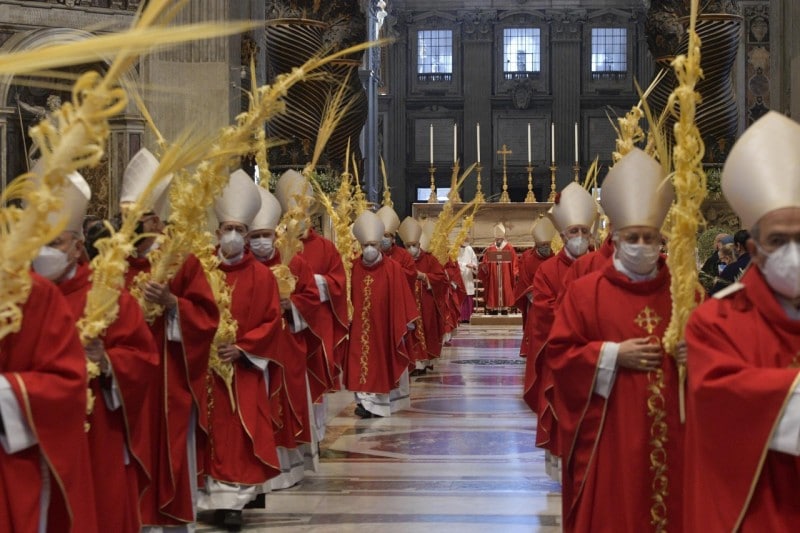
Image: Palm Sunday Mass in St Peter’s Basilica, 28 March 2021. ©Vatican Media
Pope Francis led the liturgy inside Saint Peter’s Basilica this Palm Sunday – for the second year in a row, owing to coronavirus emergency restrictions – with a limited congregation gathered before the altar of the chair behind the high altar. 120 places were reserved for the faithful, and some thirty for cardinals.

In his Angelus remarks -- delivered from the basilica -- Pope Francis noted that this is the second year in a row we are marking Holy Week under pandemic conditions. “Last year, we were mostly shocked,” Pope Francis said. “This year we are more sorely tried.” At the end of his Angelus remarks, Pope Francis also offered prayers for Indonesia, where suicide bombers wounded more than a dozen people in a Palm Sunday attack on a Catholic cathedral.
In his homily, Pope Francis focused on the sense of amazement Holy Week evokes, from the joy with which Our Lord is greeted on entering Jerusalem to the sorrow of his condemnation, passion, and crucifixion.

“His people expect a powerful liberator at Passover,” Pope Francis said, “yet he comes to bring the Passover to fulfilment by sacrificing himself.”

Noting that his people hoped to vanquish the Romans by the sword, while Jesus had come to celebrate God’s triumph through the cross, Pope Francis asked: “What happened to those people who in a few days’ time went from shouting ‘Hosanna!’ to crying out ‘Crucify him!’?”

“They were following an idea of the Messiah rather than the Messiah,” Pope Francis offered in answer to his own question. “They admired Jesus, but they did not let themselves be amazed by him.”

While scholars and theologians dispute whether those cheering Our Lord as he entered the holy city were the same crowd as those who called for his blood, the distinction Pope Francis made applies rather to general personal and interpersonal dynamics.

“Admiration can be worldly, since it follows its own tastes and expectations,” Pope Francis said, “Amazement, on the other hand, remains open to others and to the newness they bring.”

“Even today, there are many people who admire Jesus,” Pope Francis continued. “He said beautiful things; he was filled with love and forgiveness; his example changed history,” he noted as things Jesus’ admirers frequently say. “To admire Jesus is not enough. We have to follow in his footsteps, to let ourselves be challenged by him; to pass from admiration to amazement.”

Pope Francis noted the “splendid icon of amazement” the Gospel gives us. “It is the scene of the centurion who, upon seeing that Jesus had died, said: ‘Truly this man was the Son of God!’,” Pope Francis said. The centurion “was amazed by love.”

“How did he see Jesus die?” Pope Francis asked. “He saw him die in love, and this amazed him. Jesus suffered immensely, but he never stopped loving.”

Image: Palm Sunday Mass in St Peter’s Basilica, 28 March 2021. ©Vatican Media
Pope Francis led the liturgy inside Saint Peter’s Basilica this Palm Sunday – for the second year in a row, owing to coronavirus emergency restrictions – with a limited congregation gathered before the altar of the chair behind the high altar. 120 places were reserved for the faithful, and some thirty for cardinals.

In his Angelus remarks -- delivered from the basilica -- Pope Francis noted that this is the second year in a row we are marking Holy Week under pandemic conditions. “Last year, we were mostly shocked,” Pope Francis said. “This year we are more sorely tried.” At the end of his Angelus remarks, Pope Francis also offered prayers for Indonesia, where suicide bombers wounded more than a dozen people in a Palm Sunday attack on a Catholic cathedral.
In his homily, Pope Francis focused on the sense of amazement Holy Week evokes, from the joy with which Our Lord is greeted on entering Jerusalem to the sorrow of his condemnation, passion, and crucifixion.

“His people expect a powerful liberator at Passover,” Pope Francis said, “yet he comes to bring the Passover to fulfilment by sacrificing himself.”

Noting that his people hoped to vanquish the Romans by the sword, while Jesus had come to celebrate God’s triumph through the cross, Pope Francis asked: “What happened to those people who in a few days’ time went from shouting ‘Hosanna!’ to crying out ‘Crucify him!’?”

“They were following an idea of the Messiah rather than the Messiah,” Pope Francis offered in answer to his own question. “They admired Jesus, but they did not let themselves be amazed by him.”

While scholars and theologians dispute whether those cheering Our Lord as he entered the holy city were the same crowd as those who called for his blood, the distinction Pope Francis made applies rather to general personal and interpersonal dynamics.

“Admiration can be worldly, since it follows its own tastes and expectations,” Pope Francis said, “Amazement, on the other hand, remains open to others and to the newness they bring.”

“Even today, there are many people who admire Jesus,” Pope Francis continued. “He said beautiful things; he was filled with love and forgiveness; his example changed history,” he noted as things Jesus’ admirers frequently say. “To admire Jesus is not enough. We have to follow in his footsteps, to let ourselves be challenged by him; to pass from admiration to amazement.”

Pope Francis noted the “splendid icon of amazement” the Gospel gives us. “It is the scene of the centurion who, upon seeing that Jesus had died, said: ‘Truly this man was the Son of God!’,” Pope Francis said. The centurion “was amazed by love.”

“How did he see Jesus die?” Pope Francis asked. “He saw him die in love, and this amazed him. Jesus suffered immensely, but he never stopped loving.”

subscribe to
the catholic herald

Continue reading your article with a subscription.
Read 5 articles with our free plan.
Subscribe

subscribe to the catholic herald today

Our best content is exclusively available to our subscribers. Subscribe today and gain instant access to expert analysis, in-depth articles, and thought-provoking insights—anytime, anywhere. Don’t miss out on the conversations that matter most.
Subscribe