One of the wonders of Passiontide, from Passion Sunday to Easter Saturday, is how it is a great spiritual leveller. The last two weeks of Lent, like the final bottleneck stage of the Camino de Santiago before pilgrims arrive at the shrine of St James, bring together all souls of Christianity, from the highest curial cardinals to wounded souls on the very fringes of society. I felt this especially on Passion Sunday, as I found myself in the depths of Northumberland on a Lenten retreat with the Order of Malta at Minsteracres Hall.
The stately house, not far from Hadrian’s Wall – its former stables now converted to a retreat house – was built by the recusant Silvertop family in the 18th century from a coal fortune. Despite the fines and persecution that Catholics were subjected to at the time, the family were able to extend the estate and buy a grant of arms (‘a tyger’s head’) in 1758. As you swing off the A68, you can see this recusant family crest still mounted on the gates as you enter the house’s long drive of sequoias – better known in Britain as Wellingtonia.
Although the Silvertop family sold up to the Passionists in 1949 due to a series of family tragedies, the house’s deep Catholic connections continue today as a leading monastic-style retreat centre. Its mission today is to ‘provide a space where people can feel welcome and are enabled to find healing and wholeness in their relationship with God’. But Minsteracres is no Douai, Buckfast or Pluscarden. Its niche is to provide help and care for the broken, and those who have lost their way in life, especially addicts, the mentally fragile, ‘substance misusers, asylum seekers, refugees and victims of torture’, along with their carers and families.
As the Order of Malta was founded in the 12th century to look after the sick and protect pilgrims on their way to Jerusalem – some medieval souls taking two years to reach the shrine of the Church of the Holy Sepulchre, built on the site of Golgotha where Christ was crucified – it seemed fitting that Minsteracres was chosen for our spiritual retreat.
Our Lenten retreat was different from Easter Triduum retreats at, say, Stonyhurst. Back in the 1950s, when my father, former MP Bill Cash, was at the school under the Jesuits, he never even went home for Easter. His parents came to the school for the Triduum, and pupils were expected to spend most of the night on their knees in prayer inside the school chapel, praying the Easter Vigil on the Saturday evening.
The retreat was led, in a superb yet spiritually refreshing and challenging way, by Fr Joseph Hamilton, former private secretary to Cardinal Pell and now rector of the Domus Australia in Rome. The retreat would be an opportunity to ‘celebrate the Divine Office together, attend Holy Mass, receive spiritual conferences, and have time for silent prayer and lectio divina’, the letter from our retreat secretary promised.
We did all these, in our own humble efforts at sanctification in preparation for Easter. The idea of such a retreat is to bring one closer to God, which it did, but I also found another unexpected thing happening: the talks, based on the treatises of early Christian theologians such as St Cyprian and St Dorotheus of Gaza, brought me closer to thinking about the paradoxes of faith that lie at the heart of some of my favourite 20th-century Catholic novelists.
During the war the large house was taken over, Brideshead-style, by the National Fire Service, which turned the grand High Victorian rooms into dormitories for 18, with trainees eating in Nissen huts while officers dined in the stately dining room, which the family had hung with 17th-century Italian tapestries. The Passionists converted it into a house chapel where we sang our Vespers, Lauds and Benediction. As we sang, we enjoyed sweeping views, through huge bow windows, of the parkland and north across the Tyne Valley.
As we sang in Latin, it was difficult not to think of the Northern Saints, St Bede, Hilda and St Cuthbert, on whose feast day – Friday, March 20 – was the arrival day for many of the retreatants. Some were not as well practised in Gregorian plainchant as others, and our Vespers – with Choir A and Choir B, seated opposite and sometimes singing simultaneously – resulted in some abbot-like admonishment to remind us that we were singing in Latin to the glory of God, not ‘chanting on the football terraces’.
As a biographer of Graham Greene, I found the conferences fascinating, as they helped to explain aspects of Greene’s often paradoxical faith in his novels in a way I had never understood before. When Fr Joseph gave a reflection on the demon of acedia, which is the sin of spiritual sloth or apathy, I immediately thought of the celebrity Catholic architect protagonist of Greene’s novel A Burnt-Out Case, who heads off to escape the modern world at an African leper colony, suffering from a form of spiritual, emotional and creative detachment. Although famous for his churches, he has lost all capacity for love, and any desire for God or anybody else: ‘I suffer from nothing. I no longer know what suffering is. I have come to an end of all that too.’
The term dates back to the Greek word describing a ‘lack of care’, if the dead were not buried properly or with the correct ritual and respect. We were given a modern masterclass on the evils of spiritual entropy as a contemporary sickness of the soul – with the temptations of social media being no cure.
Greene famously said he suffered from depression, but what I learned is that acedia is not to be confused with depression or ‘burnout’, as it is not so much about one’s mental health as a spiritual disease relating directly to one’s relationship with God and others. It is vain, neglectful, selfish, narcissistic and the opposite of love. At least that is how it felt as I shuffled out of the ballroom at 12.30pm on the Saturday before Holy Mass. Greene’s anti-hero Querry suffered from acedia, and he needed the sacraments, to attend Mass and to pray, rather than any treatment for depression.
Another notable conference was on St Cyprian’s 3rd-century Treatise X on ‘jealousy and envy’. Jealousy, said the 3rd-century bishop of Carthage, who was martyred in 258, lay at the root of all evil, being one of the devil’s favourite ways of planting the seed of discord. It was the ‘fountain’ of all vices, a ‘dark and hidden mischief’, often leading to contempt for God and schism.
And yet, as I listened intently to the theological talk, nodding in agreement with the spiritual insights of St Cyprian through the sharp lens of our retreat priest, another Greene anti-hero would not leave my mind. When it came to questions, I asked whether it was possible for jealousy to bring people closer to God, citing the example of the atheist narrator Maurice Bendrix in Greene’s 1951 novel The End of the Affair.
Convinced that his mistress Sarah is having an affair with another man, he is racked by jealousy and goes so far as hiring a private detective to follow her. In the end, it turns out not to be another lover she is seeing, but a priest, as she wishes to convert to the Catholic Faith. Yet it is the seed of jealousy that becomes the spiritual catalyst for the outpouring of love, hate and passion that drives the atheist novelist to begin to believe there may be a God after all. After Pope Pius XII read the novel in 1951 he wrote to an English bishop about Greene: ‘I think this man is in trouble. If he ever comes to you, you must help him.’
But it was seeing the house change its occupants over the centuries, but not its spiritual purpose, that stayed with me most on the long train journey from Riding Mill to Wolverhampton on Sunday afternoon after Mass. One saddening aspect of the retreat was learning that, after nearly 75 years at Minsteracres, the Passionist community was moving on, although the retreat centre will remain open.
On my final morning, as I walked in the early spring sunshine around the Peace Garden and the estate’s Shrubbery Walk, I was reminded how the stories behind great houses help to teach us who we are. As Charles Ryder writes in Brideshead Revisited, at the end, when he kneels in the family chapel having learned new prayers as a convert, he reflects that ‘something quite remote from anything the builders intended had come out of their work’ – the flame of a new faith, referring to ‘a beaten copper lamp of deplorable design, re-lit before the beaten copper doors of a tabernacle’, which the ‘old knights’ saw from their tombs in the Middle Ages.
More than a thousand years on, as around 30 knights prayed at Mass in choir dress at their Lenten retreat, little had changed. What survives is not the stones, bricks, families or architects, but the ancient Faith itself, which is what brings us all together at Easter.
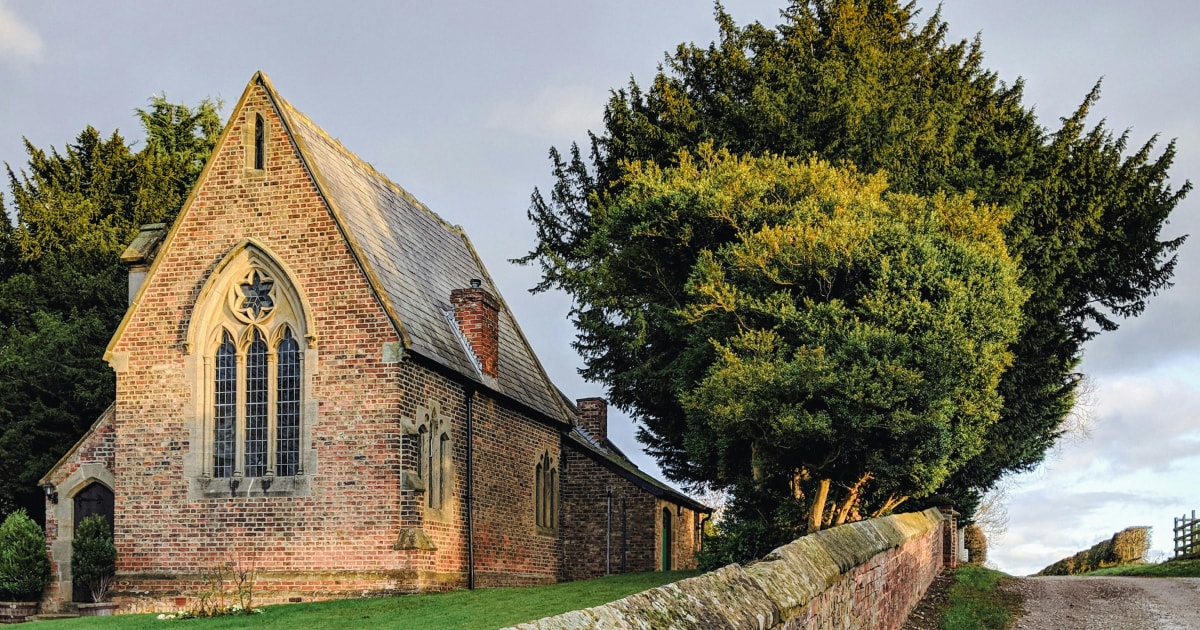
True, the liturgy has moved on since Vatican II, and not always to the liking of all Catholics today. Indeed, as we sat in our pews in St Elizabeth’s parish church – a Victorian church connected to the house – on Passion Sunday, the congregation (locals as well as retreatants) were asked to fill in a questionnaire for parish feedback and a diocesan review. I noticed that a knight next to me wrote: ‘Thank you for a most enjoyable retreat and your kind hospitality. My only suggestion is to consider celebrating Sunday Mass in Latin.’ Who knows whether this prayer may be answered at our return in 2028.