
SAINT OF THE WEEK: 5 June - Saint Boniface
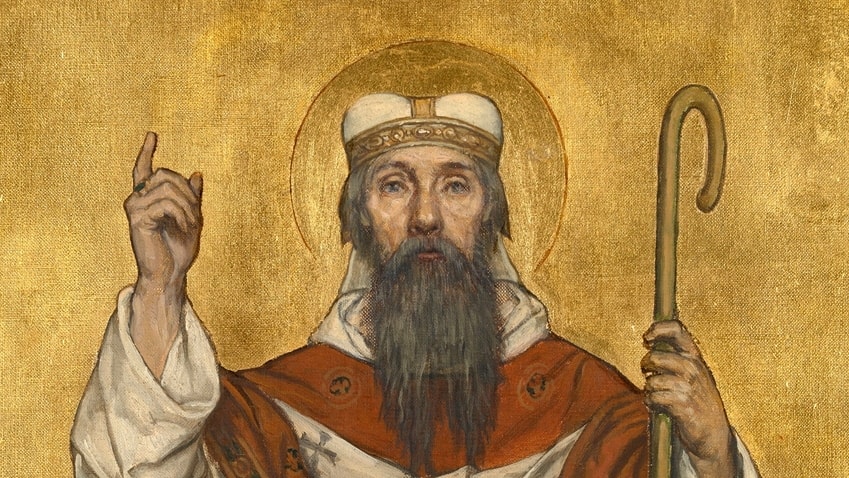
Many saints are widely associated with the place of their birth – St Boniface, on the other hand, is best known for his work transforming lands far from his native home. Born in Anglo-Saxon England, his legacy is most visible across the North Sea in Germany and the Low Countries, where he and other saints helped to establish Christianity and strengthen the structures of the Church during the eighth century.
Boniface was born Wynfrith, or Winfrid, around 675. While the people of Crediton in Devon have long claimed him as their own, the evidence is scant and his birthplace cannot be spoken of with any certainty. He was educated in a monastery – probably at Exeter – from an early age and was drawn to the life and calling of the monks. Winfrid’s prosperous family hoped he would pursue a different path, but he pursued his monastic calling regardless.
In the religious life, Winfrid’s talents quickly became apparent, and he developed a reputation as a scholar, teacher and administrator. When the abbot of Nursling died, he was invited to succeed him – an honour many monks would have envied. Instead, Winfrid declined the office to pursue other plans. In 716 he set out for Frisia (mostly in what is now the Netherlands), hoping to evangelise the local population. He first travelled to Utrecht, where he spent much time with St Willibrord, the great missionary who had laboured among the Frisians since the 690s. Politics, alas, intervened in the shape of an ongoing war between the Frisians and Charles Martel. Dismayed, Winfrid returned to the peace of Nursling.
This setback did not diminish his sense of vocation. Within a year he was on the move again, travelling to Rome where he met Pope Gregory II. Recognising both his ability and his determination, the Pope gave him a new name – Boniface – and commissioned him to undertake missionary work among the peoples of Germania.
The most famous episode of Boniface’s life took place near Geismar. Local pagans venerated a great oak tree dedicated to Donar, or Thor, the Germanic god of thunder. Boniface resolved to challenge the cult publicly and assert the primacy of the true God. He marched up to the sacred tree and took an axe to it, cutting it down before a crowd that expected divine vengeance to be exacted at any moment. When the mighty oak fell and no punishment followed, many witnesses concluded that the old gods were powerless and embraced the Christian faith. Wood from the oak was subsequently used in the building of a church.
The years that followed were remarkably fruitful. Boniface founded monasteries, organised dioceses, consecrated bishops and strengthened links between the churches of the German lands and Rome. Among the institutions associated with him, the monastery of Fulda became one of the most important centres of Christian learning in medieval Europe.
Boniface never abandoned his desire to evangelise the Frisians. In the early 750s, despite advancing age and decades of labour, he returned once more to the region where his first missionary efforts had failed. It was there that his life came to an end. In 754, while preparing to administer Confirmation to new converts near Dokkum, he and his companions were attacked and killed by a band of brigands.
After his death, Boniface’s body was carried first to Utrecht and then to Mainz before finally being taken to Fulda. There his relics remain today, and his tomb continues to attract pilgrims more than 12 centuries after his martyrdom.
St Boniface is remembered as the Apostle of Germany, but his significance extends beyond a single nation. An English monk commissioned by a Roman Pope, labouring among the peoples of northern Europe, St Boniface helped shape the Christian identity of an entire region. Few missionaries have left such an enduring mark on the history of the Church in Europe.