

This week we celebrate the feasts of several martyrs, beginning with St Justin Martyr on June 1, Ss Marcellinus and Peter on June 2, then the 19th-century martyrs St Charles Lwanga and his companions on June 3. Finally we have, on June 5, St Boniface, an 8th-century martyr who played a major role in the establishment of monastic life across Europe. We also begin this month’s series on saints who studied law, which also includes martyrs such as St Catherine of Alexandria and St Thomas Becket.
The readings at Mass provide us with the Letters of Saint Paul to Timothy, which address the challenges that will inevitably attend the Christian life. “Indeed, all who desire to live a godly life in Christ Jesus will be persecuted, while evil people and impostors will go on from bad to worse, deceiving and being deceived. But as for you, continue in what you have learned and have firmly believed, knowing from whom you learned it and how from childhood you have been acquainted with the sacred writings, which are able to make you wise for salvation through faith in Christ Jesus. All Scripture is breathed out by God and profitable for teaching, for reproof, for correction, and for training in righteousness, that the man of God may be complete, equipped for every good work.”

On this theme, on page 39 of Magnificat, we have a beautiful meditation by the 20th century Jesuit Fr John Lenz, who was interned during the second world war, outlining how suffering can benefit us in our development as Christians. “Only in the school of the greatest suffering can we really experience what we have only learned in theory before. By this I mean the sort of prayer which pierces the soul like a sword, the sort of faith in God which forges the soul on God’s own hand, the final giving of one’s whole being to God, an unconditional surrender, a blind submission to the Divine Will.”
As we move towards the end of the week, we pass through the feast of St Norbert on the 6th June, accompanied by a meditation by Fr Joseph Rives, a 17th century Norbertine, who gives us a warning: "You cannot serve both God and mammon. In other words, you cannot serve both the God of Light and the Lord of Darkness; you cannot serve the clear-seeing God and the Blind One; you cannot serve the true God and a devil who wants to be worshipped like God and then rule over you.”
How we act towards others will reveal whether we belong to God, as Saint Teresa of Calcutta, reminds us on page 61. “Jesus said again and again, If you give a glass of water in my name, you give it to me. If you receive a little child in my name, you receive me…. One day I picked up a small child six years old in the street. And I could see from the face that that child was very, very hungry. So I gave her a piece of bread and the little one took the bread and started eating it crumb by crumb. So I said to the child, Eat the bread, you are hungry, eat the bread. And she looked at me and said, I am afraid when the bread will be finished, I will be hungry again. So she thought by eating it slowly, slowly, she will feel less hungry. The pain of hunger is terrible and that is where you and I must come and give until it hurts….And this giving is love of God in action.”
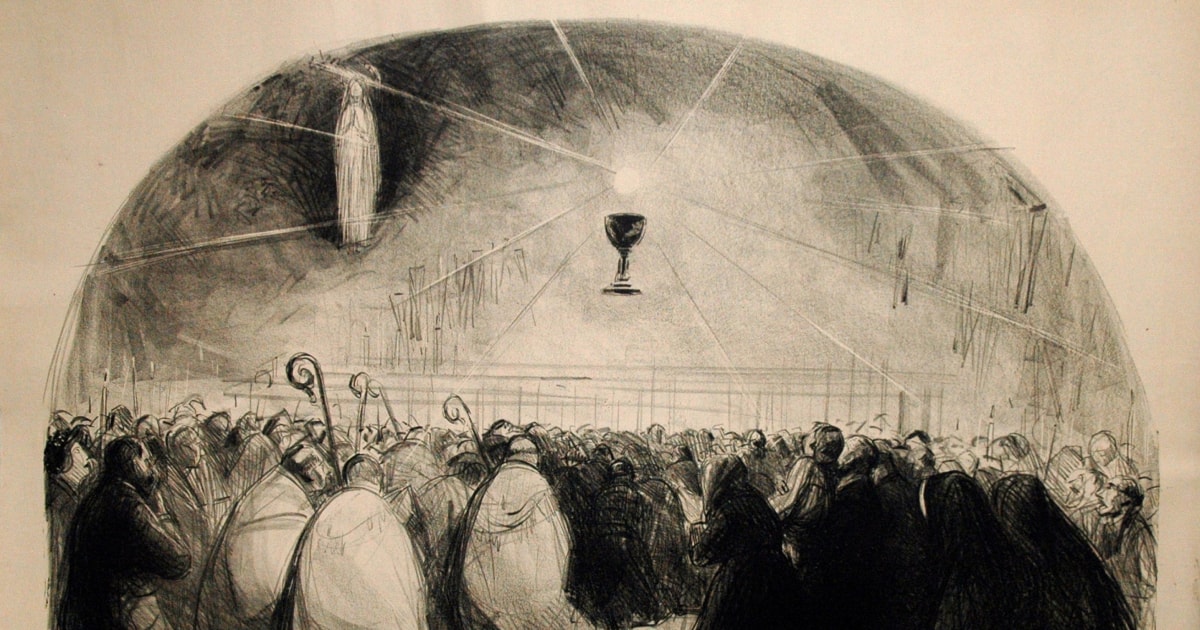
The never-depleted, living bread of the Eucharist is of course the food which satisfies our most fundamental hunger: the hunger for Love Incarnate. As we prepare for the processions which mark the feast of Corpus Christi, we can dive deeper into the Gospel of this Sunday with the help of our Lectio Divina on page 90, which draws attention to the memorable phrase of Saint Ignatius of Antioch about the Eucharist being “the medicine of immortality”. The heart of this great feast is conveyed in the words of Saint John Chrysostom. “In order that we may become Christ’s Body, not in desire only, but also in very fact, let us become commingled with that Body. This, in truth, takes place by means of the food which he has given us as a gift, because he desired to prove the love which he has for us. It is for this reason that he has shared himself with us and has brought his Body down to our level.”
Angels’ bread made pilgrims’ feeding
truly bread for children’s eating,
to dogs not to be offered.
Signed by Isaac on the altar,
by the lamb and paschal supper,
and in the manna figured.
Jesu, food and feeder of us,
here with mercy feed and friend us,
then grant in heaven felicity!
Lord of all, who here do feed us,
heav’nly guests, heirs, fellows make us,
in eternal company.