.png)


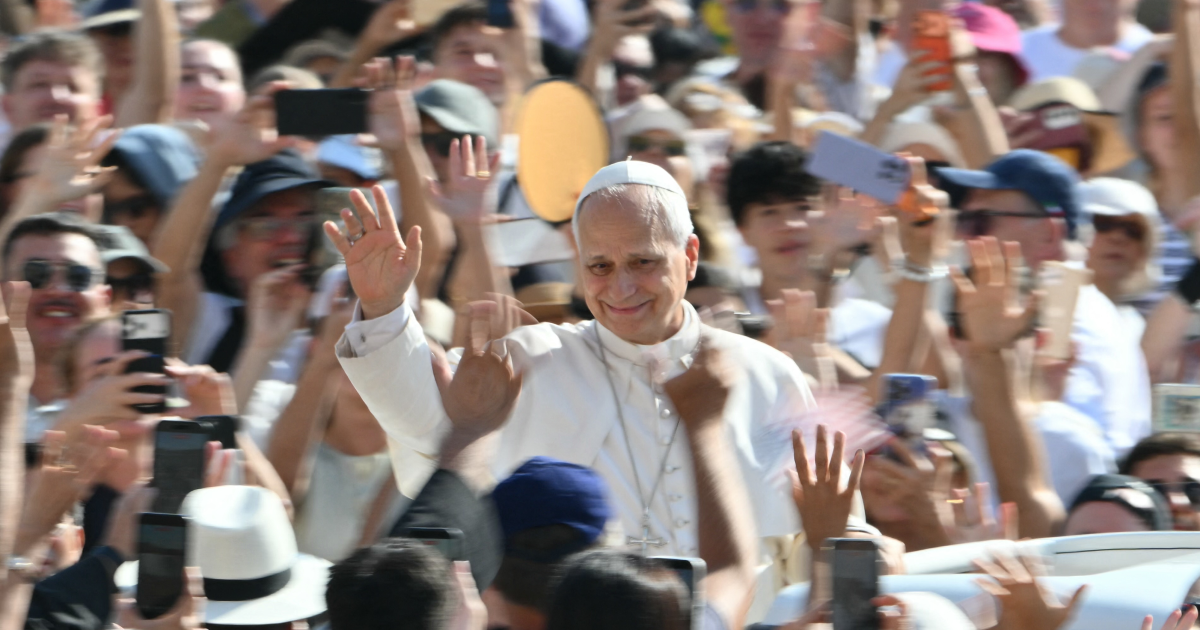
The Pope has finally broken his personal silence on the issue of the Society of St Pius X, telling journalists on Tuesday that the Society’s refusal of “several points of the Second Vatican Council” is the Vatican’s breaking point.
Since the SSPX announced the 1 July episcopal consecrations back in February, Pope Leo XIV has kept a notable and in many ways peculiar personal silence on the issue. Negotiations between the Society and the Holy See have been handled by Cardinal Victor Manuel Fernández – a noteworthy choice by Leo given that Fernández is behind many of the doctrinal concerns the Society raises.
But exiting Castel Gandolfo on Tuesday, Leo finally fielded a question on the topic, as journalists were eager to make up for the in-flight press conference they were denied on the return flight from Spain.
“I am considering making another appeal and saying ‘don’t do this, let’s try to live the communion of the Church.’ But it is their choice,” he commented.
“We must,” he continued, “realise what it means for them and for the Church. Certainly, the division among Christians is a painful point.”
In closing, Leo pointed to the aspect which has emerged as the chief point of contention, namely Vatican II:
“However, they refuse to accept some fundamental elements of the Church, starting with several points of the Second Vatican Council. If they make that choice, I am sorry. But we must move forward.”
After the Society’s announcement that it would consecrate new bishops on 1 July, the Vatican hastily began talks which had hitherto stalled due to the Vatican’s apparent reluctance to engage.
The breakdown in such talks was swift, and writing in February, SSPX Superior General Fr Davide Pagliarani explained the reason behind this. “We both know in advance that we cannot agree doctrinally, particularly regarding the fundamental orientations adopted since the Second Vatican Council,” Pagliarani wrote. “This disagreement, for the Society’s part, does not stem from a mere difference of opinion, but from a genuine case of conscience, arising from what has proven to be a rupture with the Tradition of the Church.”
Cardinal Fernández warned on May 13 that the act of consecrating new bishops without the papal mandate would entail a “schismatic act” and thus incur the penalty of excommunication. Whether the Vatican follows through with this threat and makes a public declaration of excommunication remains to be seen, but if the Holy See does so then it would be a rare instance in recent years of such a pronouncement.
The SSPX has remained firm in its intention to proceed with the consecrations, noting that “regrettably all the discussions entered into have remained without result, and none of the concerns expressed have received any truly satisfactory response”. Come 1 July, four new bishops will thus be consecrated at Ecône, likely incurring the Holy See’s censure along with the two consecrating bishops.
Leo’s comments on Tuesday, however, have for many highlighted the issues about Vatican II raised by the Society.
Penning a public appeal to the Church, the Holy See’s former visitor to the SSPX – Bishop Athanasius Schneider of the Archdiocese of Astana – questioned why there is such a heavy emphasis on the ecumenical, pastoral council that is Vatican II. Schneider wrote:
“Why is the unconditional acceptance of the texts of Vatican II presented as a conditio sine qua non for full communion with the Holy See, while no comparable requirement exists with respect to the pastoral, disciplinary, or non-definitive teachings of the preceding twenty Ecumenical Councils?”
He further noted how among the Vatican II texts there “are several… whose formulations are ambiguous and difficult to reconcile with doctrines taught consistently by the Magisterium from the era of the Church Fathers through the period immediately preceding the Council”.
Schneider has gone so far as to say that the SSPX’s citing of an act of conscience is important, and that “if they do not carry out the consecrations, their work will come to an end, and this would be a damage to the entire Church”.
The prelate has previously attested that certain figures in Rome have been actively working to ensure that dialogue with the SSPX was fruitless, while also opining that excommunication would be “unjust” and “not valid”.
Certainly, Leo’s focus on the Second Vatican Council as a key reason for the chasm between Rome and the Society has not been received well by many Catholics who have – in the spirit of fidelity to the Holy See – sought to raise questions and concerns about the Council’s texts and effects.
At the start and close of the Council, both Popes John XXIII and Paul VI respectively also affirmed the “pastoral” nature of the affair – an element which has lent further weight to critics like the SSPX questioning why the Council is being used as a litmus test of “full communion”.
The Society’s “uncompromising clarity in doctrine, liturgy, and priestly formation” has thus been contrasted with the “demand to accept Vatican II and the current path of the Church since the Second Vatican Council”.
In Bishop Schneider’s assessment, the entire debate can be summarised by the Vatican’s demand that the Society accept “without substantial objection, certain objectively ambiguous and non-definite teachings of the Second Vatican Council, ambiguous statements of the post-conciliar papal magisterium, and objective doctrinal and ritual flaws in the Novus Ordo”. This, he warns, is unprecedented in Church history.
It now remains to be seen what final appeal Leo will make towards the Society and whether it will be enough to reopen dialogue.
Michael Haynes is an English journalist in the Holy See Press Corps. He serves as Vatican Correspondent and Analyst for Pelican+ and the Catholic Herald, while readers can follow him at Per Mariam and on X/Twitter @MLJHaynes.