

The Pope has approved yet another bishop for a Chinese diocese under the terms of the secretive Sino-Vatican deal, but in doing so has ceded authority to Beijing over the territory of the diocese.
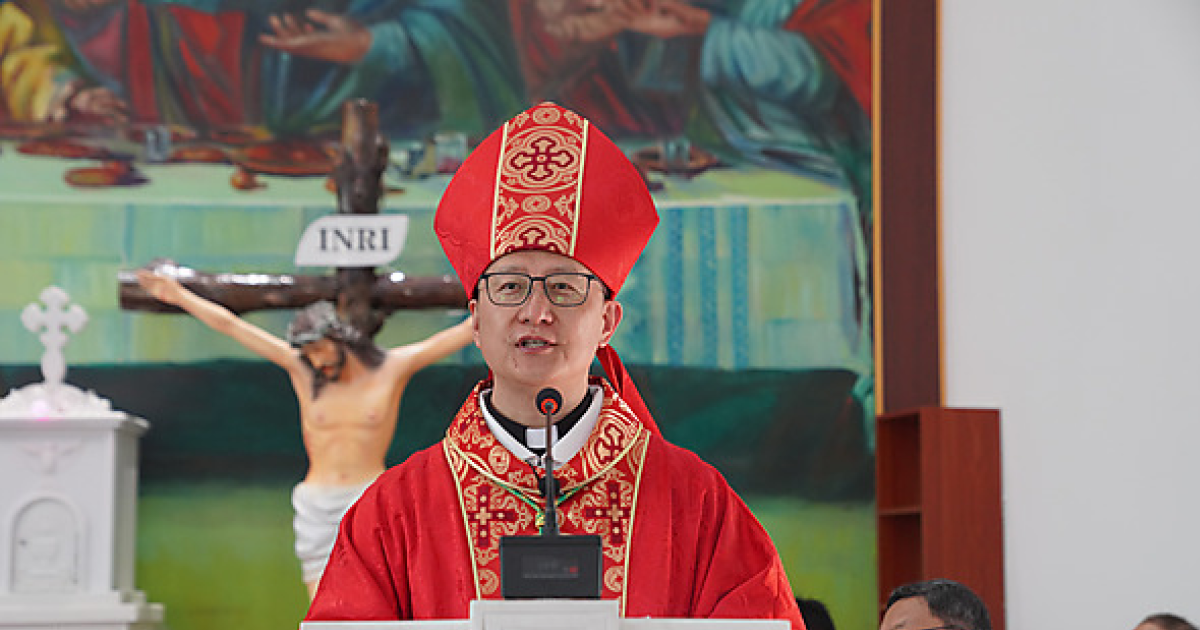
Nestled in the Holy See press bulletin on 30th July was an announcement about the consecration of Father Francis Xavier Duan Yongkun as coadjutor of the Diocese of Bameng, located in the Inner Mongolia Autonomous Region.
As with last week’s consecration of a Chinese bishop, Pope Leo reportedly approved the move on 15th June, but it was only publicised on the day of his consecration in China.
Once again, as is customary with all such appointments, the state-approved church known as the Chinese Catholic Patriotic Association (CCPA) made no mention of the role of the Vatican in the move. Instead, it noted that Youngkun was elected by the state-church body on 18th March this year.
The bishop was ordained as a priest in 2011 and is currently just 45, making him one of the youngest prelates in the world and thus similar in age to Bishop Chang Yanfeng, who was consecrated last week to lead the nearby Diocese of Chifeng.
Youngkun’s consecration ceremony was conducted by officials from the state-approved ecclesial bodies, none of which are recognised by the Holy See, nor do they recognise the Holy See either.
The new bishop will now serve as coadjutor with right of succession to Bishop Matthias Du Jiang, who is only in his 60’s but reportedly suffering from ill health. No mention was made of him by the Holy See or Beijing as the current ordinary, though the CCPA noted him among the co-consecrators.
What both the Vatican and the CCPA also left out of their announcements was the historical context which makes the consecration of Youngkun so notable.
Bishop Du Jiang was consecrated in secret for the Underground Church in 2004, and had to conceal his identity as a bishop from the Chinese authorities.
In 2010 the authorities eventually and grudgingly decided to acknowledge him as a bishop, but kept him under house arrest prior to the official installation ceremony since he refused to concelebrate Mass with Bishop Joseph Ma Yinglin. Bp. Yinglin was a member of the CCPA and was consecrated bishop without papal approval in 2006.
The ceremony went ahead after much resistance, and led to great concern amongst the Underground community over dangerous rapprochement with the schismatic Chinese church.
When Du Jiang was secretly consecrated in 2004 as a bishop loyal to the Holy See it was, oddly enough, for the territory of the Diocese of Bameng – a district created by the Chinese government in the 1980’s and not recognised by the Holy See. The CCPA carved up part of the Holy See recognised territory of the Diocese of Ningxia and the Apostolic Prefecture of Lindong in order to form the new diocese of Bameng.
At the time of Du Jiang’s official recognition in 2010, the Holy See was faced with a choice of whether or not to acknowledge the diocese made by China. Tacitly, it seems, the Vatican rolled with not putting up a fuss – and thus Du Jiang went to work in the area of that diocese.
However, prior to this week Bameng did not appear in the Holy See’s official documentation. It was not recognised in the pontifical yearbook which records all the names and statistical data of the Church and no record of the announcement is found in the Holy See press office statements archived from the year 2010.
All that changed this week, when the Vatican issued its announcement of Youngkun’s consecration. With this consecration it seems that once again China has gained the upper hand in the tense relationship with the Holy See.
There is recent precedent for such a territorial surrender by the Vatican. In September the Vatican announced that Leo had decided to suppress the two dioceses of Xuanhua and Xiwanzi, and instead to erect the new diocese of Zhangjiakou.
It was an externally benign move, but one which was in fact a surrender to China on the same issue. The two suppressed dioceses were erected by Pope Pius XII and were part of the Underground Church – never being officially recognised by the Chinese authorities. The Chinese instead established the Diocese of Zhangjiakou in 1980 as a means to envelop the two Underground Church dioceses and draw people into the state-approved church which has loyalty to Communism and China at its heart. Zhangjiakou remained unapproved and unrecognised by the Holy See until 2025.
As in September, the Holy See posited Youngkun’s consecration as within the framework of the Sino-Vatican deal. Leo XIV appears to be as enthusiastic in utilising the deal as Pope Francis was in promulgating and defending it, but the problem is that such support vanishes outside the pope’s office. Diplomats, politicians, China experts and local Catholic all oppose the deal.
In practice, the secretive deal works in China’s favour, and though the Pope apparently maintains a veto power over the choice of bishops, Beijing consistently appears in charge.
The ink had barely dried on the deal before AsiaNews – a site that regularly documents the abductions and torturing of underground Catholics – reported that “[u]nderground Catholics bitterly suspect that the Vatican has abandoned them.” That sentiment remains among faithful Catholics.
China-expert Gordon Chang stated this week that the deal has been “used by the Communist Party to decimate Catholicism in China.”
“The Communist Party has always attacked religion, but now they have the Vatican as an ally,” he opined.
The Vatican has certainly forced itself into a contradictory position in signing the deal. Although it still recognises the Underground Church, the Holy See has not appointed bishops to it, and is therefore not sustaining it. Beijing has used the China deal to argue that the Underground Church is “illegal”, and so, said Chang, “the real Catholic church in China is withering” as the Vatican essentially allows the Underground Church to die out.
Questioned on his China policy last summer, Leo replied that “in the short term, I will continue the policy that the Holy See has followed for some years now. I in no way pretend to be wiser or more experienced than all those who have come before me.”
With the China deal’s author, Cardinal Pietro Parolin, still at the helm as Secretary of State, it appears that Leo’s China policy is currently much the same as his predecessor’s.
Michael Haynes is an English journalist in the Holy See Press Corps. He serves as Vatican Correspondent for the Catholic Herald, while readers can follow him at Per Mariam and on X @MLJHaynes.